Recently, I launched from Blackpoint marina on Biscayne Bay. Normally, this location is not my first choice because it does not provide as many opportunities for wading bird photographs as other places on the bay. But, this area has the most beautiful shoreline and creeks to wander in. It was at Blackpoint where I was first introduced to Biscayne Bay, so it is a special place, if for only that reason.
It is also where I have done some experimenting with mangrove photos. About 1/2 mile north of Blackpoint is a small lake that is somewhat hidden behind a couple small mangrove islands that separate it from the bay. In the morning, this is an exceptionally beautiful and quiet place where I don't mind floating around gazing at the trees and water. On this particular morning I was floating around some mangroves that were full of large propagules. They happened to be in good light as well. Propagules are the seedlings that hang like cigars from the branches and occurs primarily during summer. It was relatively calm and protected where I was so the water was uninterrupted. The clear reflections of the thick mangroves were so real looking. I began to play around with photographing those reflections by causing small ripples in the water with my paddle blade. Here are a couple of shots. To someone that is unfamiliar with mangrove trees, it might seem a bit scary if this is what they saw in the water.
Attempting these reflection shots inspired me to try something
different. Awhile back, I had fun using a blur technique when visiting
Fairchild Tropical Gardens one time. I was pleased with the effects and
thought it might be interesting to try it with the mangroves. Lots of
trial and error in getting the right exposure and blur, I worked between
shutter speeds of 1/6 to 1/13 and apertures no larger than f16,
staying mostly within f22-29. ISO was set to its lowest level. The sky was nicely clouded over, which made it easier to expose. I was
quite happy with the outcome. One of the photos is at the top and here
are a few more. The last photo was shot on another day and with that, I
attempted to include the propagule reflection in the water. The bonus was the smoky
like appearance of the water caused by the camera movement. For all these shots, I used a vertical motion with the camera.
Photographing the natural areas of south Florida including Everglades, Big Cypress and Biscayne Bay
Monday, July 23, 2012
Wednesday, July 18, 2012
Bon Appetit
During my many visits to the Biscayne Bay or Chokoloskee Bay bird rookery over the years, I have watched and photographed nestlings fed by a parent. This is never an easy scene to capture. It happens quickly with lots of commotion and often times hidden behind branches and leaves, and fluttering wings. Every once in awhile, I can capture the moment with some success. Here are some photos, recent and past. Birds represented here are cattle egret, great white egret, snowy egret, cormorant and brown pelican. To your health little birds!
Sunday, July 1, 2012
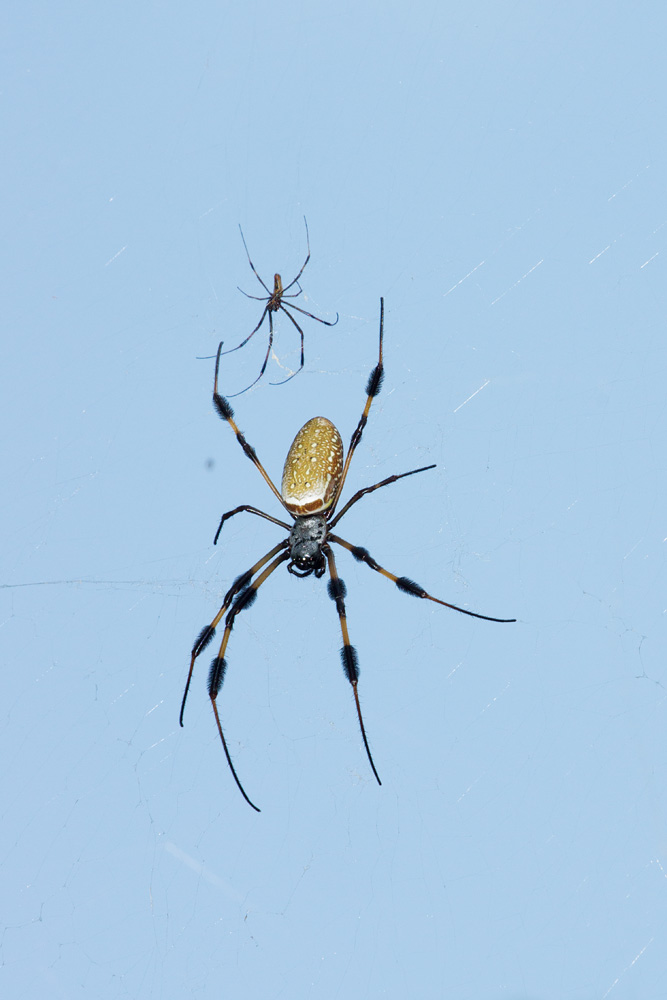
The spider has a mate
Not one to pass up an opportunity, I went back out to Biscayne Bay on a second day with perfect conditions. Between rain and winds, opportunities like this don't come often during these strange summer months. I had success on Friday, so I thought I would repeat and head to the bird rookery and after that, check out my moth-eating golden silk spider in the creek.
I haven't had a moment to check out my rookery photos, so for now, the topic continues to be the golden silk spider. I found the same spider that I photographed while she ate a moth yesterday, but today there was no remains of the moth in the web. Instead, the spider had a mate.
Spent some time photographing a couple more spiders; one in particular was closer and considerably larger than the first one. I decided to toss a small mangrove leaf toward the web. It instantly got caught in the web and in a split second, the large golden silk was on it. The spider's legs and antennae were all over the leaf, looking for animal protein to consume. After a few minutes, the leaf fell out of the web. I repeated this three times and attempted some photographs. On the fourth try, the spider did not budge after having been fooled.
All photos shown here were shot with sky as background, same with the previous blog's photos. Flash was used on all photos.
Friday, June 29, 2012
Moth for lunch
As soon as the rain cleared out, the winds calmed down. Perfect conditions for Biscayne Bay. The sky was clear all morning, with the exception of the low thermal clouds on the horizon during sunrise. Once the sun cleared them, it was blue skies the remainder of the morning. Today, I would take full advantage of the calm conditions and stayed on the water 5 hours. Most of that time was spent at the rookery and there are photos from that visit. I headed back to the launch site and on the way, detoured into one of the many creeks along the western shoreline of Biscayne Bay. In the canopied creeks, I can find my favorite 8-legged subject, the golden silk spider.
There were several spiders not far from the entrance of the creek. When attempting to photograph them, the trick is to find one that is in full view and good lighting. I always use my flash when photographing the spiders because most of the time they are backlit or shadowed by the canopy. As I paddled, I searched above and within second, found my subject for the remainder of the day. The spider had a large object in her web; soon it became apparent it was a butterfly or moth.
This spider was very difficult to find a good angle and light on it. I wanted to see the spider in full and struggled to get into the best position to do that. Overall, I was able to shoot the spider as it ate its meal from two very good perspectives. The flash did the trick and made it possible for me to shoot at a low shutter speed (1/250) and high aperture (f14). the higher aperture was necessary to get the depth on the spider and the moth.
Always looking for a new or unique composition with the golden silk spider, I was lucky to have come upon this one today.
Sunday, June 10, 2012
A second visit with the albino yellowcrown nightheron
Since discovering this odd bird, I wondered if I would see it again. Wondering is over; I came back to the same area and it was feeding in the grasses. This morning, the outgoing tide competed with the 10 knot easterly winds. Despite being on the water 4 hours before low tide, there was plenty of grasses revealed for the wading birds. This is not always the case with water levels greater than a foot or so. But it appears the prevailing easterly winds have swept the grasses up into the shallows, creating clumpy grass islands everywhere. This is an interesting way to find wading birds as the water levels are relatively high right up to the edge of a grass island. This makes approaching a wading bird very tricky when there is wind.
The east wind was assertive and my boat was easily blown toward the grassy areas. The waves caused the boat to rock, making photography impossible. My only chance of capturing the birds was to get close enough so that I could anchor the boat with my feet. Several yellowcrown nightherons (adults and juvys) and a few other wading bird species speckled the grassy area. It didn't take hard looking to find the albino yellowcrown, it was alone on one of the islands, furthest from the shoreline. Excellent! I might possibly be able to approach the bird. Soon, I was foot-anchored and attempting to photograph the albino bird within about 40-50 ft. Clouds were passing over the sun on occasion, but otherwise, lighting was excellent. Over time, the winds settled down and the water receded enough that I could easily ground the boat and keep it stable.
Lots of other activity was happening near by. Normally, I would go after the dancing tricolor heron that was busy catching food; but today, I wanted to stay with the white yellowcrown nightheron as long as possible. Later, I came up on a normal colored yellowcrown nightheron and to contrast it with the albino, included a few photos of it here. In addition to its white feathers, notice the albino bird does not have the white breeding plumes on its head, and it has a yellow beak rather than a black one.
Tuesday, May 29, 2012
Life in the grasses
When easterly winds prevail, the grass debris is pushed up against the shoreline of Biscayne Bay. The grasses have accumulated so much that at Matheson Hammock launch site, you have to carry the boat through knee-deep grasses before you reach the water. Near low tide, there is about 25 ft of grasses between land and water, making the launch difficult especially when you have three or more loads to carry through the thick grasses. At any rate, these grasses become the feeding grounds for the wading birds (please note, the "great egret" shown above is a white morph great blue heron).
The shallow waters along the shoreline of the bay also make it precarious for large boats that meander into the area. Case in point, the sailboat "Second Wind" somehow became grounded in these shallow waters several weeks ago. From the last time I saw it, it had been pushed further into the shallows, and now sits right up against the shoreline where it will remain indefinitely.
In the meantime, the birds foraged in the grasses while I hung out with them for a few hours. Got on to a couple of snowy egrets; one appears to be in breeding plumage. Some of the white ibises also appear to be in breeding colors, as their beaks and legs become a deep red as opposed the orange non-breeding color.
Normally, I stay in my boat and get as low as possible when photographing wading birds. However, today the birds were foraging among mounds of grasses, some sticking out of the water 10 in or more. Pools of water formed between these mounds and that is where the birds foraged. Consequently, grass became the foreground and the background of the photos. As I attempted to capture photos of the yellow-foot snowy egret, I noticed that the foreground grasses were not allowing the yellow feet to show. I got out of the boat and stood up. Usually, this is enough to alarm the birds, but today, they stayed. From a higher vantage point, I could see the yellow feet and reflections in the water. These are some of the photos taken during the early morning hours of a beautiful morning.
The shallow waters along the shoreline of the bay also make it precarious for large boats that meander into the area. Case in point, the sailboat "Second Wind" somehow became grounded in these shallow waters several weeks ago. From the last time I saw it, it had been pushed further into the shallows, and now sits right up against the shoreline where it will remain indefinitely.
In the meantime, the birds foraged in the grasses while I hung out with them for a few hours. Got on to a couple of snowy egrets; one appears to be in breeding plumage. Some of the white ibises also appear to be in breeding colors, as their beaks and legs become a deep red as opposed the orange non-breeding color.
Normally, I stay in my boat and get as low as possible when photographing wading birds. However, today the birds were foraging among mounds of grasses, some sticking out of the water 10 in or more. Pools of water formed between these mounds and that is where the birds foraged. Consequently, grass became the foreground and the background of the photos. As I attempted to capture photos of the yellow-foot snowy egret, I noticed that the foreground grasses were not allowing the yellow feet to show. I got out of the boat and stood up. Usually, this is enough to alarm the birds, but today, they stayed. From a higher vantage point, I could see the yellow feet and reflections in the water. These are some of the photos taken during the early morning hours of a beautiful morning.
Sunday, May 27, 2012
Albino Yellowcrown Nightheron
What are the chances of sighting an albino bird in the wild? Wikifacts says the probability is 1 in 17,000 in humans if that is a clue. Whatever the probability is, I found one on Biscayne Bay. It was alone (while other groups of birds had been photographed within a mile range of the shoreline), busily foraging for crabs. After spending a few hours photographing various birds including the yellowcrown nightheron, little blue heron, snowy egret, tricolor heron, white ibis and great white egret, I had put away the camera and started paddling for the sake of paddling. Not having quite gotten the photo bug out of my system, I spotted a white bird amongst some small mangroves in the water and thought I might have a chance at photographing the scene.
I paddled closer and headed toward a good light as the bird seemed content to stay in a small area between two mangroves. I approached within 100 ft in the shallow water and waited for a nice pose. Snap, snap, a couple shots were taken. At first, I thought it was a juvenile little blue heron or maybe a snowy egret. But the bird appeared odd, not quite having the body shape or the slender beak of a little blue or snowy. No, something was quite different about this bird. After the initial shot, I examined the photo in zoom on the LCD and lo and behold, the white feathered bird had flaming red eyes.
Wow! I had never heard of a white morph version of the nightheron but after a bit of research and soliciting an expert opinion of an ornithologist, it is concluded that this bird is an albino. The bird allowed me to get very close and I spent a solid 45 minutes with it until the water levels rose enough to cause the bird to perch in the mangroves. A once-in-a-lifetime chance, this was a special encounter.
I paddled closer and headed toward a good light as the bird seemed content to stay in a small area between two mangroves. I approached within 100 ft in the shallow water and waited for a nice pose. Snap, snap, a couple shots were taken. At first, I thought it was a juvenile little blue heron or maybe a snowy egret. But the bird appeared odd, not quite having the body shape or the slender beak of a little blue or snowy. No, something was quite different about this bird. After the initial shot, I examined the photo in zoom on the LCD and lo and behold, the white feathered bird had flaming red eyes.
Wow! I had never heard of a white morph version of the nightheron but after a bit of research and soliciting an expert opinion of an ornithologist, it is concluded that this bird is an albino. The bird allowed me to get very close and I spent a solid 45 minutes with it until the water levels rose enough to cause the bird to perch in the mangroves. A once-in-a-lifetime chance, this was a special encounter.
Subscribe to:
Posts (Atom)