Friday, July 22, 2011

Great day on the bay part 2: variety of waders

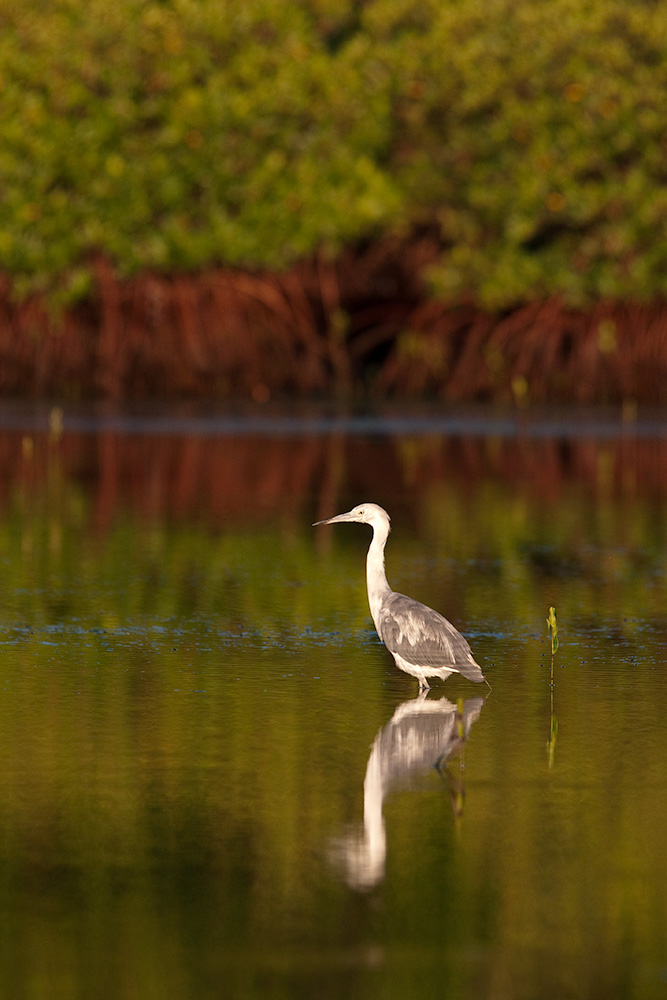
I focused attention on the juvenile tricolored heron in my last blog, today I turn to the variety of other waders that were present on the bay two mornings ago. As soon as the sun was cleared of the clouds, the shoreline became illuminated from its rays. That's when I look for those photo opportunities of birds foraging in the shallow waters reflecting the mangroves. Today was ideal with calm waters. There were a couple of things I attempted today. First, I wanted to maintain as low an ISO as possible to minimize noise. I typically do not go above 800 and prefer to not use 640 or higher. But early mornings in a boat make that difficult without using a less than optimal shutter speed. The glow of the sun allowed me to begin shooting semi-white birds (tricolor heron, juvenile little blue heron) at an ISO of 640 and a shutter speed of 400. Not bad for when the bird is not moving much but as soon as it strikes the water, 1/400 will result in blurriness. I had started with a juvenile little blue heron and over a course of about 20 minutes, I was down a full stop using an ISO of 320. It shifted the histogram to the left, but I was happy with the results regardless. I was content with the shutter speed for this bird that never seemed to find a fish to strike. Here are a couple images with the classic mangrove reflections complimenting the bright bird.


The other thing that I attempted was to compose a shot of a bird with mangrove roots in the upper portion of the frame believing that this would add some depth and balance to the photo. Even more to the point, I love the look of the mangrove roots and their reflections in the water. I also like to capture a bird (preferably a white one) close to the roots so that they fill the frame. Whenever I look at such a photo, the roots always appear so much larger. Today, I had lots of options with many birds foraging in and around the smallish mangrove trees that form a barrier between the ocean and the shoreline. Here are a few shots that include the mangrove roots.


I spent the first couple hours following the tricolor herons, a green heron, some white ibises and little blue herons. The sun was high in the sky and the tide was rolling in. I expected to put the camera away and paddle back to the launch site. On my way, I noticed a great white egret looking for food. While the smaller waders pretty much disappear into the trees as the water levels rise, the larger egrets are frequently still out there searching. I paddled closer and figured if it lets me hang out close enough, maybe I'd attempt to capture some images. Sure enough, this bird was too intent on feeding that it barely paid attention to me. So I hung out with the lone white bird. Here are a few results of that encounter. The challenge was to stay between the bird and the sun and it was heading in a direction that made it more difficult to capture it with a good head angle toward the camera. The other challenge is that the sun and shoreline are not perpendicular to each other, so consequently I almost always have to do some kind of rotation to the image in post processing. When the shoreline is in the frame, it often is not running parallel to the ripples in the water created by the bird. But, that's a relatively minor issue when it is all said and done.


It was such a productive day that I barely noticed the intense heat during the 4 hours I was on the water. The great white egret was a perfect ending to it all. Almost always alone in its pursuits, here is another image of this glorious bird.

Thursday, July 21, 2011

Great day on the bay part 1: a tribute to the tricolor heron

Here's a quote I ran across: "Knowing trees, I understand the meaning of patience. Knowing grass, I can appreciate persistence." I'm inclined to change that to "Knowing nature, I understand the meaning of patience. Knowing birds, I can appreciate persistence." I think most bird photographers have two qualities in common with their subjects; patience and persistence. A bird requires them for survival, a bird photographer requires them for successful capture of a bird.

Without getting too contemplative, I simply want to convey what a fantastic day it was on the water. I arrived at the bay at 6 am, before sunrise. The water was dead calm and the eastern sky was congested with cumulus clouds (they are actually called cumulus congestus), as is the case every summer morning here in south Florida. During the initial minutes of sunrise, the sun is covered by these clouds but eventually they burn off with increasing temperatures. Here is how the day started:


The clouds burned off quickly and soon I was shooting with clear skies. Low tide was scheduled at 8:40 am, perfect for wading bird photography here on Biscayne Bay. I never know what I will find out here, but the bay never disappoints. Today was a bonanza of bird photo opportunities. It wasn't easy, I can't simply anchor my boat and stay in one spot. Rather, I have to follow the birds, sometimes hundreds of feet away. And at low tide, that often means pushing my boat with some effort through very shallow waters. The grasses provide an easier surface to glide across, but it is not easy. The worse part is when I get into a good position with birds, they move and then I am stuck having to push myself out of the spot and work my way back into another one.

But all that effort pays off eventually and today, it paid off big. Let's see, I captured a few ibises, a green heron, a juvenile little blue heron, a great white egret and a juvenile tricolor heron; over the course of about 4 hours. Each of these birds were a hit, but the star of the day was the tricolor heron.

For this blog, I pay tribute to this patient and persistent bird as it allowed me to get very close to it while it pursued its prey. I love photographing this bird because it offers so many styles of foraging behavior. It's quite dynamic and is almost always moving. Enjoy these photos of the young tricolor heron.


Sunday, July 17, 2011

Calm, clouds and heat


The combination of the three makes Biscayne Bay an awesome place. I love summers in Miami, only because it is when I spend most of my time on Biscayne Bay. A precious jewel to our city, few know that it exists beyond the few beaches that people frequent.


Today, like yesterday, heated up quickly and the breeze was absent all morning. The water was glazed with sunlight but the clouds and the reflections were dynamic. Using the polarizer filter on the 18-70mm lens, I played with the side light. Today, there would be no photographs of birds (a few spiders, but no birds), and I simply paddled around and photographed the clouds. Having a boat in the waterscape composition adds depth, at least you can appreciate the vastness of the bay. So I took advantage of having Vivian near by as she fished and captured her beautiful Hemlock canoe in the water.

I can be a little more care free taking these photos. I let the sun and its intense light do what it does best and that is to offer severe contrast to the clouds and water reflections. With that I shoot in just about any direction where the sun is at my side or in front of me at an angle. Enjoy these dreamy photos of Biscayne and imagine feeling the sun and the heat.


Friday, July 15, 2011

High key on the water


Dang it was hot this morning. With no breeze to speak of, it felt like being in a sauna. But the magic of the bay called and I had an opportunity to get out there on a weekday. On the water by 7 am, distant clouds seemed to be dropping water but these never appeared threatening. Rather, the thin veil of clouds the covered the majority of the sky burned away and soon, the sky was clear with only the distant cumulus clouds laying over the horizon. The water was like glass and Chicken Key and the distant city scape of Miami looked gray against the whiteness of the sky and water. This would be a good day to visit the sponge farms for high key, backlit shots.


Cormorants live in great number near the sponge farms and consequently spend time resting on the various sticks in the water. I love the scene and have been attempting to capture it with various bird poses and interactions. It is about a 2-mile paddle to get there, so I enjoyed the time it took to get there. Lots of baby sharks were swimming in the water and at one point a couple of them swam under the boat in a curious kind of way. I thought maybe the boat provided shade that allowed them to see their prey. Cormorants were flying around, some were in the water. The peace was breathtaking, no other boats, no planes making noise; all this allowed me to ignore the heat.

I arrived at the sponge farm sticks to find several cormorants hanging out. I wanted to see what I could capture there and also try for some flight shots. The combination of sticks and uncooperative bird poses made it somewhat difficult today. But I stayed long enough to capture a few good shots. As I've always said, these are pretty much what comes out of the camera. I set the exposure at + 1 2/3 and increased the ISO so I could keep a relatively high shutter speed for flying birds. For the most part, the sun was off-centered to the left about 25 degrees as I pointed the camera toward the birds. You can judge from the reflections in the water that the sun was not overhead, but low enough to provide some long reflections.

Sitting in a boat on the water while facing toward the sun as the temperature approached 90 degrees and without the benefit of a breeze gets to you after awhile. I had to leave and face the other direction. I decided to head into the creek to hang with the spiders. Those photos will come later. For now, enjoy these high key silhouettes of the cormorant. Here are a couple more with a little post processing. I added a low density yellow filter to the first one and the next two photos are in grayscale.


Sunday, July 10, 2011

Dark birds, white birds


Went to the rookery on Biscayne this morning. It was busy with adult and juvenile birds and it was good to see so much activity. This particular rookery is primarily made up of the dark feathered double crested cormorant and the white feathered cattle egret. Consequently, I typically choose which of the two birds to concentrate on and set the exposure accordingly. There is about a 1 2/3 stop difference between the two (give or take a 1/3).


As the clouds dissipated and the morning sun burned through, I anchored and watched for activity. Soon, I was concentrating on several adult cattle egret and a juvenile little blue heron. Juvenile cattle egrets were hiding well today. Dark clouds covered a part of the sky offering a beautiful contrast to the white feathers. Shooting was very challenging this morning as my boat never seemed to want to stay in one place. Every few minutes or so I had to pick up the paddle and twist my boat around to get back into position. Meanwhile, a bird flies in, landing beautifully in the trees, while I am busy messing with the boat. That's how it goes.


The day was quite hot and humid and many cormorants were hanging out in the water to cool off. This became a nice photo opportunity. I changed my exposure to capture the dark birds in the glistening water. Having set the meter at about +1 stop, I had to increase the ISO to 800 in order to reach a reasonable shutter speed (1/800). The dark birds lend themselves to a high key effect on the water. I attempted to capture birds flying over water reflecting white clouds. The cormorant flies low enough to the water that you can also capture its dark reflection.


There was some activity as well. Occasionally, an adult and juvenile cormorant came into the water and the adult began feeding the baby. I captured this activity but from a great distance. Here's a shot of the adult attempting to get away from the relentless juvenile.


I also noticed some birds in the water going after branches. Here's another shot from a great distance of a cormorant with a very large branch. Not sure if it managed to get it to the nest or not.


Overall, a pretty good day on the water.

Monday, July 4, 2011

Mosquito festival in Chokoloskee

Never in my years coming to Chokoloskee Island in the summer have I witnessed the thick mosquitoes that were there to greet us at the marina. Our friend Mike, who lives on the island, warned us and we took his warning to heart. Before getting out of the car, we put on our mosquito net jackets, and thick knit gloves. At 6:30 am, we loaded our boats with an overcast sky (sun barely peeking out of the east horizon) and absolutely no breeze. The mosquitoes were so thick that it reminded me of the old saying, "you could swing a cup and catch a quart".

There has only been one time that I have experienced mosquitoes as bad as this. Two years ago, I had the privilege to paddle out to Mud Lake, near Flamingo in the dead of summer. After driving the mud-holed dirt road to get to the launch site, I paddled out Buttonwood canal to Coot Bay and then into a creek that led to Mud Lake. In there were a flock of flamingos that a friend had found days before. He guided me out there so I could photograph them. I blogged about that trip on June 29, 2009. To do this trip, I had to completely protect myself from the onslaught of mosquitoes. In addition to the mosquito jacket, I wore heavy knit gloves, sealed my pant sleeves with velcro straps, wore wool socks and sneakers and heavy nylon pants. Knowing that I would not want to expose myself for any second, I froze a Camelback container of water and wore that under my moquito jacket. Not only did the frozen water keep me cool, but I could drink thawed ice without unzipping the jacket. It was well worth the trouble. Check out that blog for photos of the flamingos. Here is one shot of the birds and another of me in the bug suit.


Today, low tide on Chokoloskee Bay was early and with the incoming all morning, I wasn't certain what to expect in terms of waders and other birds. From the launch, I saw none appearing on the exposed oyster beds and decided to head over to the oyster flats on the south end of the island. The sun was rising but the sky was veiled with clouds. I could hear rumbling thunder off in the north distance, but no storm clouds could be seen. I wasn't worried too much about that this early in the morning and figured if I didn't have any luck photographing, I would spend the morning simply paddling around the labyrinth of mangrove islands between the bay and the gulf.

Lots of birds were on the oyster flats but were difficult to see with the back light. I noticed a large number of darkish birds on one small island and attempted to paddle closer to them and get them into front light. The group consisted of about 30 juvenile ibises, brown and white in color, mostly brown. It was quite shallow and the outgoing current was relatively strong. I attempted to stake out about 150 ft or so from the birds, and with that, they spooked and promptly flew away. And that would be how the remainder of my morning with the birds would turn out.

I carefully paddled around the exposed oyster shells attempting to get close to birds, but they would not have anything to do with it. I never bothered to take my camera out. Here is a shot of the bay at low tide from a couple years ago, just to give you a sense of the scene.


Earlier, I had eyed a group of roseate spoonbills near the mouth of Chokoloskee Pass, about 1/4 mile away at this point. I decided to paddle over to them as I was having no luck in my current location. There were about 10 of them, mostly juveniles. The young roseates are distinguishable from the adults with their white feathers covering their head. The adults, on the other hand have exposed skin around the head and you can see their ear openings. The ears look so alien. The birds let me get rather close to them (about 50 ft) , but they did move over to the other side of the tiny oyster flat, rendering several of them invisible from the neck down. A few stayed in place and with the sun barely cleared of clouds, I took the camera out and decided not to bother with the flash. The lens immediately fogged up, as is the case every time I go out this time of year. After awhile, the lens cleared and I took some shots, but without much enthusiasm. The birds were not cooperating much. The photo above is one of a few shots I took and below is another of two adults. I took post processing liberty with this one, for the hell of it. You can really see those ears on these two birds.


I put the camera away and paddled. I was still wearing the mosquito jacket. Having a net over your face is not ideal when photographing, but what are you going to do. There was enough cloud cover to keep the sun from blazing too hot, and with a slight breeze, it wasn't as uncomfortable as it could be. Eventually though, it did warm up enough that I had to take it off. Mosquitoes were still around and never completely disappeared. But, they weren't swarming. I paddled about 7 miles or so as the morning drew on, without taking the camera out. The tide was rolling in and what birds I did see (several of them actually), they were never close enough to photograph. Nevertheless, I had a very pleasant paddle.

I decided to see what was happening at the pilings near the marina. Several brown pelicans and sandwich terns were resting there. I took the camera out and attached the flash (still overcast) and attempted some photos of the pelicans as they preened. All were facing away from me. I was not pleased with any of the photos enough to bother processing. But, one bird did provide me some nice photos. The bird flew off its perch and landed in the water where it sat drifting for several minutes. It wasn't paddling or bathing or anything, just sitting with its beak touching the water slightly. I suspect is was cooling down, nothing more than that. Here are a couple shots of that beautiful bird.


This was not a good day for photographing. I only had a few photos to show for it, about 1/100 of the number of mosquitoes that made it into our car and hitchhiked back to Miami with us. Whatever energy I had left over from the morning I used for swatting the bugs all the way back home. Such is the Everglades in the summer. Got to love it.