Sunday, October 2, 2011

Return to Flamingo


It has been over two years since I photographed on Florida Bay, near Flamingo. So I was happy to finally get back to the vast low tide mudflat that spreads across the bay in front of the marina. The Everglades comes alive in the winter and this weekend felt like the first day of the dry season with cooler temperatures and skies clear of rain clouds. Instead, what replaced the bold cumulus clouds were the wispy cirrus clouds, the leading end of a front.

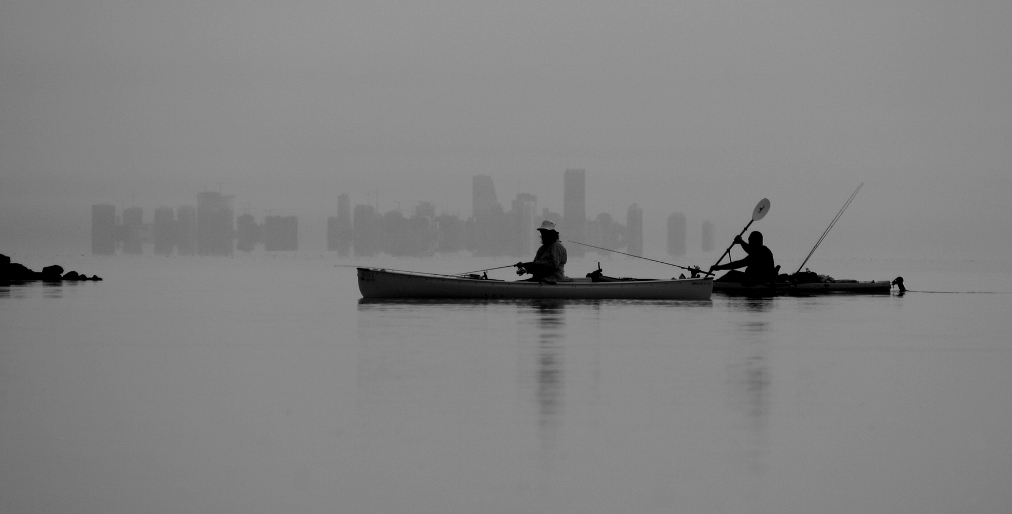
On the water by 7:30 am, I had no expectations as low tide would not be reached until after 2 pm. I paddled in 1-2 feet of water across the flat that would later be covered with wading birds. The photo above shows how the day started. I and my fishing companions paddled east into the sun toward Snake Bight (recently, the park made this a no motor zone). Here are a couple scenes as we approached. The brown pelicans were busy diving. In the second photo, the bird is standing on the "no motor zone" sign. The dark specks are dragonflies which were in great number.


Osprey are plentiful on Florida Bay and their nests are often easily photographed, by land and by water. Today, I watched several of them criss crossing the sky on their fishing expeditions. Here's one with a pinfish.


Within a few hours, the mudflat near the marina channel was exposed and several birds had begun to congregate. First, it was primarily laughing gulls, willets and a few royal terns. One of the challenges of photographing at this mudflat is to avoid the background noise which is the park's very large visitor center and the channel markers. But, I have learned that sometimes, the buildings can offer colorful reflections in the water, such as in this photo.

Later, egrets and herons flew in and joined the mudflat party. Among them were some osprey that had landed in the water. It appeared they were preening or simply cooling off. Here's one of them that was shrieking at another bird.


I approached the mudflat knowing that I would not be able to stay in one spot for long as the water levels declined. This is not where you want to be stuck without water. The mud here is like wet cement. With my canoe, I can glide through 1 inch of water, but I do not want to do that over a great distance. At one point, a reddish egret appeared, quite close to my boat. This is the only location in the Everglades where I have been able to photograph reddish egrets. Every once in a blue moon I see one on a paddling trip, but rarely to photograph.

Now, I concentrated on the dancing egret, but continued to be mindful of the declining water level. This bird is a joy to photograph (but challenging), offering endless poses with its theatrical fishing technique. At one point, the bird came within 15 feet of me. Here's a few photos of this fanciful egret. It has a needlenose fish in one of the photos.


It was getting hot and the sun was fully exposed. Not wanting this day to end, I paddled over to the east side of the tiny island near the marina channel. The birds had almost completely surrounded this island that sits in the middle of the flat. I paddled around in the deeper portion and began facing the west toward the island were a willet was foraging. Several egrets were wandering around but at this point, I was very limited as to where I coul go with the boat. I concentrated on the willet, a dullish type bird. But what attracted me was the light on the water, showing again the red reflection of the building. The pastel blue and red was attractive, even though the bird was not so colorful. Here is one image.


I paddled back to the channel opening. There, a young great blue heron greeted me with a classic flasher pose as it cools off.

What started with low expectations ended several hours later with a stack of excellent photo opportunities. Not included in these photos are the black skimmers, shark tails, jumping mullet and the best of all, the season's first siting of a flock of white pelicans. Yes, winter is definitely here!

Sunday, September 25, 2011

High Key


Nature photography has so many rules, all made to be broken. When the sun is high enough that the underside of flying birds is shadowed, the rule is to put away the camera and wait until a couple hours before sunset to take it back out again. Then there is the harsh reflecting light of the water. It's uncomfortable enough to paddle toward the sun and the glaring water, but try to photograph in that direction and it's even more uncomfortable; except when photographing flying cormorants.

I learned quickly that photography from a canoe (or any boat) has more limitations than photography from solid ground. But then, I began to see the possibilities; you know the folksy saying "When handed lemons, make lemonade". For the past 7 years, I have been trying to make lemonade. One thing that is almost always the case is that I am on the water way past those golden hours of morning light, and often paddling well past noon on camping trips through the Everglades. While harsh overhead or side light makes many things less photographable, the very same light makes other things more photographable.

On Biscayne Bay, I have always been attracted to high key scenes. I started experimenting with the possibility of capturing them as I watched cormorants flying past. What is attractive about these birds is how low to the water they fly. Consequently, they reflect. On a calm day, it is a scene that cannot be resisted. Empty space in an image adds impact to the subject, it's as simple as that. So, I started experimenting one day when there was nothing else to photograph. Here's my first attempt, and because it worked for me, I have been attempting these types of shots ever since.


The old sponge farm (the sticks) has become one of my favorite high key subjects. That first became evident when I ran across this scene below, one of my favorites. I got lucky with the line of cormorants in the water.


I also experimented with the mangrove trees that stray into the bay from the main shoreline in one particular area that I paddle. As a result, I can get the trees into a high key light. With their hanging roots, they make interesting designs. For the shot below, I added the water ripples by using my paddle.


I continue attempting to capture flying cormorants, speedy devils they are. But where I've spent a good amount of time this summer is with the cormorants hanging out on the sticks. For these shots I attempt to either isolate one or two, or capture the entire scene, such as this shot. I always attempt to capture these beautiful birds in a wing spread position, but they do not always cooperate.


Capturing these high key images is way too easy. With the sun high enough, cloudy or not, the calm water and the horizon become one. That's what I look for and with that, I meter off the water, compensate about +1 1/3 and start shooting. With the flying birds, I need at least 1/800, so the ISO gets bumped up to 640. When there are several birds, I use f8 to f11. With post processing, it is usually nothing more than some curve work to lighten the lights and darken the darks. Sometimes, a bit of water movement causes ripple reflections and these need to be cloned out, but this is a minor thing.

Enjoy the photos and remember, photography rules are meant to be broken.


Thursday, September 22, 2011

Low Key


Two versions of bird photographs come out of my Biscayne Bay visits. On one side of me are the high key images. On my other side, are the low key images. For this blog, I present the latter. Both are appealing to me because a bird stands out well from its surroundings in either version. In the low key version, a white bird stands out exceptionally and ironically, is an easy capture regarding exposure settings. It may not appear that way at first given the great contrast between the bird and its surroundings.

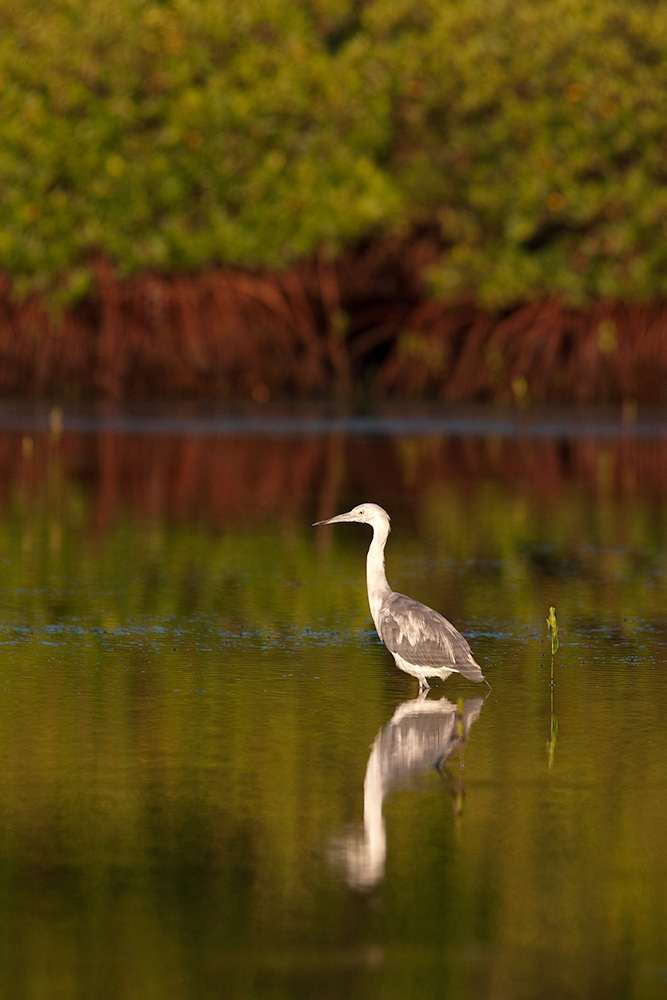
How does one expose such a scene? Simple, expose for the bird and underexpose the surroundings. I find that matrix metering (also known as evaluative metering) works quite well for this. In the morning light, the mangroves foliage and prop roots and their reflections tend to be midtone or slightly lighter than midtone. Dark tones prevail in and around the roots and where the water is not reflecting anything. So overall, it is a midtone scene. If I know I am going to photograph a white bird (egret, adult ibis, very young little blue heron), I compensate about -1 stop, using manual exposure (this amount of compensation may vary between cameras). For darker birds that contain some white, such as tricolor or little blue heron, I compensate about -1/2 to -2/3.


There is one small area that I love to capture these birds. The mangroves barely receive the light because of a few small trees sticking out into the water that cast shadows on them. This leaves the water in front of the mangroves clear of shade and when a bird comes into that part of the water, it is lit up with light while the background is dark in shadows. This is a very cool effect as it allows the bird full exposure while all else goes dark. Some of the prop roots and mangrove seedlings in the water will appear in a shadowy form. The best parts are the reflections, especially from the bird. In calm, debris-less water, it is striking.

Once I know I have the right conditions and birds, I attempt to capture the bird in interesting or dynamic positions and with catch light in their eye. These opportunities vary according to the type of bird. For instance, the tricolor heron is a great subject with it's large yellow feet and striking pose. The ibis is a bit more challenging, but the long down-curved beak gives the bird an interesting profile regardless of what it is doing. The ibis forages nervously and is almost always moving. If you are lucky, you will capture the bird with prey.


Once I hone in on a bird or two or three, I have a range of area I can work with from one position. Remember, I am in a boat, staked out or anchored in one spot once I have my ideal scene. I find that with the sun directly behind my back, I have about 90 degrees of freedom to work with (45 degrees to the left and to the right of me). Outside of this, the side lighting is ineffective. Certain birds will cooperate better and stay within this light range most of the time. The ibis and little blue heron are good examples. The great white egret and tricolor heron tend to move along, which means I have to follow them, not easy to do in a boat. The best condition is when the water is shallow enough for me to move the boat with my foot. Having long legs pays off sometimes.

The shadowy mangroves and the reflections give off an impressionist type of feel as the greens and reds tend to flow into each other. I love the scene and with the right positioning of the bird in the frame, it is beautiful to me. I use the mangroves and reflections as a means of framing the bird.

I have a direct approach to post processing. Because the camera is dumber than my eyes, I need to work the image a bit to get back what I saw with my eyes. With the correctly exposed bird in the frame, I will either bring out some of the light on the mangroves and the reflections using some curves and dodging, or I will darken the surroundings so that only the bird and its reflections appear. The two photos below demonstrate these techniques. The first one was darkened, although I left the reflections in the foreground. And the second is where the mangroves are as much a part of the scene as the resting egret.


Sunday, September 18, 2011

Thank you Juanita Greene, Lloyd Miller and Lancelot Jones


I wrote 5 years ago, "Biscayne Bay is where I feed my soul. It is conveniently close to my home that it seems spiritually reckless to think of it in such a way. After all, we find inspiration in those individuals who have shared their stories of spiritual awakenings through nature while traversing dangerous mountains or paddling treacherous waters in remote areas of the world. To the contrary, Biscayne Bay casually shoulders up to Miami. The presence of the city is a constant reminder that we need to nurture our wilderness with all our hearts as we live our urban routine. When I am in the city, I know Biscayne Bay is with me, like a good friend that might say goodbye one day."

And for Biscayne Bay, I thank those three great people, Juanita Greene, Lloyd Miller and Lancelot Jones. Without one of them, this park would not exist and an oil refinery would sit where I now photograph the bird rookeries. Where fishermen now chase bonefish in the shallow flats, freighter boats would instead be moving in and out of the deep water port. But because of the brave voices that stood up for Biscayne Bay, it became a protected park monument in 1968. In 1980, it became a national park, over 180,000 acres worth.

There are two unique qualities of this national park. A major city lays adjacent to it and 96% of it is water. And let's not forget the Turkey Point nuclear plant and Mount Trashmore, both located on the edge of the park. Maybe it is especially for these reasons that Biscayne Bay must be carefully watched over and cared for. As the park management moves toward expanding the no-motor zone on my beloved bay waters, I think nostalgically over the years that I have spent exploring this bay and experiencing its highs and lows.

From one vantage point, I have been reminded of our urban reality:


But from another, I share this reality with you:


Sunday, September 11, 2011

So Juvenile


Sometimes, there are so many birds to photograph on Biscayne Bay on any given morning that it is like an endless buffet, all you can eat. Last weekend proved to be that; and now, one week later, I am writing my fourth and final blog entry describing my fun with the birds that weekend. While the gulls and the great white egrets served as main courses, the handful of juvenile ibises and little blue herons were the soup de jour. Almost always available to photograph, I find the juvenile LBH to be more beautiful than its adult counterpart. This is likely due to the difficult distinction between an adult LBH and its surroundings on the bay; whereas the juvenile LBH stands out with its white (soon to turn blue) feathers. They also tend to be less shy and allow me to drift close. Here are a couple photos from that weekend and a couple more from previous days. Interestingly, the first two photos are the same bird taken on separate days.


The juvenile white ibis is also quite beautiful. Opposite to the LBH, the juvenile stands out less so on the grassy waters compared to the adult. But this can vary depending on the juvenile's development stage. While the youngest of them present mostly brown feathers, the older juvenile contains more white feathers. But making them more beautiful is how the brown and white feathers intermingle. It appears the head and neck are the last of the feathers to turn white. It also appears that the brown feathers turn white but leave a darker outline along the edges of the feather, leaving a pattern that you do not see in a fully grown ibis. Here are a couple photos for the weekend.


And just for comparison, here are adult versions.