Sunday, October 24, 2010

The white pelicans are back

It is that time of year again that makes me nostalgic for winter months in the Everglades. It means preparing for our camping season, enjoying the cooler temperatures and witnessing the return of one of the most beautiful birds in south Florida. Groups of American white pelicans have already been spotted in the gulf islands of the Ten Thousand Islands. If I lived on Chokoloskee Island, I would be able to capture the amazing migration flights of thousands of these birds as I could look up into the sky frequently and it would only be a matter of short time before I see them. Everything about the American white Pelican is spectacular, not the least of which is the 8-ft wing span! I once thought the brown pelican was amazingly large, until I first saw one standing next to a white pelican.


Besides the obvious differences body size and feather colors, there are other differences between the white and brown pelicans. If you are around them enough to observe their behaviors in the water, you will quickly notice that they also differ in how they catch fish. Brown pelicans typically dive for fish; sometimes alone, sometimes in the presence of other pelicans. White pelicans, on the other hand, catch fish while swimming in groups. They don't dive into the water, rather they dip their pouch to catch schools of bait fish. Another notable difference is that white pelicans rest on ground, such as mud flats (near Flamingo in Florida Bay), oyster shell beds (Chokoloskee Bay), or beachy islands (such as Plover or Pavilion keys in the Ten Thousand Islands). You will not see them resting in trees like the brown pelicans normally do. Nor will you see them taking up a piling post near a marina where you often watch brown pelicans hanging with the gulls and eagerly awaiting the remains of a fisherman's catch. The white pelicans are more elusive and rarely seen alone.


And yet another difference between the white and brown is that the whites do not nest in southern Florida. Rather, they make a long migration from northern United States and Canada around October and November each year. Late in winter, you'll begin to notice large bumps on their beaks, an indication that they are preparing for breeding season which begins with a migration back north sometime around March.

On two occasions, I have seen white pelicans here in the summer, once on Chokoloskee Bay and once on Biscayne Bay. The two things that struck me most were that it was summer and the bird was alone. I reckon that the bird on Chokoloskee Bay was old and could not make the migration back. There it stood among active roseate spoonbills all around it. It appeared beaten with old age and simply worn down. The other bird on Biscayne Bay had some grayish coloring on its feathers and I suspect this was a young one that made a migration south with its parents and did not go back north in spring since it was not yet ready for breeding.


I think the most amazing scene I have witnessed in the Everglades was in January of 2008 when paddling to Pearl Bay for an easy overnight trip. The plan was to spend a good portion of the time exploring the area and look for hidden bays. While paddling to the chickee, I watched some birds flying high, swirling around with the thermals, much like vultures do. Woodstorks also appear this way. I soon recognized them as white pelicans. As I continued paddling, I continued seeing more birds. They appeared to be coming out of a back area, arising over the mangrove canopy. Once I arrived in Pearl Bay, I had already watched several hundred fly overhead. As I set up camp and went back out on the water, their flights continued for the entire afternoon. Where were they coming from I wondered?


I learned that they feed in the hidden back bays during the day and fly out in the afternoon, which is what I was witnessing. The next morning, I headed into one of those back bays before sunrise, sat in the boat and waited as the sun began to peak over the horizon. Before long, I could hear their powerful wings and then they appeared. By the hundreds, the large birds were soon flying directly over me, almost within reach! They were coming back to feed again. Seems that the fish get caught in these back bays in the winter, and that's food for these birds.
The white pelicans are back now and soon I will be out there with them. Just look up and you can see their magnificence . Another Everglades precious gem.

Sunday, October 10, 2010

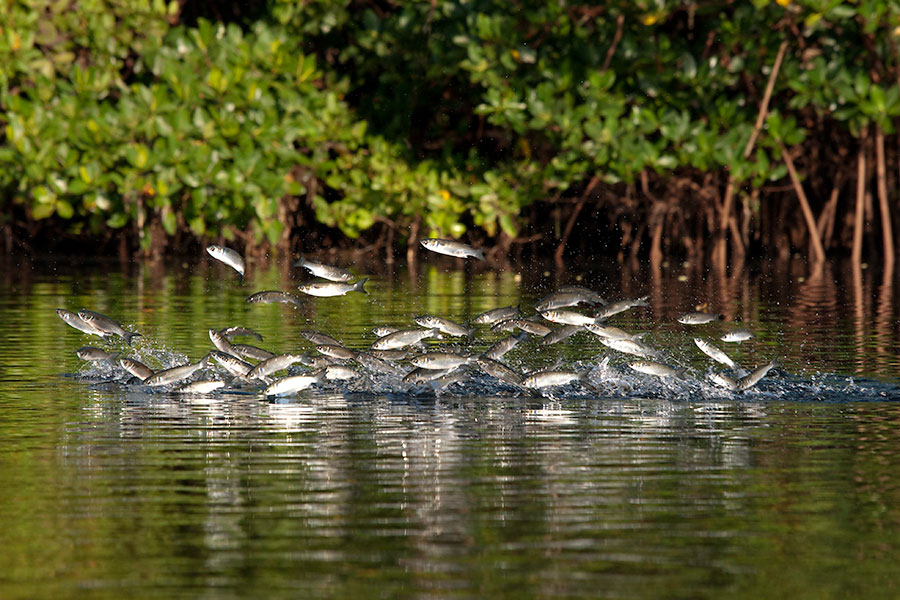
Water boiling with bait fish


That time of year, the mullet are running and wow, what an incoming tide it was this morning. Low was scheduled around 6:30 with a new moon effect. High tide was to be so high today that there were flood warnings for the Miami coastal area. Instead of parking at the usual launch site at Mattheson, we put our boats in at the canal. I was paddling under the bridge and toward the marina at first light, about 7:15 am, expecting to get into very shallow flats where there would be plenty of birds around.


Winds were calm as I passed the powerboat launch area toward the open waters. I could see small silhouettes of birds on the flat. As the sun began to peak over the horizon and cast a brilliant orange glow on the water, I thought it would be fun to try to capture a bird or two sihouetted against the bright color. I was surprised that the water was deep enough between the birds and the shoreline so much so that I had no problem drifting along. There were a few little blue herons and one great white egret. Gulls were actively diving for food and what a opportunity that would be; a beautiful silhouette of a bird diving and coming back up with fish in beak.


All that was a dream as the birds, one by one flew away. By now, I realized that the incoming tide was quite strong and the water was rising by the second. I paddled further south along the shoreline. I've seen negative tides here where I would need to paddle at least 500 feet off shore. Not today, the strong incoming did not give the low tide a chance. Wading birds were few as a result.


Despite there being few birds in the water, the water was alive with bait fish. This became a spectacle as the sun rose over the water. Soon, I was staked out and waiting for a spray of fish to capture. I had two choices, high key facing the open water or facing the mangroves where the greens and browns reflected beautifully on the water. This is where I concentrated and waited. I got where I could find an underwater chase and follow the leading ripples that indicated bait fish would be jumping in number at any second. Sometimes, I would hear that sound of spraying water and find them that way. Even without birds to photograph, Biscayne Bay's got something. Alway.

The water rose quickly and later I headed into the creek. The current rushed me in as I looked for my golden silk weaver spider. One was still there, surprisingly. I see them late in summer, but by fall, these spiders seem to disappear. I got out the flash and set up the anchor. No way could I photograph without the anchor today. I threw it in the water and waited to see where the boat would end up. After a few attempts, I finally got the position I wanted and started shooting. I closed the aperture to f11 (but preferred f16) and increased the ISO so as not to compromise shutter speed too much. As slow as 1/250, I was able to get some good shots of the 8-legged beauty.


Not a bad day, I was happy to be able to practice capturing the bait fish. That has always eluded me, but with the mullet running thick through these waters, I had an unusual amount of opportunity. Next time, I'll be ready for them.

Sunday, October 3, 2010

Quality time on the bay


Over two months has passed since having a good photo day on Biscayne. August and September were filled with weekends of storm clouds and rain,work and other obligations. Finally, it was a perfect day to be on the bay. Let me count the ways; good tide conditions, no rain or storms in the forecast, mostly unclouded skies, and extremely calm winds. On the water by 7:15 am just as the sun peaked over the horizon, I did not leave until noon.

The sky was brilliant with oranges and reds, clouds still remaining on the low horizon and directing the sun's rays in all parts of the sky. As we loaded the boats, we watched the hundreds of ibises that make their morning southerly flight. They roost at night on Chicken Key and the island near the Deering Estate and always just before the sun reaches its full view, they fly off to where I do not know; inland somewhere, perhaps where they can feed on insects. Whatever reason they have, the scene on the bay was breathtaking and of course my camera was still in the pelican case. Meanwhile, the mullet were running like crazy through the water; it's that time of year. Because these schools of bait fish are constantly under attack, the water was boiling with activity. As I began my paddle, a large shark could be seen about 200 ft away, its back fin swishing back and forth behind the front fin. It was a thing of beauty, black silhouette on sky reflected waters, and it was coming closer. Once again, my camera was not ready!

Ah well, I had a purpose today and that was to get over to the sponge farms to photograph the social interactions of the laughing gulls and royal terns. Always fun to watch, I thought the conditions would work to my advantage because of the lowering tide and the fact that the winds were to come out of the N to NE at 5-10 sometime later in the morning. With those winds, the birds would be landing and taking off facing me as I sit with the sun to my back. With anticipation, I began the paddle to the sponge farms.


Several gulls and some cormorants were roosting on the sticks. There are basically 3 clusters of sticks of varying lengths arranged close to each other. The first cluster is in open waters near the channel and offers mostly a clean sky background. You have to watch for boats in the channel and the buildings that sit behind the distant shoreline. Good shots have been taken from here. The second set of sticks is further north and lies a couple hundred feet from mangroves. This offers a nice background and can be quite rewarding when attempting to capture the birds flying off and banking as they swoop around the sticks. The third cluster is larger than the other two and contains probably 3 times as many sticks. There can be lots of activity there, but the problem is that the scene is very crowded. Rarely can you get a clean shot of a bird. So, I settled on the second cluster where there were fewer birds, but plenty of action.

Everything was working well. I staked out easily in the water that was gradually getting shallower and the birds did not mind my presence at all. That's one of the best things about photographing gulls. Yes they are common and sometimes annoying, but they are a great subject for a few reasons; they don't mind you getting close, they are very social and offer lots of interactions, they have character, and frankly, they are beautiful with their wings spread. I can sit with them all day and not get bored. That's an important ingredient for a wildlife photographer, you must have endless amounts of patience and the absolute desire to learn every nuance of a bird or other animal. There are rarely "lucky" shots in nature.

Everything was working well except for one thing; there was no wind and the birds were facing away from me. Beautiful landing scenes were happening, lots of territorial disputes and I could not capture one scene! At one point, a gull landed with a shrimp in mouth. I had never seen this before. How great a shot this could have been had the bird only landed toward me. Here's the shot as it was seen, and will never get past this post.


Since I couldn't capture the birds landing or taking off, I concentrated on capturing them as they took flight and banked around the sticks, with the beautiful mangrove and their reflections in the water. Many flight shots were taken, but none was considered good enough to post because of inadequate wing position, blurriness or bad angle. But I did manage a few cute shots of them resting on the sticks.


In the meantime, the tide was rolling out and white birds began to accumulate along the nearby shoreline. Feeding time for the wading birds!! One particular area was filled with about a dozen white birds. Further north, great white egrets were starting to appear, scattered about giving each other a wide berth. I left the gulls and headed toward the white birds. I approached them and watched quietly, getting myself into the best lighting spot. There were about 8 snowy egrets, all appearing to be quite young. I think this because their yellow feet were not as brilliant yellow as I am use to seeing them. There were a few ibises among them. They were mostly standing and preening but on occasion one would break off and spear the water for food.


I had a good set up, I just needed the birds to cooperate; alittle separation between them, good background, some action, some good poses, etc. And then I heard the noisy motor off in the distance getting louder. It was a motorized glider, one of those single seaters. I've seen them out here before, probably the same one. It approached on the gulf side and came within 500 feet. The birds spooked immediately. The glider moved on, and eventually the birds returned one by one. Then the glider came back, and once again the birds spooked. For some reason, the driver of this noisy aircraft decided to fly over me at least 3 times. At one point, I had got very close to a tricolor heron and as soon as the air craft flew over, the bird was gone. I suppose the birds flying looked nice from above.


The morning wore on and the sun was quite high by now, well past optimal lighting. I faced the sun and watched the sponge farm activity. It was high key time, those shots that are very simple, yet compelling. I experimented with several horizontal and vertical compositions. Cormorants were around and I waited for one to spread its wings, making a lovely silhouette. For these shots, I meter on the water or sky, use a aperture of at least f11, and compensate between +1 to +1.67, depending on the sun's angle. Wnith a high enough ISO, I can get a shutter speed of 1/400, quite adequate for still targets.

High key shots mean that the sun is high above and it is hot. The heat felt good, but it has been four hours already on the water. Time to get back with a near perfect morning on the bay behind me. Oh what the hell, it WAS perfect.


Sunday, August 29, 2010

Dealing with the dang winds

Concerning the winds, I look at them with two views; one as someone photographing from a canoe and the other as a paddler going on a long trip through the Everglades. As a winter season paddler, my range of wind tolerance goes as high as 25 mph. At 20-25 mph, I can paddle a headwind with much effort and my boat stays reasonably dry (side and back winds are a different story). Anything below 15 mph is acceptable, even on long trips.

For photography, winds take on a different meaning. 0-5 mph is preferred. 5-10 mph is OK but slightly annoying when attempting to anchor and stake out. Anything over 10 mph is unacceptable. And today, I had 10-15 mph on the bay, east winds no less.

Launched from the Mattheson cannel and came out to the bay through the marina. It was low tide at about that time, so there would be birds regardless of the stiff wind pushing against the shoreline where they would be wading in the grassy low tide shallows. The sky was a combination of rising cumulus clouds mixed with lighter cirrus clouds. The sun didn't have much chance for showing through, but somehow managed to eventually. Once on the bay, I had a moderate chop coming and waited until I got relatively close to the creek entrance before pulling out the camera and attaching the flash and beamer.

A flock of ibises flew in and I noticed a few other characters, little blues and tricolors. Laughing gulls were flying past in great numbers and this continued all morning. Several hundred of them flew in a southerly direction to where I had no idea. I watched a few brown pelicans fly by and spotted one or two diving near by. Same with cormorants.


I came up on the entrance of the creek. The birds were feeding but not in great number. The water was too restless and it was only in those areas where the water was too shallow to be affected by the wind that it took on a glassy smooth appearance. For instance, a tricolor heron was catching breakfast along some calm water but just above its head the water was running through a slightly deeper channel and appeared rough and noisy. In other words, not a clean background.

There are only a few deep enough narrow "channels" to move the canoe in closer to the shoreline. In one of them, I watched something relatively large move quickly in the water. Bait fish promptly jumped in attempt to flee the predator. Then I spotted something odd in the water, something I have never seen on this bay. It was the recognizable back of a gator, or more likely, a crocodile. The tail appeared above the water and near it were the large eyes and snout. Not a large croc, maybe only 5 feet in length, it disappeared under water. My first bay croc! Soon, I noticed its head on my right, a silhouette in the grassy water. Very cool, and I figured this was a smart croc. It's location made it easy for it to ambush bait fish and other marine animals that had been trapped in the shallows at slack tide. As is the case with the birds, lots of opportunity to feed on all kinds of marine life in this area. The photo above shows the head of the croc and you can see the water conditions as well.

The wind at my back, I pulled in as close to the ibises as I could get. Eventually, a couple young snowy egrets came in. A couple little blue herons got relatively close and a tricolor heron came in for a short period. When I shoot wading birds, I get my boat into a position that provides the best lighting within a "window". I figure it's about a 45 degree span, maybe a bit more when using the flash as a light filler. So when I see birds, I first figure out where I need to be in order to place them in the center of the window of opportunity and then began my approach very slowly.

In these shallow grasses, the boat hull slides across the grassy mud and it is noticeable. I moved slowly, stopping when the birds appear alert and wait for them to resume their business. Eventually I found an acceptable spot and stayed there. Birds flew in and out but mostly, the ibises did not move much. Even in very shallow water when the boat is firm on ground, the 10-15 mph winds will move my light boat. I used my foot as an anchor and that worked well. The ibises were in great location, the water was calm and the mangrove reflections were like an impressionist painting. My favorite bay scene.


The east winds continued to blow the water in and soon, the grasses disappeared as the water levels rose. All the birds flew away into hidden mangrove forests, except for a couple great white egrets that were still feeding on some shallow areas behind me. I attempted to capture some backlit scenes of one of them. The winds never stopped and at this point, there was no reason to stay out here. I put away the better beamer and headed into creeks to find my golden silk spiders.

Lovely spiders, the female golden silk weaver, I found a couple of them in good location. In the creeks, these spiders conveniently place their webs across the creek but in locations high enough that you don't run into them. Some are too far up and not photographable, but many are close. I found one that became animated and quickly moved onto a recently caught fly in the web. That's what I try to capture with these spiders. I have a million photos of them pretty much in the same position, but one that is moving offers some unique qualities. Also, background is everything. Today was perfect with several clouds in the sky. The mixture of blue and white in the sky is a great background for these spiders. I worked on one of them for about an hour, going between backlit and frontlit positions. The current was relatively strong and anchoring was very tricky. Without the anchor, I just let the current move the boat, attempting to slow it down with mangrove branches. With this situation, I simply have to take several photos in between moving the boat back in place, and hope one of 10 or so is sharp enough.

My neck sore from looking up continuously, I left the spiders and paddled back to the canal. Another beautiful day on the bay, despite the wind.


Sunday, August 15, 2010

Bonefish wishing on Biscayne


I had more opportunities to photograph fisherman than I did birds today. The biggest challenge this morning was the lighting. First, I was on the water before sunrise, about 6:30 am. The tide was still rolling out reaching its low a few hours later. Word was out that the best time to spot the elusive bonefish was just before sun up. So I was there, with those kayak/canoe fishermen who are as obsessed with catching a bonefish as I am with capturing a sharp image of a heron catching a fish.

In the dark, we paddled out the creek. The cloud cover in the sky would dampen the sunrise and it remained quite dark for awhile. There was a hint of light on the calm bay water, and the cloud covered sunlight gave out some nice orange hues, but far from brilliant. it was that type of sunrise that looked to be covered in parafilm. Still beautiful, I watched the silhouettes of the fishermen scattering about the bay, searching for those tails.

I paddled out into the open bay as the sun tried to come up. Eventually, it appeared above the clouds and finally, the mangrove shoreline was lit up. Before it got light, I had seen a couple juvy yellowcrown nightherons flitting around the shoreline. A couple tricolor herons and great blue herons flew over. Only one or two cormorants did I see today, an unusual thing. I heard the melancholy appeal of the osprey, but never did see it. Noisy kingfishers were seen and heard but to photograph one of those jet birds is near impossible, at least when you are on the water.

I finally noticed the yellowcrowns feeding along the mangrove roots. With nice lighting, I was able to get relatively close to one before it realized I was too close and flew off to a near by spot, not so well lit. Since these guys were not cooperating with the light, I zoomed in on the distant shoreline that was lit up by the sun to search for a moving target. I spotted a white bird and started to paddle over to it. It was about 1/3 mile away and in the meantime, the sky hazed over with a thin veil of clouds. I took out the flash and kept my eye on the bird. A noisy boat behind the jetty got the bird's attention. With me approaching and the noise, it flew to another spot nearby.


While paddling toward the bird, I couldn't help but notice the water sparkles where the sun was now casting its light strongly behind me. The fishermen were in the distance where the most light appeared on the water. I decided to try out my new trick that I had learned from Denise Ippolito's photography blog. I set the aperture to 22 to get a great depth of field and stopped down with the shutter speed. The sun light was a bit diffuse, so I didn' stop down too much, I think about 1/3. I captured some vertical shots of Vivian in her canoe and David in his kayak. I enjoy photographing each of them, Vivian's canoe is so beautiful and David looks great when he is standing in his boat fly fishing. Earlier, I had a decent shot at bonefish whisperer as he poled along looking for tails. The only problem is with me photographing fishermen is that my camera and/or lens scares the fish away. Consequently, I rarely get a photo of someone actually fishing!


The tide was continuing to roll out and finally, more birds began to appear along the shoreline. That's when I came up on a little blue heron that was eagerly catching worms and shrimp that it hardly noticed me as I attempted to capture him in the act. A green heron appeared out of the shadows but was not as animated as the little blue. With a little time spent with these two birds, I decided it was time to leave.

Next weekend, I will be attending a macro photo workshop with Roman Kurywczak. Going to be learning about diffusers and reflectors, not that I will be using those tools in the canoe (well, maybe in the creeks???). But, since Roman is also a landscape photo expert, I plan to sneak in some questions about that. If I am lucky, may get out on the bay again this week before I begin the semester. Maybe Deering next time.

Monday, August 9, 2010

Chokoloskee and those storm clouds: part III


Never ceasing to be beautiful and amazingly alive are the summer storm clouds that make any day on the water interesting and sometimes precarious. Despite all the clouds and rain, I didn't see one lightning bolt until I was in my car heading toward Miami. Saturday's storms never came into the bay area and simply skirted around from the south and the west side. Running parallel with the large darkness above, I paddled some after leaving the roseates and putting away the large lens. While paddling, the sun light came in, brightening the mangroves with the angry clouds hovering above. It's irresistable to me, the contrasting mangrove reflections.

The next morning was just as beautiful but in a way that allowed me to photograph the white terns and juvy pelicans at the pilings. Even with the bit of rain I got while paddling (which was a relief from the heat), there was not much wind, an unusual thing when storms come through. This was another enjoyable summer morning on Choko bay when I know my time on the water is limited.


Lovely to me, mangroves will never get tiring or boring. They, like the fauna on the water, present unique photo challenges. But you really can't photograph mangroves well enough without those clouds. Clyde Butcher understands that better than anyone. I listened to him tell of how he would go out to the Ten Thousand Islands with a boat captain and would find that the captain paid no attention at all to the clouds. It was as if Butcher had opened the captain's eyes to the Everglades. Butcher watches clouds and can read their story and never knows what the ending will be until he gets to it. He simply watches and studies, and knows that the clouds are as much a part of the mystery of the Everglades as the mangrove roots that walk on the water. He knows that those clouds are formed by the very same water and trees he photographs. He understands the necessity of those clouds and better than most, can capture what looks like a common Everglades scene and turn it into something spectacular and unique, in black and white.


Maybe color is not a bad alternative, maybe there is a way to photograph these scenes and present them in a way that makes even the most remote character pay attention. I doubt that my little photos will fascinate very many beyond myself and the few who basically feel the same way I do about the Everglades, but nevertheless, I continue to capture them, over and over and over again.

Chokoloskee and the tern wars: part II

Two days on Choko Bay. I knew I would have to contend with possible storms, skittish birds, oyster bars and a fast rising tide. So what's new on this bay, one of the most challenging places to photograph birds. After realizing that roseates would not be photographed, I had to look for something else. the storm clouds can often be great subjects if the ligting is right, and it was much of the time (I'll post those on the next blog). I also had to get over the fact that while my gunwales were silenced (see previous post for the meaning behind this), it was the screeching of my boat hull against oyster shells that alerted the birds to my presence. Which is why I decided that Biscayne Bay was the better choice for my stealth strategy. But anyway...

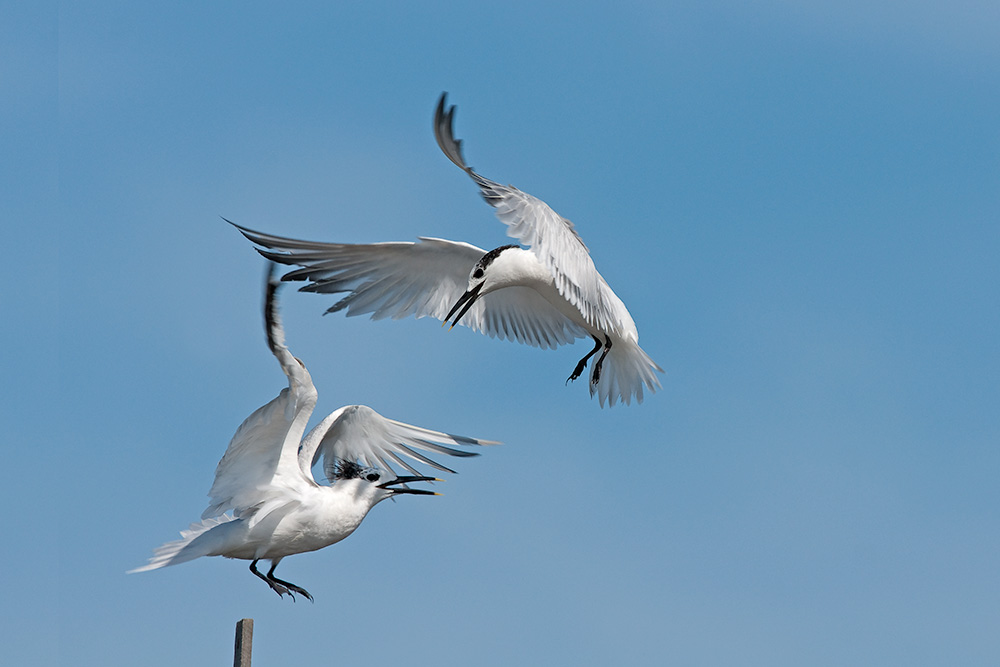
I was hoping that one of my favorite chokoloskee bird subjects would be available this weekend, although I had thoughts that early August might be too early. For the past several years, I have found that the sandwich terns and few herring gulls appear in September after having been absent for some time. With an incoming tide, they turn up near the marina where there are several pilings. The sandwich terns are in great number consequently are continually competing with each other for precious piling space. Sometimes, they clash with a large brown pelican. This is where the fun begins. I was so happy to find that the sandwich terns were back, in full force.

Here's the part I like about photographing the terns in this spot. First, I can set up easily with good light (sun behind me). I am near the marina and in an area where there is no boat traffic, so I have lots of choices for spots to hang out and anchor or stake out if the tide is low enough. Fights ensue constantly as one bird bullies another off a piling. On a few occasions, a pelican will fly in and knock a tern out of the way. In fact, I photographed a scene where this happened, and when I looked at one of the photos, the pelican's foot was clearly planted on the poor little tern that was attempting to get out of the way. Ouch!


By the time I arrived on Saturday, the sun was uncovered but it was high, not a good set up for flying birds. I looked for banking shots but the birds were too fast and often the pilings got in the way. The wind was such that birds were not landing toward me, so getting a good light on the wings was near impossible. I didn't bother with the flash because I was ready to get off the water and I knew I would be back the next day. BTW, it was painfully hot and humid on the water this weekend, lots of no see ums as well.


On Sunday, I got back to the marina much earlier than the day before. The storms were more threatening and were coming closer to the area. I wasn't sure how much time I would have, so I got there as early as possible. I spent about an hour and a half with the terns using my flash. For about half that time, the lighting was exquisite. What made it so were the very dark clouds in the background. The only problem was that it would be down pouring soon and I needed to get off the water before that happened. I still needed to load up the gear and boats and wasn't keen on doing that in driving rain. Soon, even the sun was covered in dark clouds, so no point in continuing.

I managed a few decent shots of the terns, but found it difficult to capture them in flight. The best shots did not come out sharp enough and were promptly deleted. Another issue that popped up on several photos was the ugly piling (notice the one above with the pelican, and that one is relatively attractive compare to others). The two photos below are keepers but keeping to my theme of the week, there are issues with each. The first one was shot on Saturday at high sun. Note the shadows riddling the scene. The second was shot during one of those exquisite lighting moments and the bird's wings are nicely displayed. But, its head is down and its right leg blends with the beak. More separation of the foot and beak and a slight head turn would have made this a better shot. These shortcomings simply keep me coming back, to try, try and try again.