Friday, January 10, 2014

Metabolic machines with feathers


I've been reading The Immense Journey by anthropologist Loren Eiseley. At one point in the book, he talks about the evolutionary achievement of a high metabolic rate and body temperature regulation, supreme characteristics of warm-blooded birds and mammals. The advantage of high metabolism is the ability to escape extreme environmental temperatures while maintaining peak mental abilities ( as opposed to hibernation that leaves an animal vulnerable to attack).


The downside of the high metabolic rate is that it requires great quantities of energy intake to support it. And with this, birds are amazing metabolic machines. It seems a bird's life consists almost entirely of obtaining food for itself and sometimes for its chicks. That, and the fact that birds have feathers and fly, make them one of the most appealing animals to photograph.


The technique of capturing food varies among the waders, but I can distinguish them into two distinct groups. On one end you have the exciting quickness of the egret or heron, or the "strikers". These birds puncture the water with their sharp beaks with dramatic results. This happens so fast that the naked eye cannot distinguish the details of the event that begins and ends within a fraction of a second. Only with a fast camera that can shoot at least 5 frames per second can you see how the event plays out. Of course to capture any of that, you have to be ready with finger on focus button while aiming right between the eye and the beak (the lores) with a steady camera. You have to anticipate where the bird's head will end up in the frame and prepare to focus on that spot. Area focus that can be easily moved around is a beautiful thing in this regard.


 Despite my efforts to capture the moment, most of my successful shots are the end results of the bird's success, as seen here. This is fine because having the bird's prey in the image is dynamic and interesting to look at.


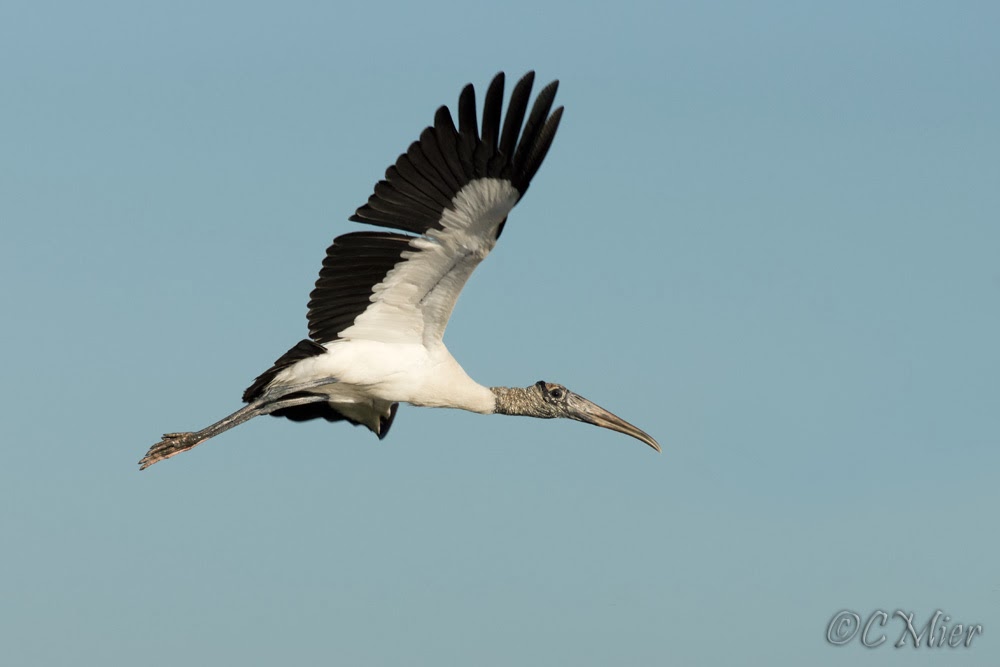
The other type of wader that I call the "forager" are the woodstork, roseate spoonbill and white ibis. I have very few good images of a woodstork and even fewer of them foraging. I also have very few good images of roseate spoonbills and frankly, if it were not for their colorful wings, I would probably ignore them as they are relatively boring foragers. There is very little pazazz in their technique; sorry roseate, I know you are a favorite among bird lovers. Now for flight shots, they can be the deal breaker in making a superb image. The white ibis is a different story and I also have endless opportunities to photograph them foraging. They tend to poke and jab at the water, and often bring their prey out of the water before swallowing it. This gives them a dynamic quality much lacking in the roseates.


And last, a tribute to the nesting parents that must feed their relentlessly hungry chicks. This blog is a celebration of the bird and its survival. May they live on this earth forever.


Saturday, January 4, 2014

Challenging light for bird photography


I recently spent nine days paddling through the Everglades. A significant portion of the route was in rivers and small creeks, but a small part of the trip was coastal. I blogged earlier about the challenges of bird photography on long paddle trips, but for this particular one, I had another challenge. In all the years that I have paddled 5 to 10 days at a time over the holidays into the new year, I have never seen as much rain and overcast skies as I did on this trip. With low light, photographing birds was not going to be on my agenda for this trip.


On our fourth day, we left Graveyard Creek to head up to Highland Beach, the one day where we would spend our entire paddle along the coastline. This section of the coastline shows serious damage from hurricane Wilma that passed through in October 2005. The storm surges destroyed some beautiful sandy beaches, including the Graveyard Creek campsite. Where there was a beach, there are now fallen trees that line the edge of the muddy banks of the deep set forest that currently serves as a small camp area. "Dark and buggy" does not begin to describe this once popular campsite.

The one nice thing about Graveyard Creek is that it attracts feeding brown pelicans and dolphins. At dawn, the pelicans were en masse, lining the mouth of the creek where several at a time would dive bomb the water while others rested on dead tree branches sticking out of the water and mud banks. It is a spectacular thing to watch these birds dive and make fantastic splashes. As I paddled away from the campsite, the sky was completely overcast as it was much of the prior days on the water. I paddled out and turned back toward the coastline where I could watch the birds diving between me and the mangrove shoreline. I wanted to photograph them as they group dived, knowing it would be extra difficult.

Brown pelicans obviously are not white birds and therefore, require more light to expose them properly, making my quest to photograph their diving feats more difficult on this gray day. I bumped up the ISO to 2000 (noise be damned!) and used the widest aperture reasonably possible in order to capture four or five diving birds at a time and went to work. They were loads of fun and I stayed on for about 30-40 minutes. Here are a couple shots, not rendered black and white.


Alittle slow on the take sometimes, it finally occurred to me that the diffuse lighting and the dark and light contrasts of the shoreline might make for some interesting compositions. And if I can find a white bird or two to throw into the mix, that would be even better. So I set the camera on black and white creative mode so that I could see the images in black and white. Please note, I shoot RAW only, which means the color data are not lost, rather I am using the creative mode as a way to see the black and white images. Once downloaded, they will appear with their color, and I simply have to re-convert them to black and white. I tried this in the Big Cypress awhile back and played around with selective coloring. Beware, you cannot do that with jpeg, if you shoot in black and white, that's all you get.

As I continued paddling north, I looked for scenes to capture in black and white. Normally, mangroves do not lend themselves well to black and white because their leaves are thick and formless when you take away the color. But on this hurricane damaged shoreline, I saw lots of opportunities for contrast and shapes. Later on the trip as I paddled down Roberts River, I came across an active osprey nest (same one I attempted to photograph four years ago) and was lucky to see both ma and pa osprey in the nest which was built on a strange looking tree.


Overall, I managed to capture a few good images of birds during this trip and have been inspired to look at black and white as another way to present them.  Below are a few more images. At one point, I saw several Magnificent Frigatebirds fly over. The first image below was an unintentional blur of two birds in one scene. I liked the effect of the blur well enough to keep it. The image of the royal terns is actually from four images. I cut and copied each bird into one image and arranged them as seen here. I rendered it black and white while deselecting the orange beaks to keep the color there. 

Lighting is key to excellent photography, but we can't always get what we want. So, remember the folksy saying "When handed lemons...", and look for unexpected opportunities.


Saturday, December 21, 2013

I love a close-up

 
Every once in awhile I get out of the canoe and head over to the Anhinga Trail in the Everglades. It is one of those rare times when I can get within inches of a bird due to their tame nature on the trail. Close up photography of certain birds, like the anhinga or cormorant is like a paradox to me. On one hand, the bird's head and beak shape make it difficult to capture an interesting composition. But on the other hand, having the ability to zoom in and out and shoot vertical or horizontal allows you to play with an infinite number of possible compositions. Not only that, the bird will pose in various ways so that the wings, along with eyes and beak become part of the composition. It is an effective way to practice composition.

 
My attention today is on the anhinga or darter. As the trail name suggests, there are many opportunities to photograph this interesting and beautiful bird (as seen with its breeding colors in the photo above). The anhinga is an amazing aquatic bird. Unlike the cormorant or other aquatic birds, the anhinga does not sit on the surface of the water before diving. Instead, it swims with only its head and neck sticking out of the water. Underwater, it sometimes will spread its wings, like a heron does on land, to create shade that will lure a fish. Once getting its prey, it surfaces and will toss it into the air, catch it head-first and swallow whole. And wow, it can swallow really large fish, like in this image taken several years ago at Shark Valley.

 
Capturing an anhinga capturing its prey is hit or miss because they dart around the water quickly. But if you hit it just right after the bird surfaces with its prey, you sometimes will have several more seconds before it swallows the fish, giving you time to capture several images at high speed. The anhinga trail is also the location for several anhinga nests, such as the one below shot a couple years ago. The challenge with these is that the nests are mostly out of good view or light and have lots of messy twigs and branches getting in the way. Somehow, I managed to get this shot using flash as the sunlight was off to the side. You might also get lucky and capture the male partner in flight with nest branches.


On my visit today, I concentrated on the close-up shots because, well, that was about the only photo opp available. For these close-ups, often the bird is standing on the wooden barrier that runs along the paved trail. I typically sit on the ground and point upward in order to remove the distracting background which might include the visitor center's roof and various vegetation. The other issue I had today is that the bird faced away from me. To capture good light on the eye, I had to wait for the bird to turn its head back toward the camera, often times when it preened its wings. I love the anhinga's wing feathers and often try to include them in the image.


I stayed with the bird for awhile, as dozens of tourists passed closely, sometimes disturbing the bird but not enough for it to move. I went back and forth between horizontal and vertical, attempting to capture various compositions with a clean background. I used my fill flash and kept the aperture at f10 or 11. With close ups, a greater depth of field is preferred so as to get the entire bird in focus. Flash helps in these situations.


If you want instant gratification with bird photography, the Anhinga Trail is the place to be. But, it comes with a few challenges. Number 1: the wooden barrier gets in the way often for those low perspective shots. Number 2: there is a lot of messy background to deal with and lighting is a bit tricky in places. Number 3: after about 8 am, there are lots of tourists. And last but not least,  the rubber-eating vultures. Right now, I am very agitated with the vultures for eating the rubber tubing that lines the rocker panels of my car. The little bastards were crazy in the parking lot at 7:30 am and going after exposed cars left and right. The park does provide tarps to cover your car, but they don't cover the rocker panels on my car. So I thought I would outsmart the birds and park on the roadway just before it enters the parking lot. Didn't work. But, I still enjoy photographing them, so here is one more image from the infamous Anhinga Trail.

Thursday, December 19, 2013

Bird Alone


I began an experiment a few years ago with an attempt to isolate a bird from its surroundings. While I do prefer the environment (especially early morning golden light on the mangroves and their reflections), I imagined that seeing only the bird and its reflection in the water with a complete black surrounding would make it "pop" out and provide a unique and interesting image. This began after one morning spent with a great white egret that was successfully catching fish along Biscayne Bay while the ripples in the wind-disturbed water reflected the blue sky, as seen below.

 
After that, I took it to another level and picked out a couple previous images of white birds and post-processed them to make the effect. This took lots of patience and some Photoshop savvy (trial and error & watching YouTube instructional videos). Mostly, the work was with the quick selection tool and refining the edges before inverting the selection and using curves to darken the surroundings. Despite the power of Photoshop,  I quickly learned that creating a successful image would begin in the field.


Consequently, when on Biscayne Bay, I would look for those opportunities that would make a "bird alone" image possible. This, of course, works best with white birds as I expose for the white feathers. causing most of the surroundings to darken. Darker birds are more difficult to work with as naturally the surroundings will be lighter upon exposure, making it more difficult to get rid of them during post-processing. But, with additional patience, it worked! I even managed to keep the water drops coming from the worm in the bird's mouth in the photo below.


Wading bird images with the bird in completely calm water are very appealing, but there is also an appeal to a reflection that is distorted by moving water. With the "bird alone" technique, I thought it added a fun dynamic to the image. I love the interaction of the water ripples and the colors of the bird's reflections. Reminds me of black light psychedelic posters from back in the 60s and 70s.

 
Water disturbed by the bird's motion is yet another element I attempt to isolate from the surroundings. Because of the light reflection, this makes the isolation from the undisturbed water easy.


If you like the effect of these, go back to some old images you might have of a wading bird and see what you can do with it. The key is to maintain the naturalness and avoid a cut-out look. And it doesn't always have to be black!


Tuesday, December 17, 2013

Bird photography on long paddle trips through the glades


It's that time of year when we head into the Everglades for several days of paddling and camping. This year, we will be out there nine days. The long range forecast is looking favorable for our first choice route which will include the Cape, the Nightmare, and some hidden routes between Watsons River and Lane Bay. Very little of my photography during these trips is for birds as most of my bird images are "on the fly" and unplanned. Instead, I focus my attention of the wide range waterscapes and bring a tripod for campsite photography.

 
Bird photography for me is a study in behavior, light and environment. Consequently, I spend hours in one place, learning and observing while photographing my bird subjects. I can count on one hand the locations where I get 99% of my bird images. Why keep going back to the same place? The reason is with every image I take, there is one better that I strive for.

 
My canoe trips through the Everglades are quite different and mostly do not allow me to spend much time in one place. Because of this, I have to approach bird photography on these trips quite differently. While it might be frustrating to not have the luxury of sitting in one spot, waiting for the right moment to capture, it is amazing how many pleasant and unexpected surprises there are on the journey. This is why I always have my telephoto lens accessible while paddling, you never know what you will find. 

 
Because the Everglades never disappoints, I manage to capture birds on these long distance paddle trips and have accumulated a variety of bird images. In fact, I've captured images of species I rarely, if ever, have a chance to photograph on my day trips.


I got to thinking about all that and decided to pull out some of those images of birds that help illustrate the variety and beauty of the Everglades. Although I will use my tripod often on this trip, I know from the past that I will get the telephoto lens out and capture my favorite subjects along the way. Here are a few from past trips, enjoy.


Saturday, December 7, 2013

Low Tide on Picnic Key


Over the Thanksgiving holiday, I spent a few days in the Ten Thousand Islands, on Picnic Key to be exact. Picnic Key was the first campsite I stayed at in the Everglades National Park almost ten years ago. Since that time, I have visited the island several times and have witnessed its beach change over the years. The most significant change came from hurricane Wilma in 2005. The storm surge decimated the windward side of the islands, including Picnic. The white sandy beach was pushed further into the thick mangroves leaving several trees with only a trunk sticking out of the low tide sand. This made photographing the island very interesting and here is one shot from almost five years ago.

 
 This latest trip to the island would be quite different from all others as we stayed there for 3 nights. I have based camped two nights on several camp locations in the park, but this is the longest stay in one spot for me. The northeast winds were relentless, making it even easier for me to stay on ground and explore the beach, which is exactly what I wanted to do anyway. I brought three lenses (wide angle, telephoto and macro), two cameras, a tripod and various odds and ends including several Cokin filters. I've been wanting to take such a trip forever and looked forward to spending quality time on the island. I dabbled one morning with my macro lens. One intriguing scene was the water stream designs in the sand. I set the camera on the tripod, turned it vertical and pointed the lens down. Here is one of those images. By the way, macro photography is, in my opinion, the most difficult to master (compared to wildlife and landscape) and it intimidates me to no end. More on that later.
 
 
Where I wanted to spend most of my photographing was on the beach at sunrise and sunset, with my tripod set up. I wanted to practice shooting with filters. The challenge would be to find a scene with some appealing foreground. Fortunately, low tide on Picnic Key occurred near both sunrise and sunset every day, providing possible foreground subjects. On the other hand, low tide can look quite messy and now, the tree debris on the beach is not as prominent as it was five years ago. I hoped to find some scenes with a tree or two, or perhaps some tidal pools that would reflect the colorful evening sky.
 
All in all, I was pleased with the results. The low tide scene gave the images an "other-worldly look to them, sometimes appearing very stark.  And the clouds did not disappoint. Spending quality time on a beach in the Everglades, doesn't get much better than that. Enjoy these sunrise and sunset images.