Saturday, May 25, 2013

Anatidaephobia

If you love animals and cartoons, than you must love Gary Larson's humor. His Far Side cartoons are classic and one of them has the following caption: Anatidaephobia: The fear that somewhere, somehow a duck is watching  you. The other day, a musgovy duck was in my backyard looking through my window. This did not scare me, but I considered it an invitation to go out and photograph my neighborhood feral ducks. During the rainy season, there is a grassy area near my home that gets flooded. This is when I like to photograph the musgovy ducklings swimming in the little ponds. Sometimes there is a bonus bird such as a green heron or white ibis to photograph. When I can't go out on the water with the canoe, I find opportunities to photograph around home.

There are some good reasons to photograph these little musgovy ducks. First, they are so dang cute (unlike the adult). Second, the water is displayed with interesting reflections coming from the grasses, trees, and buildings. The display of colors is quite attractive, but the challenge is avoiding the noise that come from various structures (fence posts, light posts, etc). The other good reason to photograph these birds is simply that they are there and I can get rather close to them (with mother duck watching me somewhere, somehow).

I get low on the grass, but not too low. I find that there are too many distractions in the background if I get as low to the ground as the duck. Instead, I stay in a sitting position which allows me to angle the shot downward such that only the water appears in the frame. Once I get into a good front light, I can stay in one spot and if I am lucky, one or two clutches of ducklings will be swimming around the small pond. I wait for one to swim into good light and where the reflections on the water are as I want them to be.

Here are some photos of my neighbors, the musgovys, and a white ibis.


Sunday, May 19, 2013

Tree Houses

Kids love tree houses. Eventually, we grow out of the tree house, which becomes only a symbol of the places we seek out to find refuge and get away from our adult responsibilities. Apparently, there are some big kid adults that have found their refuge in actual tree houses. Along Biscayne Bay shoreline, I have found some of these hide-a-ways. Years ago, someone made a tree house on the bay in a clump of mangroves separated from the main shoreline. You can see it on Google Earth. Over time, it became dilapidated and unsafe to step onto. But, the location must be prime because someone decided to do some renovating. Above is a photo of the improved tree house, with a nice sturdy dock to support the upper stories. It is furnished with a comfortable chair and a container of nails.

To make this tree house, some one has to get the material there either by boat or from the shoreline which is only about 10 feet away. I think someone is getting the materials from land and below is a clue:


The photo of the platform above is directly across from the tree house. One can easily get there by foot or bicycle.

A few hundred feet south of that platform is another. I found this one by land while riding my bike in the area a year or so ago. From a dirt road, wood planks are strategically laid out along the muddy mangrove floor, taking you to this little open area on the bay. Notice the bench on the platform. Not the best angle for watching a sunrise, but its the thought that counts.


A couple weekends ago I launched from Blackpoint . About a 1/4 mile or so from the point, I spotted something in the trees. I wasn't surprised to see something as I am always finding debris washed up into the mangroves. Some of it traveled far to get here along the gulf stream and some things are too large to haul out in a canoe. What caught my eye this time were several bamboo poles tied together on the mangrove roots. My first thought was it was a washed up raft. Instead, it was a platform created for a tree house. I think the tree house in the photo above has an appealing quality to it because it is so well hidden from the main bay, but this new one wins the award for having the best view. In fact, it is a penthouse view with a hammock of sorts hanging about 12 feet off the ground. For this tree house, someone had to have brought in the building material by boat, and a large boat at that. Here's a view of it:


I guess some people are still living their tree house fantasies.

Tuesday, May 7, 2013

The dazzling white bird with the long S-shaped neck

For the past several years I have visited the nesting great white egret in the Everglades. The bird conveniently nests amongst the brown pelican, which I wrote about in my previous blog. For this writing, the subject is the great white egret. The rookery consists of a several dozen nests (at best guess, there are nearly a hundred nests) When photographing these birds, I attempt to isolate one family (usually one adult and two chicks) from other birds in nearby nests. This is not easy as the nests are close together. But typically, I can identify two or three isolated nests and work with each of them.


For my last two visits to the rookery, I had my sites on a small area consisting of several families of egrets. This made it impossible to isolate one family from another. But it was stunning to watch the activity among the families as more than one feeding would go on at a time. I wanted to somehow capture the entire chaotic scene which might include at least two families. This meant that as many as six or more birds could make up the composition of the photo. 99% of the time, I must photograph a bird at my maximum focal length of 400mm to fill the frame in a meaningful way. But for these subjects, I needed to zoom out and was able to create several compositions at 300-330mm focal length.


Normally, I get away with an open aperture of f5.6. This works well with one bird and more than one bird if they are similar distances from the lens. To capture several birds in the trees, I needed to increase the depth of field; so I settled on f9.0. This seemed to work very well as all the birds appeared to be in focus.

Another challenge that comes with capturing the nesting birds is to make sense of the chaos that is the feeding scene. For long periods, I observe the young nestlings wait for a parent to come back with food. Their skinny long necks allow them to see above the mangrove canopy and they look so forlorn in their long wait for food. Then all of a sudden, an adult comes swooping in. Immediately the little birds begin thrusting their beaks violently upward toward the adult's beak and it becomes a flurry of activity as each chick attempts to grab the adult. Sharp beaks are pointing in every direction among the flapping wings and when attempting to photograph these scenes, I rifle off as many shots as I can. Upon inspection of each photo, I throw away those that could not be possibly identified as a young chick being fed by an adult. The photos that I keep are those that clearly show a feeding chick and perhaps some beautiful wing display. Eye catch and head angle are also important.

Enjoy these photos of the nesting egret families. Bon appetit petit oiseau.


Sunday, April 21, 2013

Pelecanus occidentalis


There is a pelican rookery in the Ten Thousand Islands area that I have been visiting since 2009. Each spring, dozens of pelican couples nest in a small area of a large body of water that is speckled with several small mangrove islands. Great and snowy egrets nest along side the large beaked pelican. From year to year, I notice changes. For instance, the pelicans have abandoned one of the islands completely (once quite popular for several pelican nests) and have moved to another. But every year, they come back to the area. And every year, I visit them with my camera.


The babies are few and far between right now, but I suspect that in a couple weeks I will see several more nest-confined chicks. For the most part, the rookery islands are an active scene of adults flying to and from the nests, mostly to gather nest material while the other parent remains on the nest.

I have written some information on the nesting pelican some time ago, so I will not repeat it here. Please check out my previous blog for more information. In the meantime, enjoy these photos of the brown pelican


Tuesday, March 5, 2013

Gator fan

I am a big gator fan and I can't remember the last time I watched a football game.  Florida is home to my favorite reptile, the American alligator. Who can imagine Florida without alligators; so common, yet so misunderstood? Aside from the spectacle of an alligator eating its prey, the appeal of the alligator to the photographer is most likely its menacing appearance with those cold eyes and large teeth. When you see one in the water, you go on alert immediately. Almost always, the animal disappears and tries to stay as far from you as possible (you and your boat that look threatening to the alligator). But sometimes, it appears close to you and will look you straight in the eyes. Sometimes, you are paddling in an area of water teaming with territorial alligators that make their presence known with a bellowing roar in surround sound. This is a challenging time to be in a boat with a camera; do I keep the lens focused on the alligator or do I paddle the hell out of there?


While many disregard the alligator, I seek them out to photograph them. Imagine my surprise to finally see an alligator on the Hells Bay trail that I have paddled through more times than I can count and had never encountered one reptile until that moment when a 10-ft alligator swam in front of us for several hundred feet. Frontlit, it offered interesting lighting in the darkness of the mangrove tunnel it swam through. Or the Rodgers River chickee  neighbor that hung out with us around dinner time. And then there were the dozens of alligators in Fisheating Creek, all quickly disappearing upon my presence, but soon reappearing as I sat quietly waiting for them. There have been many encounters with alligators and when I am lucky enough, I get to photograph them. I look for a couple things; clean surroundings (lots of empty space) and angled lighting to accentuate the textures of the animal. Here are a few of my favorites.


Monday, January 21, 2013

Big Cypress in black and white

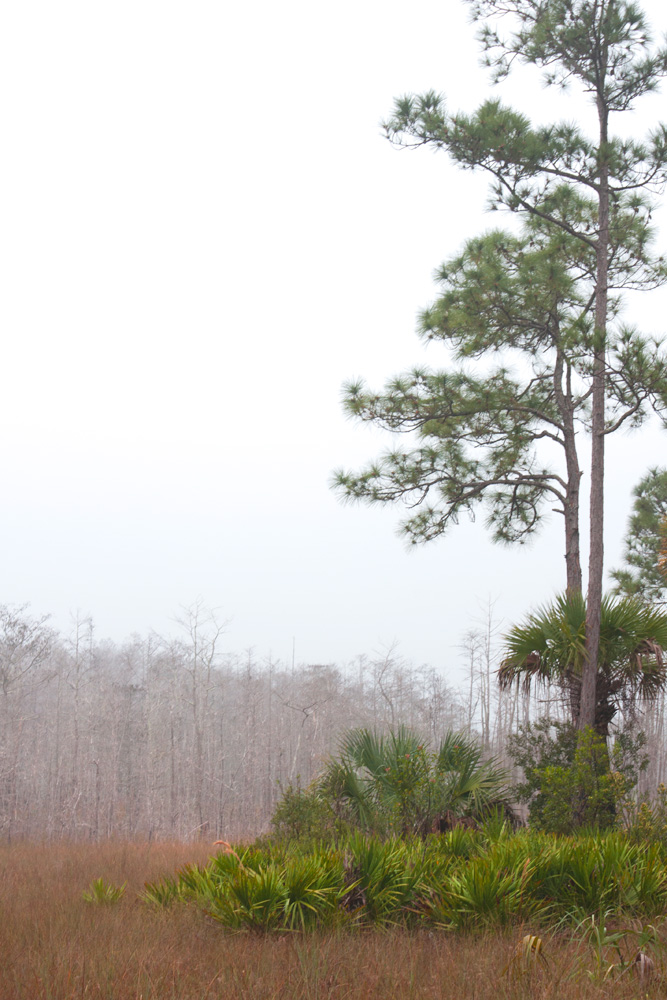
Every January, I lead a beginners' overnight backpack hike for the Florida Trail Association (FTA). The chapter I belong to maintains the section of the Florida trail that begins at the I-75 rest stop (near mile marker 63) and runs north several miles. There are 3 loop trails (blue, red, and yellow) running from the main one (orange). Off the blue trail is a beautiful campsite called Carpenter Camp. It is located within a mixed pine and cypress forest that contains cypress domes and hardwood hammocks loaded with palmetto and cabbage palms.

Normally, I do not photograph with a DSLR while hiking. If I do bring it, I use it only from the campsite when I am free of the backpack and have time to wander away. This year, I decided to bring my alpha-700 (and leave the tripod home) with the intention of taking more photos while hiking as well as around the campsite. I decided to experiment in black and white this time.

Before heading out, I put the camera's "creative style" on black and white. Because I shoot in RAW format, I would not lose any color data; rather, I would simply view the photos in the LCD as black and white. Then, once downloaded into Lightroom, the photos appear with their color. The post-processing includes putting the photo back into black and white, but with total control over the data. If you shoot in jpeg, your black and white photos will remain black and white without color data.

The two days in the Big Cypress were perfect for my experiment. For the most part, the sky remained cloud-covered. This diffuses the light nicely. For a few of the photos, I noticed I had the trail marks in view. I decided to play around with that, keeping the trail mark color in post-processing. Here are a couple examples of that.


Later after setting up camp, I wandered into a hardwood hammock full of cabbage and palmetto palms. The palm leaves (living and dead) and the airplants were intriguing.  Here are a couple experiments with that (notice the blue trail mark in one photo).


While black and white was my goal, many of my photos remained in color. These were the photos shot in evening or early morning with the best light. The evening sky was filled with cloud patterns while the setting sun remained uncovered. The sweet light was irresistible on the swamp forest. Here are a few, all shot within feet of our campsite. 


Sunday, January 6, 2013

Experimenting with intentional camera movement


Last summer, I began using the intentional camera movement (ICM) technique to photograph mangroves on Biscayne Bay. Here is a link to my pbase gallery with some of those photos. More recently, I used the ICM technique while paddling in Charley Creek, located in the Ten Thousand Island area of the Everglades. I was there on a 10-day paddle trip through the Everglades and spent a couple days going into the creek. The purpose was to photograph birds, but conditions did not allow it as I wanted. While paddling through the dark mangrove forest, I was again inspired to try ICM to capture the mangroves.  On the day that I attempted these, the sky was mainly overcast, which diffuses the light through the forest. This is perfect for ICM for two reasons. One, it reduces the harsh contrasts and two, it reduces the overall light. This is good for ICM because the lower lighting accommodates the necessary slow shutter speed. And the lack of harsh contrast allows a nicer blend of colors and avoids the streaks of blown out whites.

Here are some photos from my experiment. All of these were taken with a 0.5 sec shutter speed and f/22 aperture. The photo above was made with a faster movement than the next two below. You can see a greater blur effect as a result on photo one. I like the colors added by the canoeist. For photo two and three below, I attempted to capture a wide angle that included the creek and the mangroves that line it. Notice the grayness on the edge of the creek in photo three. That's low tide mud!


For this next photo, I focused on the large mangrove roots and zoomed out beginning at 70 mm. For all these photos, I am attempting to capture the mysterious darkness of the mangrove forest. Basically trying to make art out of chaos.


For more about our 10-day trip, I wrote a story and include a slide show of photos at my website cmierphotoandfitness.