Sunday, May 27, 2012

Albino Yellowcrown Nightheron

What are the chances of sighting an albino bird in the wild? Wikifacts says the probability is 1 in 17,000 in humans if that is a clue. Whatever the probability is, I found one on Biscayne Bay. It was alone (while other groups of birds had been photographed within a mile range of the shoreline), busily foraging for crabs. After spending a few hours photographing various birds including the yellowcrown nightheron, little blue heron, snowy egret, tricolor heron, white ibis and great white egret, I had put away the camera and started paddling for the sake of paddling. Not having quite gotten the photo bug out of my system, I spotted a white bird amongst some small mangroves in the water and thought I might have a chance at photographing the scene.


I paddled closer and headed toward a good light as the bird seemed content to stay in a small area between two mangroves. I approached within 100 ft in the shallow water and waited for a nice pose. Snap, snap, a couple shots were taken. At first, I thought it was a juvenile little blue heron or maybe a snowy egret. But the bird appeared odd, not quite having the body shape or the slender beak of a little blue or snowy. No, something was quite different about this bird. After the initial shot, I examined the photo in zoom on the LCD and lo and behold, the white feathered bird had flaming red eyes.


Wow! I had never heard of a white morph version of the nightheron but after a bit of research and soliciting an expert opinion of an ornithologist, it is concluded that this bird is an albino. The bird allowed me to get very close and I spent a solid 45 minutes with it until the water levels rose enough to cause the bird to perch in the mangroves. A once-in-a-lifetime chance, this was a special encounter.


Thursday, May 24, 2012

Green Heron on home turf

Lately, the rainstorms have been continuous making it impossible to get out on the water. Too bad because the tides this week were perfect for wading birds in morning light. Problem is, there has not been any morning light most of the time. Finally on Wednesday after a full day of rain, the sun peeked out in the evening. With the rains, there is flooding and there is an open area in my highly populated living community that holds pools of rain water. This is a beautiful thing to see as the green grasses intermingle with the water and the buildings and trees offer some interesting reflections. Come evening, the light on the water pools is irresistible.

The community bird, the musgovy duck is attracted to these pools; and so are the white ibises. I have photographed these birds many times here. I sprayed myself with bug repellent, grabbed a foam mat and headed over there about 5:30 pm thinking I might capture some ibises or some of the baby ducklings that are in great number right now. The ducklings were there as expected, but there was an unexpected visitor this time, a green heron.


At first, the bird spooked, despite my careful approach and flew to a near by tree. As I sat on the mat and captured some ducklings in the water, the green heron eventually came back. The bird was going after two food sources, flying dragonflies (dozens of them flitting over the water) and tadpoles in the water. Soon, the bird had forgotten about me and got within 10 feet. I was shooting at 120mm at one point.

I rarely capture green herons while in the canoe, in fact I doubt I have a green heron photo from the Everglades (from the canoe). The only place I have captured them while in the boat is on Biscayne Bay and I can count those encounters on one hand. Why is the green heron so elusive? It's a small bird, relative to other herons and egrets and it hangs out in the shadows of the mangroves most of the time. Though I may see green herons flying about or creeping around the mangroves; and I hear them often, rarely do they allow me to capture them with the following criteria: good light, bird not shadowed or covered, and background is not busy. But, if I do have the good fortune to capture the green heron with these criteria, the bird often will cooperate and allow several shots of it preening or fishing.


And so it was today. I spent about an hour with the green heron and the musgovy ducks before the clouds and trees covered the sun.

Tuesday, May 22, 2012

Egret and Pelican Rookery: Feeding Time


I think that feeding the chicks is the most difficult and energy-requiring task of the adult parent. Having seen many great egret chick feedings, it can also be concluded that it is risky and can cause significant injury to both chick and parent. Upon closer inspection of photos, one can see peck wounds along the beaks of adults and chicks. And no wonder, the great white egret beak is a weapon.

With more than one chick to feed, there is a constant battle. I learned that birds secret the hormone corticosterone (a stress hormone) that stimulates begging (most likely it stimulates hunger), which in turn increases parent provisioning (obesity in humans is correlated with cortisol levels, I wonder if there is a connection). Nevertheless, the success of feeding depends not only on prey density but also on this hormone. One chick often dominates and is fed more successfully than the smaller sibling(s). The parent flies in and does not begin the feeding right away. Rather, the adult will stand over the chicks that are begging and jutting their necks upward toward the adult's face. The adult stands erect and it is as if it is teasing the little ones that are working hard to get closer to the adult's beak. A chick will finally reach the adult's beak and within a split second, the adult is pulled downward with chick attached, beak to beak. The second or third chick will attempt to get in there and as seen in the photo below, both are clamped onto the adult while regurgitated food is transferred to the chick.


After about a minute of this, the adult will pull away and resume its erect position. Mean time, the siblings squabble and then commence with the begging. The process repeats itself a few times before the parent has enough and flies off leaving the little beggers behind.


Pelican feeding does not appear as violent. Instead, the chick can place its entire head into the adult's poach. Below are two photos of a rather large juvenile getting fed by its parent. It looked as if the chick did not have any siblings. This is a good thing for the chick because without competition, it will receive all the food and learning opportunities from the parent. Bon Apetit, petit oiseau!


Thursday, May 17, 2012

Egret and Pelican Rookery: the Hustle and Bustle

Nesting adults work very hard. Chicks must be fed, nests must be reinforced continuously as chicks grow and adults have to eat too. With all that, school is in as the adults must also teach the chicks to fly and forage. At the rookery, I watch all this activity and with several visits can observe the progress of the pelican and egret families.

Because of lighting and wind protection, I have a narrow range from which I can photograph the bird activity. The highest concentration of brown pelican nests are located on the periphery of the island cluster that serves as the rookery. Although the pelicans can be photographed in good morning light, it is the exposure to the open bay that makes it difficult to photograph them. And during my most recent visit, there were strong easterly winds. Despite that, I gave it a try before the winds increased. The concentrated pelican nest site is noticeable from a distance as I crossed the bay. In the early morning hours before the sun burns high above, the adult pelicans (and 1-2 yr old juveniles) are busy flying to and from the island. The morning light on their brown wings is quite beautiful. I love their landing and take-off wing patterns and can spend long periods of time attempting pelican flight shots.

As I paddled toward the island, I could not resist the temptation to photograph the pelicans, but in less than ideal conditions. In early light (around 7 am), a high noisy ISO (had it at 1600 at one point) is required to keep the shutter speed reasonably high (1/640 is the slowest acceptable which incurs a nice wing tip blur). But with my boat being broadsided by the winds, a sharp image was unlikely. Consequently, these photos are for journal purpose only.


I moved over to the more protected area where I spend 90% of my time while at the rookery. From this vantage point, I can observe several great egret nests. There was one couple that appeared to not have any chicks and may still have eggs incubating. Something was going on because one of the adults was frequently bringing in twigs. This particular nest was located in the best light, so consequently, they were the highlight of the day. Other nests around them clearly had chicks, some of them close to adult size.


During this visit, I had few ideal opportunities to photograph the egrets. From my vantage point, I had rookery islands surrounding me, but only a relatively small portion of it located in the best light. As I sat in my canoe and waited for some action in the good light, lots of activity was going on to my right in a side light that shadowed the white birds. Most of the time, I sat waiting for that perfect shot that would take advantage of the warm morning light hitting the white feathers directly. This is most ideal with an easterly wind so that the birds display their beautiful wing spans as they land. Consequently, there are few photos in this collection illustrating the hustle and bustle of the egret and pelican rookery.


Tuesday, May 15, 2012

Egret and Pelican Rookery: Learning to fly

Mercury poisoning from agriculture has been a scourge in the Everglades for decades. Fish eat the mercury, birds eat the fish. The more favorable the hydrology is for concentrated prey, the greater the mercury exposure to the birds. I ran across a study that measured mercury levels in nesting great egrets and white ibises in 2006 (excellent breeding conditions) and 2007 (below average breeding conditions). I was expecting to get very depressed while reading the report. Given that great egrets are "upper level trophic piscivores" (not only that, they are fish eating animals high on the food chain), their exposure to mercury during excellent breeding conditions would naturally be high.


The report found high mercury levels in these birds, especially during excellent breeding season. The great egret experiences the brunt of it, while the "lower trophic level generalist" white ibis does not consume much mercury. However, in the great egret chick, most of the mercury gets routed into the growing wings. This might be because feathers represent the majority of growth in the nestling. Once fully grown, feathers lose their blood vessels and so whatever mercury is in the feathers will stay in the feathers. Because of this, the chicks are buffered from the poison. In fact, bird feathers are used as indicators of heavy metal pollution. So the good news from the report is that the mercury does not have a negative impact on these birds, at least in the short term.


At the rookery this past weekend, I watched several great egret and brown pelican chicks exercise their not-yet-fully-grown wings. Upon examining the photos, you can surmise that stages of growth that occurs. The feathers, which are nothing more than extensions of the skin are comprised of remiges and coverts. Remiges are the large flight feathers that we love to photograph so much. These are often referred to as primaries (the outer wings) and secondaries (inner wings). The coverts are smaller, closer to the bird's torso and form an outer layer of insulation. When you look at the nestlings wings, you can see that the coverts are not formed yet, leaving the remiges exposed. The underside of the great egret wings look more like skin than feather.

The first two photos below are egret nestlings. The first was shot this past weekend and clearly shows the lack of covert feathers on the bird. The second photo was shot approximately 1 year ago. You can see that this bird's feathers are more developed and appear more adult-like. The third photo shows an adult.


Not to forget the brown pelican, the nestlings are also working hard to spread their wings. The first photo shows a juvenile that is close to fledging. The second photo includes two juveniles at different stages; one not yet able to leave the nest and the about-to-fledge juvenile. Notice the adult hunkered in its nest. The third photo again demonstrates a young nestling exercising its small wings. Compared to the first photo, this baby has a ways to go!


Monday, May 7, 2012

Bird photography challenges

Finally got out on Biscayne Bay on a beautiful, calm and mostly cloudless morning. Barely a hint of wind, it never felt too hot, although it did reach 86 degrees. Given the incoming tide all morning, it was a good time to head over to the rookery as no wading birds would be wading with the rising water levels (perigee moon effect making it stronger than usual).

This particular rookery is by far the most challenging of all the bird areas I photograph from the canoe. There are several of them (some unique to the canoe) but the greatest is the shyness of the birds. In short, they hide from me and their flight patterns are affected by my presence. Consequently I have to demonstrate extreme patience in hopes that if I sit still long enough they will forget me and come back into sight. Or I can face away from the tree island rookery and settle for only flight shots as the birds fly in and out. Even that is difficult as the birds' flight patterns are often affected by my presence.

At any rate, I try my hardest to capture the cattle egrets (mostly) in good poses and I am going for that particular shot where all the elements come together. Consider that these birds are mostly in the mangroves (unless it is a flight shot), so the elements I am looking for include the following: good lighting, frontal view of landing or take off, no mangrove leaves covering the bird in any way, sharpness, head turned enough toward camera, and enough sky background to see the bird well. With all these criteria, I rarely get "that shot".
Nevertheless, I keep trying and in the meantime, here are a few different poses of the nesting cattle egret, including one juvenile. None of these is "that shot" but they at least illustrate the busy life of a nesting cattle egret.


Tuesday, April 17, 2012

A weekend in the Everglades

The last possible weekend to camp and the winds once again foiled our plans to get out to the gulf. With expected 25+ knot winds clocking from the NE to the SE during the Easter holiday weekend, we decided to head down to Flamingo and car camp. Not our first choice by any means, but it did provide us the opportunity to explore various locations, including land sites where I might photograph birds with my feet on ground.

The 3-day excursion began early Friday morning at the Coot Bay Pond launch site. From there, we headed across Coot Bay into the Mud and Bear Lakes. Three years ago, I went into Mud lake to photograph a flock of flamingos in the dead of summer, see photo above. This time, there were no flamingos and the wading birds and lone white pelican would not allow me within a couple hundred feet. There were several flocks of American Coots but they also are very shy around boats; here's one photo of a raft of coots.

As I leisurely paddled around, Vivian fished and while I rarely capture fishermen and their catch, this time she was catching snook continuously that it became inevitable that I get a photograph.

The next day would be totally different. The winds calmed down enough to give us reason to head out to Florida Bay. With the outgoing tide, the mud flats grew in size and that meant the shore and wading birds would have lots of space. It's a bit tricky photographing on the bay with the outgoing tide. Florida Bay mud is like quicksand and you don't want to spend your entire day waiting for the tide to reverse so you can set yourself loose (getting out of the boat is not an option). I have learned to focus attention on a bird, but to stay attentive to the water levels. In most other places, like Biscayne Bay, I need not worry much about that and can lose myself in the birds while the water under my boat disappears. But here on Florida Bay, that's a recipe for disaster. Not only that,the winds became more intense out of the east and after a few hours, would force me out of the water. In the meantime, a few photos were captured. Here's a high key shot of a cormorant, would much preferred an open wing pose. The next two are common shorebirds on the flats; a curlew sandpiper and a willet.


Later that day as the winds continued blowing, I walked to Eco Pond. It was late afternoon and the lighting was beautiful except for frequent cloud cover. There were several black necked stilts and some greater yellowlegs in the pond. The stilts did not come close, but the reflections on the pond were irresistible. Here's a couple shots.


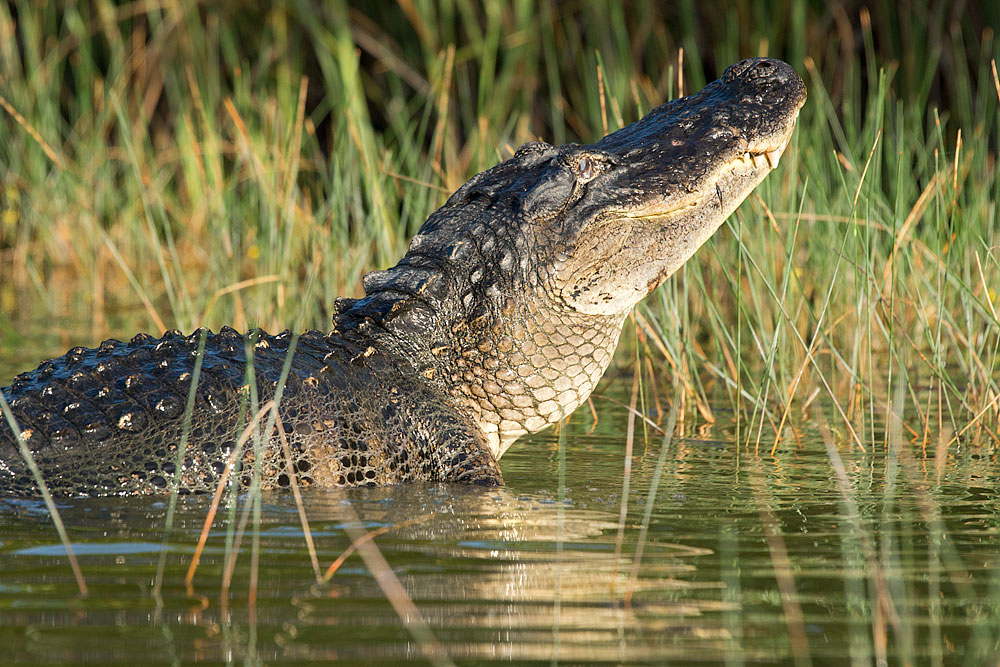
Early Sunday morning we broke camp and drove to 9-mile pond. The black vultures were there in great number to greet us. We launched in a beautiful morning light. Soon, it became evident that the territorial male gators were working their territories. Vivian hooked a spotted gar only to have 2 gators come after her catch. Safely away from that encounter, another gator spooked under her boat causing a scary wake. In the meantime, I was following a couple large lizards that were heading towards a well lit grassy bank. It was a beautiful set up for photographing and I waited for one to get into a good light. But then, one ran out of the water onto the bank as the larger gator chased it. Shortly after, the classic territorial gator bellows began. Here's a shot of one big guy as it bellowed, arching its back and head out of the water. Sitting in the middle of the lake, it was a surround sound of gator bellows, enough to cause me to put the camera away and clear the area.

In the meantime, the lovely vultures were pecking away at the rubber lining along the bottom of my car doors. They are notorious for this, but luckily, we stopped them before they did damage. If they weren't so dang cute...

Another great weekend in the Everglades.