Thursday, September 22, 2011

Low Key


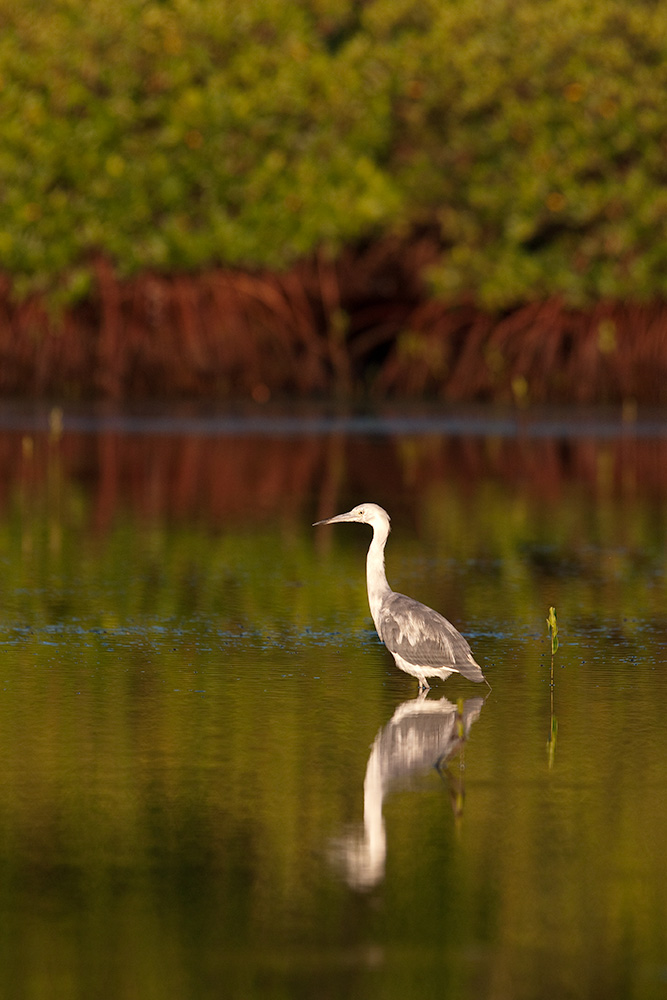
Two versions of bird photographs come out of my Biscayne Bay visits. On one side of me are the high key images. On my other side, are the low key images. For this blog, I present the latter. Both are appealing to me because a bird stands out well from its surroundings in either version. In the low key version, a white bird stands out exceptionally and ironically, is an easy capture regarding exposure settings. It may not appear that way at first given the great contrast between the bird and its surroundings.

How does one expose such a scene? Simple, expose for the bird and underexpose the surroundings. I find that matrix metering (also known as evaluative metering) works quite well for this. In the morning light, the mangroves foliage and prop roots and their reflections tend to be midtone or slightly lighter than midtone. Dark tones prevail in and around the roots and where the water is not reflecting anything. So overall, it is a midtone scene. If I know I am going to photograph a white bird (egret, adult ibis, very young little blue heron), I compensate about -1 stop, using manual exposure (this amount of compensation may vary between cameras). For darker birds that contain some white, such as tricolor or little blue heron, I compensate about -1/2 to -2/3.


There is one small area that I love to capture these birds. The mangroves barely receive the light because of a few small trees sticking out into the water that cast shadows on them. This leaves the water in front of the mangroves clear of shade and when a bird comes into that part of the water, it is lit up with light while the background is dark in shadows. This is a very cool effect as it allows the bird full exposure while all else goes dark. Some of the prop roots and mangrove seedlings in the water will appear in a shadowy form. The best parts are the reflections, especially from the bird. In calm, debris-less water, it is striking.

Once I know I have the right conditions and birds, I attempt to capture the bird in interesting or dynamic positions and with catch light in their eye. These opportunities vary according to the type of bird. For instance, the tricolor heron is a great subject with it's large yellow feet and striking pose. The ibis is a bit more challenging, but the long down-curved beak gives the bird an interesting profile regardless of what it is doing. The ibis forages nervously and is almost always moving. If you are lucky, you will capture the bird with prey.


Once I hone in on a bird or two or three, I have a range of area I can work with from one position. Remember, I am in a boat, staked out or anchored in one spot once I have my ideal scene. I find that with the sun directly behind my back, I have about 90 degrees of freedom to work with (45 degrees to the left and to the right of me). Outside of this, the side lighting is ineffective. Certain birds will cooperate better and stay within this light range most of the time. The ibis and little blue heron are good examples. The great white egret and tricolor heron tend to move along, which means I have to follow them, not easy to do in a boat. The best condition is when the water is shallow enough for me to move the boat with my foot. Having long legs pays off sometimes.

The shadowy mangroves and the reflections give off an impressionist type of feel as the greens and reds tend to flow into each other. I love the scene and with the right positioning of the bird in the frame, it is beautiful to me. I use the mangroves and reflections as a means of framing the bird.

I have a direct approach to post processing. Because the camera is dumber than my eyes, I need to work the image a bit to get back what I saw with my eyes. With the correctly exposed bird in the frame, I will either bring out some of the light on the mangroves and the reflections using some curves and dodging, or I will darken the surroundings so that only the bird and its reflections appear. The two photos below demonstrate these techniques. The first one was darkened, although I left the reflections in the foreground. And the second is where the mangroves are as much a part of the scene as the resting egret.


Sunday, September 18, 2011

Thank you Juanita Greene, Lloyd Miller and Lancelot Jones


I wrote 5 years ago, "Biscayne Bay is where I feed my soul. It is conveniently close to my home that it seems spiritually reckless to think of it in such a way. After all, we find inspiration in those individuals who have shared their stories of spiritual awakenings through nature while traversing dangerous mountains or paddling treacherous waters in remote areas of the world. To the contrary, Biscayne Bay casually shoulders up to Miami. The presence of the city is a constant reminder that we need to nurture our wilderness with all our hearts as we live our urban routine. When I am in the city, I know Biscayne Bay is with me, like a good friend that might say goodbye one day."

And for Biscayne Bay, I thank those three great people, Juanita Greene, Lloyd Miller and Lancelot Jones. Without one of them, this park would not exist and an oil refinery would sit where I now photograph the bird rookeries. Where fishermen now chase bonefish in the shallow flats, freighter boats would instead be moving in and out of the deep water port. But because of the brave voices that stood up for Biscayne Bay, it became a protected park monument in 1968. In 1980, it became a national park, over 180,000 acres worth.

There are two unique qualities of this national park. A major city lays adjacent to it and 96% of it is water. And let's not forget the Turkey Point nuclear plant and Mount Trashmore, both located on the edge of the park. Maybe it is especially for these reasons that Biscayne Bay must be carefully watched over and cared for. As the park management moves toward expanding the no-motor zone on my beloved bay waters, I think nostalgically over the years that I have spent exploring this bay and experiencing its highs and lows.

From one vantage point, I have been reminded of our urban reality:


But from another, I share this reality with you:


Sunday, September 11, 2011

So Juvenile


Sometimes, there are so many birds to photograph on Biscayne Bay on any given morning that it is like an endless buffet, all you can eat. Last weekend proved to be that; and now, one week later, I am writing my fourth and final blog entry describing my fun with the birds that weekend. While the gulls and the great white egrets served as main courses, the handful of juvenile ibises and little blue herons were the soup de jour. Almost always available to photograph, I find the juvenile LBH to be more beautiful than its adult counterpart. This is likely due to the difficult distinction between an adult LBH and its surroundings on the bay; whereas the juvenile LBH stands out with its white (soon to turn blue) feathers. They also tend to be less shy and allow me to drift close. Here are a couple photos from that weekend and a couple more from previous days. Interestingly, the first two photos are the same bird taken on separate days.


The juvenile white ibis is also quite beautiful. Opposite to the LBH, the juvenile stands out less so on the grassy waters compared to the adult. But this can vary depending on the juvenile's development stage. While the youngest of them present mostly brown feathers, the older juvenile contains more white feathers. But making them more beautiful is how the brown and white feathers intermingle. It appears the head and neck are the last of the feathers to turn white. It also appears that the brown feathers turn white but leave a darker outline along the edges of the feather, leaving a pattern that you do not see in a fully grown ibis. Here are a couple photos for the weekend.


And just for comparison, here are adult versions.


Wednesday, September 7, 2011

The greatest of egrets

On my second day of the weekend on Biscayne Bay, I was expecting a repeat of the first day. As I mentioned in my last post, the laughing gulls took over the area. Today, it was the great white egret that commanded the most attention.

I have to admit, with the exception of the egret rookery on Chokoloskee Bay, the great white egret has not been a favorite subject of mine. There are a few reasons for this. First, unless the egret is busily catching food or flying above, it tends to be stagnant and its long neck pose borders on a cliche scene from Florida outdoors. And it can stay in that position for endless amounts of time. Second,the great white egret is not normally a social animal, it tends to forage alone. Many times, I see several great white egrets in the shallows of the bay, but there is almost always a great distance between them. Third, they tend to be very wary of me and my boat and can scare away easily.

On the other hand, of all the birds I photograph on this bay, the great white egret has surprised me the most with its willingness to overcome its shyness. And I have to say that this summer has been full of surprises. When this happens, I can sit in my canoe watching an egret strut past me within 10 feet. I can make a loud noise and it does not scare. I can pass by it without it flinching. This is when the great white egret becomes one of my favorite subjects to photograph.


On this morning, I had the surprising good fortune to be in the close company of several great white egrets. I was out on the bay by 7:30 am. The sky was covered in dark clouds that were moving quickly north, soon leaving me with intermittent clear and cloudy skies. With an interesting combination of lighting conditions, I chose to not take out the flash today. Instead, I saw an opportunity to capitalize on the diffuse light that comes with clouds and which, when exposed correctly, can provide optimal light for birds. I have to admit, I have some photos here where I wished I had taken the time to use the flash. the back lit shots below are good examples of when a bit of fill flash would have taken the photo over the top. As it were, I had to use dodging and curve work to get the white bird to "pop" out of the white background. The results can be stunning with the flash. Just look at Arthur Morris's work to see how that works.

As I paddled over to the mouth of the creek that only yesterday was full of laughing gulls, I noticed a few great white egrets out and about, 3 hours before low tide. I found a good place to stake out where I had 3 birds in good view. They were also letting me get relatively close to them (about 80-100 ft). Soon, there were a few more of them. After several minutes, one or two of them got very close to me, within 15-20 ft. This is when it got interesting. I was soon surrounded by egrets, some in the back light, some with front light. I heard a splash behind me and turned to look in the direction of the sun. An egret within 25 ft had just captured a lizard fish. The back light (a bit to the side actually) lit up the scene. It was irresistible. I metered quickly on the water and compensated about +1. I rifled off several shots as the bird maneuvered the fish in its beak. Here are a couple of images.


The egrets were quite busy capturing prey. Blowfish, lizardfish, whatever they could find. What I am guessing is that these birds were juveniles. I am not sure why I think that other than the fact they were less shy than usual. Most juvenile egrets and herons are quite distinct from their adult counterparts. Take the little blue heron for instance; it starts out with white feathers that gradually turns to patchy blue and white and eventually all blue. The great white egret juvenile, on the other hand, is similar to the adult. Even in the nests the young birds quickly grow and become adult sized. This is quite alarming when you watch an adult attempt to feed the large babies.

When the food is plentiful, so are the birds. The egrets were filling up with food before the tide rolled in. I was lucky to be in the midst of it all. I had lots of various options for lighting and compositions. For those poses when the bird is not capturing a fish (just a pretty pose), I attempt to frame the bird with the mangroves and water. For these scenes, lighting and clean surroundings are critical and I go for these images when the morning sun lights up the mangroves and their reflections, such as this image and the first one shown above.


Today, the clouds covered the sun often, but leaving enough light that it could work. Here is when I attempted to capture the bird with as clean of a background as possible. This was difficult as the water gets messy with grass and wind current. At one point, I captured an egret that had caught a lizard fish. Another egret came along to steal it and the bird flew away. Here is a shot of it as it did so. You can see the diffuse lighting on the feathers, which is quite pleasing. Even with the sun high in the sky, the clouds help to neutralize the shadows and highlights. But, I do hope the bird photography police are not looking because this photo breaks a couple significant rules. First, it is flying away from the camera. And second, but not least of all, I cut off its feet. Oh well! I still like this photo for some reason.


Last, while experimenting with lighting, I am always trying to capture some action. Inevitably, that means a bird with prey in beak. For these shots, I want the bird's head to be turned toward me so I can capture the light in its eye. I would like the prey to be easily seen as well and water splashes and drops are a plus. The water can be complimentary by adding some dynamics or it can be distracting. For the first photo below, I love the reflections in the water. I also like the bird's position and the fish in its beak is easily seen. The water drops are a bonus. For comparison, the second photo is less dynamic, the water does not add anything to the composition. But, the bird's prey is of interest, it is a blowfish fully blown.


Not a bad weekend on the bay. So far, I have shown the gull and the great white egret and a smattering of other subjects. But wait, there's more. The ibises and the little blues did not disappoint. They are saved for the next entry.

Monday, September 5, 2011

The gulls are back in town

Opportunists to the nth degree, gulls can be so much fun to photograph. Despite this, they are often overlooked by photographers for the rarer or more colorful forms of birds. Gulls are common, they are seen often and in great numbers anywhere near ocean waters. Not the most attractive birds with there dullish gray and white feathers, they are frequently difficult to distinguish in terms of species and maturity.

Gulls have adapted well to human populated environments. Yes, they may frequent areas of trash and they can be bothersome on the beach. But watch an episode of "The Deadliest Catch" and notice the birds surrounding the boat that plows through 20-30 ft waves in freezing rain. How did those birds get in the middle of the Bering Sea under such horrible conditions? Apparently it is opportunity, and if you can't appreciate their willingness to swoop in and steal a leftover cheese curl next to you while you relax on the beach, at least appreciate that they are survivors as a result of that behavior.

Gulls are kleptoparasites, they steal from others. I first recognized this behavior while paddling in the gulf and noticing the gulls hanging around the brown pelicans that were diving and fishing. As soon as a pelican's pouch was full of fish, the gull swooped in attempting to capture the tiny fish that somehow would escape the pelicans pouch. I have watch gulls flying around a large raft of cormorants swimming in the shallow waters of Biscayne Bay. While the cormorants seemingly did nothing but drift, the gulls busily dove amongst them searching for food. I have sat in my canoe on the mudflat of Florida Bay near Flamingo where dozens of snowy egrets were foraging all around. Gulls were in great number and as soon as an egret captured something edible, one or two gulls would come after the bird; a chase would ensue in air and many times, the larger gull would get the goods.

Because of their common presence and social behaviors, gulls offer very interesting photographic opportunities. And sometimes, they present color (like the laughing gull in breeding plumage). Observe their social activities and what is often considered annoying becomes an interesting display of behavior that can only be captured frozen in time. Their interactions with each other always include facial expressions that are fierce and sharp with redness. The wing span displays a delicate design of grayscale from 0 to 255. Fear demonstrated in the face of one bird is palpable when another bird attacks its space, challenging its defense.

How can one not like these birds? I do and I was so happy to see hundreds of them in the shallow grasses of Biscayne Bay the other morning. This is the time of year that the laughing gulls migrate through, maybe to the Caribbean or South America. Or maybe some stay in the area. Whatever is happening, they are in great number and this all begins in August. On this morning, I was on the water by 7 am to watch the sunrise (or at least the clouds that covered the sunrise) over the water. Low tide was around 9 am and the grasses near the mouth of the creek where I spend many hours in the summer were becoming more and more revealed as the outgoing continued.

A few egrets, herons and ibises were foraging around as usual. But something much less usual was happening. The laughing gulls were flying in and landing in the grasses. Not long before 9 am, there must have been 300 gulls standing in the grassy water. For the most part, they were just standing and resting. But frequently, few would get into a tussle. Gulls continued to fly in and out. They appeared to not be doing anything but resting. Occasionally, one would swoop down at the grass and pick something up. But mostly, they were just standing, all facing east toward the wind.

Over time, more ibises began to forage around the gulls. Sometimes, a gull would harass the ibis with fresh caught food in its beak. And yet another display of kleptoparasitism was captured. The ibis, being quite territorial, seemed to always win against the attack of the smaller sized gull. Here are a couple shots of that interaction, captured as I was honing in on the ibis that just captured the lizard fish.


Among the gulls were juveniles, noted by the brownish color. I also noticed that some of the adults had red at the tip of their beaks; perhaps leftover from the summer breeding plumage. After some time, the tide shifted and the water levels began to rise. The birds were gone by 10 am.

That was on Saturday. I was back at the same place on Sunday, expecting to see the same thing, except the low tide was 1 hr later. Not one gull landed on the flats as the water levels sunk before 10 am. Not one. There were plenty of them flying over head, but not once did they stop. What was different about this day? What drives these birds to do what they do? It just goes to show you, you can visit the same place day in and day out but nothing is exactly repeated. So many variables, many of which we do not understand. That's what brings me back, again and again. Just like the fisherman that chases the bonefish day in and day out on this bay, I will attempt to learn it; and enjoy every moment of it even if I never figure it out.


Sunday, September 4, 2011

Not only for the birds


Foremost on my mind when I come to Biscayne Bay are the birds. After all, I see them in much greater number than all other possible subjects. But frequently, I find other animals and subjects to photograph. For instance, during the winter months, I find Portuguese man-o-wars floating in the water, looking much like a piece of plastic debris at first glance.

Occasionally, I spot a raccoon or two busily feeding along the shoreline at low tide.

Sharks are a common site, although it is primarily their dorsal and caudal fins that I spot, as they slice through the surface of the silky water in a graceful pattern owned only by sharks.

The golden silk orbweaving spider residing in the creeks can be the center of attention during those halycon mornings of summer.

The clouds are beautiful characters here in the subtropics, especially during the summer to fall transition months when rain and storms are a daily occurrence. This weekend, the clouds demanded acute attention as one does not want to be caught on the water during a lightning storm.
And then there are the fish. How does one photograph fish above water? Simple, the fish have to come out of water. It isn't that simple actually, but the fact that the mullet are running now helps. Mullet, otherwise known as baitfish migrate south along the Atlantic coastline starting around mid August and continuing this for several weeks. Mullet love to jump out of the water; although I doubt it is for the love of it as much as it is an attempt to flee a predator. At certain times of the year, like now, you can watch schools of mullet fly out of the water as they try to get away from the larger fish that are ravenous feeders; barracuda, tarpon, redfish, snook, etc.

I had two glorious mornings on the bay this holiday weekend. As the title says, it was not only for the birds this weekend. Mullet, blue crab and clouds were captured this time around. The winds grew steadily and messed up the water, and the clouds made the lighting interesting, challenging and sometimes dull. But it was a real holiday on the bay. Lots of birds photographed, but for this blog, attention is on all the other stuff going on. Below are a few photos from the weekend.