Saturday, June 18, 2011

Finding magic on the bay


I had low expectations today; SSE winds were relatively strong. Not so bad for paddling, but far more than enough to stir up the water to make photographing from a boat difficult. Low tide was around 6:30 am and a fast rising incoming would be complimenting those winds enough that I really did not expect to take many photos. From the Deering launch, I watched the sun rise over Chicken Key. There were enough scattered clouds to give the sky some color. Here is how the day started.


About a half dozen long necked great whites were scattered around the shallows near the launch site while the rising sun cast a beautiful orange on the water. Silhouettes of these birds feeding in the water are quite beautiful with the warm morning light. But as can be seen here, the rough water was not going to let this work.


I paddled out to face the birds with a back light. The sun moved in and out of small clouds, pretty much the entire morning. Of course this challenges my metering. I noticed some smaller birds clustered over by the people's dock. When I got there, I attempted to stake out my new pole. If there was only one item I could bring aboard my boat along with the cameras it would have to be the stake out pole (OK two items, I am legally required to have a PFD). I cannot photograph from my canoe without a stake out pole. Hands down, it is my most important tool for photographing from a boat. Sometimes, the water is too deep for it, but not often. My tried and true stake out pole recently broke (the tip broke off). Vivian made another, about 1/2-in thick pole used for holding up plants. It's made of steel and is flexible. I stuck it in the water and it caught hard rock. I tried to stake out but no use. The pole bent and when I tried to bend it back in shape, it broke. Long story short, with a rising tide coming in, I had no stake out pole and there were birds feeding everywhere. Fortunately, the water was shallow enough that I could plant a foot on the ground.


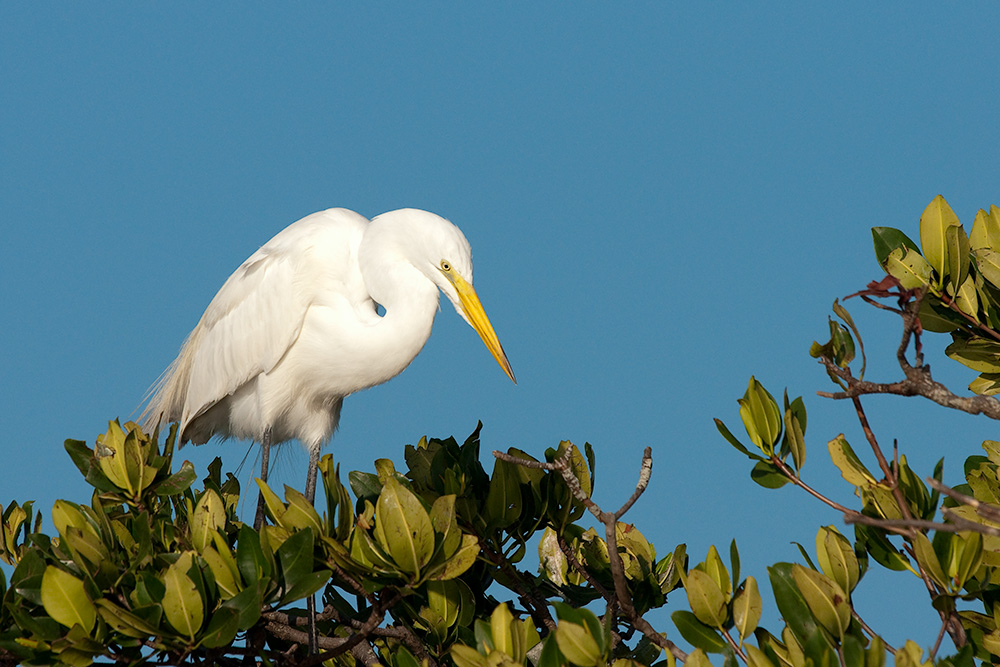
After some time, I headed back over to where the great egrets were still feeding. One bird was relatively close to me. I scoped it out and quietly approached it. GWEs tend to not have patience with intruders as a rule. But sometimes, you come on to one that is being so successful with fishing that it doesn't take notice of much else. It's simply focusing on the fish. Today, the birds were feasting on pinfish. This bird appeared to catch a fish at a rate of about 1 per 1-2 minutes. Lots of photo opps with this guy. Using my foot, I followed the bird along the shoreline. It continued moving parallel to the shoreline, never attempting to get away from me. After some time, it started moving closer to my boat. I was soon shooting at less than 140 mm.


The bird gave me lots of opportunities for various lighting effects and a combination of vertical and horizontal shots. The sun continued moving in and out of cloud, but mostly out. I must have spent a good hour with this lone bird until it flew off toward the mangroves. Just as well, the water levels were rising enough that I would no longer be able to hold my boat still.


I paddled on and decided to go into a couple of the creeks to find the golden silk weavers. They usually start coming out in the summer months. This is when you can paddle down a mangrove tunnel and see a continuous row of female spiders above your head. Today, I found several and many of them with their mate. The male spider is about a fifth of the size of the female. Here are a couple shots. The first is a couple with what looks like a cluster of leftover meals. The second photo is a shot of a female gorging on a beetle. Her head is buried in the bug's thorax.


Sunday, June 5, 2011

The seagrass bed of Biscayne Bay

The shallow bay grasses serve as a nursery to many marine species including crab and shrimp. As you paddle in the crystal clear water, you can see the grass covered sea floor quite clearly. Many living things hide in these grasses and often you see them. Occasionally, I come up on a southern or spotted stingray and I will watch it dart away gracefully. Recently, I watched a few infant bonnethead sharks swim around and follow our boats as we paddled north between Blackpoint and Chicken Key. Shark are a frequent siting here, much more often than dolphin and manatee. Last year's freeze killed many marine life. This year, things seem to be getting back to normal; I am noticing many more blue crab this year. This is good news for Biscayne Bay and all the life it supports.

Where there are shallow grass flats, there are birds. Today, I expected high easterly winds, but with the low tide at about 7 am, that would not pose a problem. The grass was exposed for an extended distance from the mangrove shoreline, meaning that the birds had lots and lots of space. This is more challenging for photography and sometimes, I wish I carried a 600mm lens on the boat (that would require a tripod). But then again, part of the fun is trying to see how close a bird or birds will let me get to them.

Today, there were a few cooperating birds, each very much involved with catching crab, shrimp, puffer fish and tiny bait fish. There were a handful of ibises at first, but then more began to congregate in an area near the shoreline and quite far away from me. Some yellowcrown nightherons (both immature and adults) were scattered about. One great white egret started my day as it fished at the edge of the low tide grass.

I focused in on a yellowcrown nightheron that has chased down a blue crab and caught it in its beak. For quite some time, the bird worked on the crab and would drop in in the grasses and then proceed to jab it with its sharp beak. Eventually, the bird had only the crab's body and soon would have it cracked open. I was not able to get close to the bird, maybe a 100 feet eventually (pushing my boat in very shallow water), and this photo below is cropped about 50%.

Almost camouflaged in the mangrove silhouetted waters was a green heron. It was working a small area and allowed me to come within 20 feet. I got as low as I could in the canoe and followed the little heron for about 30 minutes as it caught tiny bait fish.


One of the challenges with capturing birds in these shallow grass flats is to get a clean area surrounding the bird. As you can see in these photos, there are all kinds of grassy debris and mangrove sprouts interrupting the water. On the otherhand, the grasses can offer an interesting scene and after all, it is naturally where the birds are on this bay. I try to find a combination of clean and natural composition, one that illustrates the true Biscayne Bay. Enjoy these photos of Biscayne Bay grasses and the birds that thrive in them.


Monday, May 30, 2011

And now the brown pelican


From my weekend at the rookeries, I have spent a fair amount of time learning more about snowy egrets, great white egrets and cattle egrets (see previous 3 posts). Now, my attention again turns to the brown pelican. Following these birds for the past 3 years has been the highlight of my rookery photography. As much as I enjoy the egrets, it is the brown pelican that has consistently provided photographs and I enjoy watching them for hours at a time.

When I first arrived at the rookery this morning, it was barely 7 am and the sun was casting a golden light. This is a time of day for photography that I love but also find more challenging from a canoe. I do not like to use an ISO setting greater than 800, so this leaves me with no more than a 1/500 shutter speed at f5.6 when photographing the brown pelicans. I can get away with a much fast shutter speed with white birds. But during the early minutes of the morning, it is the brown pelican that I find to be most photogenic. They like to swim and fly early in the morning, so I often come up on the rookery noticing several immature and adult pelicans flying in to the rookery islands or swimming around the area. I was also fortunate to have an east wind, which meant that the birds would be making their flight landings while facing me, as seen in the photo above.

The slow shutter speed is fast enough to capture these birds sharply but also with some wing blur, which I like. Here is another photo. Sadly, the bird is missing a foot.


Soon after, I paddled closer to one of the islands which was mainly inhabited by pelican nests. There are a few nests that are low enough to be almost eye level. I can kneel in my boat while shooting, which provides me a 1- 1.5 ft higher perspective than sitting. And today, I had an incoming tide which meant that the water level would quickly raise up. Perfect for rookery photography. A few weeks ago, I blogged on the brood reduction hypothesis so noticeable among the brown pelicans. Here are a couple photos that clearly demonstrate the size difference within a brood. Notice the two smaller pelicans behind the big one in the first photo. In the second photo, the smaller sibling's face can be barely seen against the bigger bird's wing near the mangrove leaves.


While focusing on some egret nests, I noticed a pelican scene in an island about 100 ft away. At the top of the mangrove canopy, a couple pelican chicks were beginning to receive some food from a parent. The scene was beautiful with all birds mostly cleared of branches. The way the parent and babies were fluttering their wings, I had a wide horizontal shot and actually had to zoom out to 330-360 mm to avoid cutting off a wing, which you can see I did in the first photo.


Here is one photo after the feeding with the adult poised to take off, leaving its chicks to wait for the next meal.


Later in the morning, still focusing on egrets, I noticed an adult pelican flying into the water and swimming under the mangrove roots to pick out a branch and then fly it back to its nest in a nearby island. I paddled a bit closer as it was side lighted. By now, the sun was quite high and the lighting a bit severe. Here's a couple shots of the adult with some nest material.


I am not sure if I will be back to the pelican rookery again this year. I am content with that; it's been a very good season and everyday that I can visit the rookery is a good experience. My learning curve is still relatively steep in terms of bird photography; but as I live in paradise, I will continue to have many more learning opportunities while capturing the wonder of birds.

The snowy egret


Memorial weekend provided me quality time at the rookeries. I spent the first day on Biscayne Bay (see the previous post titled "Cosmopolitan bird") and the second day at the pelican rookery in the Everglades (see previous post titled "The great white egret"). During other visits to the rookery, I have watched several snowy egrets and rarely got an opportunity to photograph them. First, they are very shy, they hide well and their flight pattern changes to avoid an intruder. Second, their nests sit low inside the tangled mangrove branches where they cannot be seen well. And third, there are fewer of them compared to the pelicans and great white egrets. So capturing a snowy egret nest scene has been impossible. In my three years visiting this rookery, I've captured one shot of a snowy flying in with a twig in its mouth, the closest I have come to photographing a nesting behavior. And only once have I witnessed a snowy adult feeding its babies. Unfortunately, I could barely see what was happening over the mangroves and certainly not well enough to photograph.


I keep trying to photograph these yellow-slippered birds, graceful in their flight. They tend to fight amongst themselves and sometimes this is demonstrated with crest raising, a beautiful display of feathers. The snowy egret is a very fierce defender of its nest and the surrounding area. I watched one or two of the adults stand alert in a fairly high position on the mangroves and call out frequently with a sharp squacking tone, I suspect a warning to the other birds to stay away. But again, capturing any of this is so difficult, sometimes because of poor lighting and most often because everything gets in the way.


Today, I had a bit more luck with these birds. One thing they do often is forage around the muddy ground along the mangrove roots. If I am lucky enough, one will walk itself into good light removed from the shadows of the mangroves. Here's one shot, although the bird decided to stand alert as it felt exposed.


There were a concentrated number of snowys in one end of an island that is about 6 ft from the end of a second island. This was a challenging location to photograph a bird with lots of shadows and busy background and foreground. I managed a few flight shots but no interaction between birds. Notice the great white egret chick looking up, a frequent posture for those birds as they wait for mom to come back with food.


There were a couple juvenile birds in one particular spot. One was brave and stood out among the mangroves well enough to photograph. My first thought was that this was a juvy snowy egret; after all, it was among adult snowy egrets. Later, I was speaking with Jason, one of the eco tour guides in the Everglades and he thought it was a reddish egret. If it was, that would be quite a remarkable find. So I did some investigating when I got home. I found my answer in the Stokes field guide to birds book.

Reddish egret - all black bill
Snowy egret - bright yellow facial skin at base of bill clearly distinguishes it from the similar immature little blue heron
Little blue heron - gray facial skin at base of the bill clearly distinguishes it from the similar snowy egret

Here are a couple photos of the bird. What do you think? Definitely a snowy egret!


If I ever get a good shot of a snowy egret, I consider myself lucky. Generally, I do not see many snowy egrets close enough to photograph on Biscayne Bay or out here in the Everglades. Once, I sat for an hour in my boat near a lone snowy egret on Biscayne Bay. It was so intent on fishing that it barely took notice of me, only 10-15 ft away. Another time I was on Florida Bay in front of the Flamingo marina where a large mud flat was covered with birds. There were several dozen snowy egrets wading around; a one time event for me. What was so fun about this scene were the equal number of laughing gulls that would chase the snowy egret after it worked to capture a bait fish. In flight, one or more gulls would try to gang up on the snowy and steal its booty. Here is a photo from each of those lucky moments.


The great white egret

Along side the brown pelican nests are the great white egret nests. This year, I had a difficult time following these guys during my visits. The biggest difference between the pelicans and the egrets is that the egrets have much lower tolerance for intruders. My rookery rule is to get no closer than 50 ft from the edge of the mangroves (for the bird's comfort as well as to get a better shooting angle with a 400mm capacity). With some wind or current, I increase that distance because of the difficulty in getting my boat positioned properly. Staking out and/or anchoring while minimizing my disturbance is a test in patience and sometimes impossible. Today was not so bad and I was able to use the stake out pole (much easier to deal with than the anchor). Inevitably, the white birds become nervous as I approach, while the pelicans appear calm and unwavered. Consequently, I've remained farther away from them and have concentrated on the more accessible pelican nests.

Today however, the egrets were more visible in the nice front light. One reason is that the chicks have grown and are more easily spotted. This imposes yet another challenge and that is to get clean shots of birds that mingle with so many other birds. Nevertheless, I was able to focus on a few egret nests where 1 or 2 chicks lived while the adults flew in and out for feeding and other chick caring responsibilities.


Watching an adult egret feed its young is fascinating but not easy. The pelican feeding is quite unruly, but what makes the egret feeding so much more painful to watch is that the birds have very sharp beaks. This cannot be a pleasant experience for any involved. The adult must avoid getting a chick beak in its eye and in fact, I noticed one adult that appeared to have an injury possibly from an impalement. In the meantime, with 2 or more chicks fighting for food, they must also avoid getting impaled. From my observations, the chick clamps its beak onto the adult's beak, unlike the cormorant and pelican chick that is allowed to put its entire head and neck inside the adult's throat. For obvious reasons, the sharp beaked egret cannot let that happen.


The feeding ritual goes something like this. The adult flies in while the chicks jab vigorously at the sky. The adult stands tall for several seconds while the chicks stretch upward attempting to get to the adult's mouth. After a short time, one of the chicks manages to clamp onto the adult's beak and without warning, the adult bends down as each of the chicks attempts to get the regurgitated food out of its mouth. This lasts for several seconds and then the adult stands tall again. It stretches its long neck and points its beak straight up and holds this position for a minute or so. Then, the feeding begins again. I am guessing that the adult is doing this stretch to move the regurgitated food back up into its mouth.

After feeding, the adult manages to get away and looks relieved when doing so. After one chick was fed, I focused on it as it flapped its wings, obviously irritated that the parent had left it again. With these egret scenes, I went back and forth between horizontal and vertical shots. While focusing on this one young chick, I held the camera horizontally in attempt to capture its wings. What I realized afterwards is that a vertical shot would have rendered a much better shot. Case in point, look at the first photo below. A vertical frame would clearly have captured the wings in their entirety. Once again, I missed my shot. The next one is not bad and I was glad to have captured the scene with the right exposure and sharpness.


Like the pelican, survival rate among GWE chicks is as low as 25% during the first year of life. While the pelican chicks require 4-5 mon before reaching independence, the GWE chicks are on their own in 2-3 mon. Chick competition in the nest is fierce. The adult lays its first egg and will continue laying up to 6 eggs with 2-3 days between each egg laying. This is amazing to me because chick growth is fast and in theory (my theory) the preceding chicks could outsize the new chicks substantially. However, whenever I observe a GWE brood, the 2 or 3 surviving chicks appear similar in size. In contrast, the 2 or 3 pelican chicks within a brood vary noticeably in size despite only hours between hatches. The GWE lays about twice as many eggs as the pelican. My theory is that competition among the egret chicks is so great during the initial period that less than half survive, resulting in 1 to 3 strong chicks to continue growing. The smaller and weaker pelican may be able to hold on longer and continue growing for some time, possibly surviving the long haul. Growth of the GWE chick is so fast that they often look as large as the adults. Notice the similar size of the adult and chick in the first photo below.


Enjoy these photos of the absolutely great white eget.


Sunday, May 29, 2011

Cosmopolitan bird

I have sort of an affection for the little cattle egret. It lacks the grace and elegance of the great white egret, it looks like a chicken when it struts around looking for bugs to eat and it hangs out with livestock. I would never consider using the word cosmopolitan to describe the cattle egret; I associate that description with sophisticated, worldly persons, not birds that can be found just about anywhere in the world. But in that latter sense, the cattle egret is truly cosmopolitan. And I really like this bird.


Originally from Africa, the cattle egret came to North America in the 1940s. Now, they are found everywhere, including Alaska. In Florida, nesting locations are seen in most areas ranging from the panhandle to the keys. It is interesting to me that the landlubber cattle egret often chooses to nest on coastal islands along with wader birds that consume marine food. The cattle egret does not fish and rarely wades in water; rather it lives primarily on insects (lots of grasshoppers). Contrary to this, I have seen cattle egrets while paddling in the salty waters of the Everglades. Recently, there were two of them hanging out with terns and other shorebirds on Little Pavilion Key, a small spit of sand in the Ten Thousand Islands region. I've also have seen a few at the brown pelican rookery I frequent, also in the Ten Thousand Islands.


My affection for the cattle egret (species identified as bubulcus ibis) began four years ago when I unexpectedly found a cattle egret rookery on Biscayne Bay. Since then, I have observed and photographed the birds of this rookery while learning many things about them. I've observed the bird's work ethic as it maintains a healthy nest and raises 3 to 4 chicks and does so in a very short period of time. Incubation takes only about 3 weeks, chicks grow rapidly and within a week or two, can regulate their own temperature and are fully feathered by 3 weeks following hatching. They begin climbing out of the nest at about 2 weeks of age and are fully independent at 6-7 weeks. The cattle egret nests along side the cormorant, which also grow quickly, but appears to rely on mom and dad for a longer period of time, compared to the cattle egret.


With breeding, nesting and raising fast growing chicks, the adult cattle egret must work very hard. While the female tends to the chicks, the male is constantly looking for nest material. The first time I photographed the rookery I noticed how specific each bird was with its flight pattern. Within a 30-min span of time, one cattle egret can fly in and out of its nest over ten times. It was at this rookery where I began to spend quality time practicing flight shots. I've improved my ability to capture birds in flight and I have the little cattle egret to thank for that.
On this memorial weekend holiday, I arrive at the rookery early in the morning with a high tide. Given the location, I would need to use my anchor with water as deep as 10 feet. I was fairly well protected from the wind, but had an outgoing current. Once I anchored correctly, my boat was quite steady and I was able to stay in one or two spots during the couple hours I spent here.


The egrets share there rookery island with cormorants and tricolor herons, but they outnumber the other bird species easily 10 to one. There was much flight activity but not very many chicks in sight. Perhaps it is too early for them to leave their nests and begin climbing around the mangrove branches. Soon though, the babies will be climbing around the canopies of the mangroves and flying about, circling earnestly around the rookery islands as they test their newly formed feathered wings. They are more difficult to capture in flight than the adults that come and go in a straight line for the most part. The chicks learn to fly by banking sharply and circling around the rookery in an unpredictable manner. I try to track them with my lens but they are very fast and are quite aware of the intruder and will quickly turn away once I am sited.


For today, I concentrated on the adults. Enjoy these photos of the beautiful cattle egret.