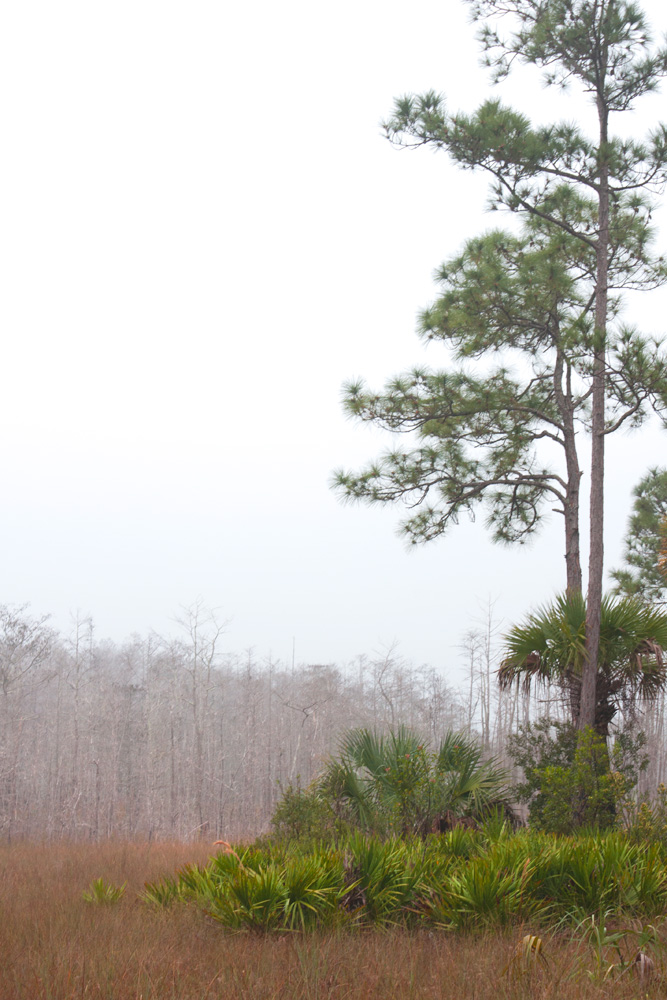
Every January, I lead a beginners' overnight backpack hike for the Florida Trail Association (FTA). The chapter I belong to maintains the section of the Florida trail that begins at the I-75 rest stop (near mile marker 63) and runs north several miles. There are 3 loop trails (blue, red, and yellow) running from the main one (orange). Off the blue trail is a beautiful campsite called Carpenter Camp. It is located within a mixed pine and cypress forest that contains cypress domes and hardwood hammocks loaded with palmetto and cabbage palms.
Normally, I do not photograph with a DSLR while hiking. If I do bring it, I use it only from the campsite when I am free of the backpack and have time to wander away. This year, I decided to bring my alpha-700 (and leave the tripod home) with the intention of taking more photos while hiking as well as around the campsite. I decided to experiment in black and white this time.
Before heading out, I put the camera's "creative style" on black and white. Because I shoot in RAW format, I would not lose any color data; rather, I would simply view the photos in the LCD as black and white. Then, once downloaded into Lightroom, the photos appear with their color. The post-processing includes putting the photo back into black and white, but with total control over the data. If you shoot in jpeg, your black and white photos will remain black and white without color data.
The two days in the Big Cypress were perfect for my experiment. For the most part, the sky remained cloud-covered. This diffuses the light nicely. For a few of the photos, I noticed I had the trail marks in view. I decided to play around with that, keeping the trail mark color in post-processing. Here are a couple examples of that.
Later after setting up camp, I wandered into a hardwood hammock full of cabbage and palmetto palms. The palm leaves (living and dead) and the airplants were intriguing. Here are a couple experiments with that (notice the blue trail mark in one photo).
While black and white was my goal, many of my photos remained in color. These were the photos shot in evening or early morning with the best light. The evening sky was filled with cloud patterns while the setting sun remained uncovered. The sweet light was irresistible on the swamp forest. Here are a few, all shot within feet of our campsite.
Photographing the natural areas of south Florida including Everglades, Big Cypress and Biscayne Bay
Monday, January 21, 2013
Sunday, January 6, 2013
Experimenting with intentional camera movement
Last summer, I began using the intentional camera movement (ICM) technique to photograph mangroves on Biscayne Bay. Here is a link to my pbase gallery with some of those photos. More recently, I used the ICM technique while paddling in Charley Creek, located in the Ten Thousand Island area of the Everglades. I was there on a 10-day paddle trip through the Everglades and spent a couple days going into the creek. The purpose was to photograph birds, but conditions did not allow it as I wanted. While paddling through the dark mangrove forest, I was again inspired to try ICM to capture the mangroves. On the day that I attempted these, the sky was mainly overcast, which diffuses the light through the forest. This is perfect for ICM for two reasons. One, it reduces the harsh contrasts and two, it reduces the overall light. This is good for ICM because the lower lighting accommodates the necessary slow shutter speed. And the lack of harsh contrast allows a nicer blend of colors and avoids the streaks of blown out whites.
Here are some photos from my experiment. All of these were taken with a 0.5 sec shutter speed and f/22 aperture. The photo above was made with a faster movement than the next two below. You can see a greater blur effect as a result on photo one. I like the colors added by the canoeist. For photo two and three below, I attempted to capture a wide angle that included the creek and the mangroves that line it. Notice the grayness on the edge of the creek in photo three. That's low tide mud!
For this next photo, I focused on the large mangrove roots and zoomed out beginning at 70 mm. For all these photos, I am attempting to capture the mysterious darkness of the mangrove forest. Basically trying to make art out of chaos.
For more about our 10-day trip, I wrote a story and include a slide show of photos at my website cmierphotoandfitness.
Sunday, December 2, 2012
Exploring the headwaters
Restoration of the Kissimmee River to its original flow is apparently the largest ecosystem restoration project in the world. For Lake Okeechobee and the Everglades, this means better water quality and improved wildlife habitat all around. What a deal. Over the Thanksgiving holiday, I was in the area of Lake Kissimmee visiting family. Vivian and I decided to check out the Lake Kissimmee SP and rent a double canoe for a Sunday morning. We spent about 3 hours on the water, photographing and fishing.
It was a beautiful wetlands marsh where powerboats and air boats can access the very large lake. It was very peaceful that morning, having only seen a few small powerboats and one airboat. We stayed in a rather small area near Tiger Creek. I had sited at least a few hundred American coots in the grassy waters, I mean they were everwhere. Several limpkins were hiding in the grasses, occasionally showing themselves in short flight. The usual egrets and herons speckled the landscape and I believe I watched two glossy ibises take flight from a distance.
The landscape, dominated by green and gold hues gave me the inspiration to use the "intentional camera movement" technique that I have been experimenting with on mangroves. Here is one creation from this experiment.
The highlight was watching a snail kite searching for food. Only managed to capture it from afar; same with the two bald eagles that circled overhead for a short period. Other than the fact we had to paddle a plastic double canoe that moved through the water like a barge, it was an awesome time on the water. Central Florida has so much to offer.
The landscape, dominated by green and gold hues gave me the inspiration to use the "intentional camera movement" technique that I have been experimenting with on mangroves. Here is one creation from this experiment.
The highlight was watching a snail kite searching for food. Only managed to capture it from afar; same with the two bald eagles that circled overhead for a short period. Other than the fact we had to paddle a plastic double canoe that moved through the water like a barge, it was an awesome time on the water. Central Florida has so much to offer.
Friday, November 16, 2012
Marsh chicken...
or otherwise known as the Common Moorhen. In terms of visibility, these red-beaked freshwater marsh birds fall somewhere between the very elusive clapper rail and the social American coot often seen in large rafts moving casually around marshy lakes. Like the coot, the vegetarian moorhen forages in the water and frequently makes head dives in search of food. Unlike the duck, their feet are not webbed and they fall into Sibley's search category of "chicken-like-Marsh". It is the adult's brilliant red beak and facial shield that make this bird not so common.
During my weekend into the Everglades marshes several weeks ago, I came up on a family of moorhens, 2 adults, 2 juveniles. They were busy foraging in a small area of the fast running stream that cuts through the marsh grasses. Quite windy that day, I managed to stake out with some effort and stay in one spot for a very long time to observe the active family. I was happy to find them on the second day and in good light. These are shy birds, but they allowed my boat to come within 6-10 feet of them. Common little birds they are, but in beautifully reflected water they make very nice subjects.
Saturday, October 20, 2012
Catching the low tide on the bay
Had to take advantage of the calm morning, with a low tide scheduled around 8:30 am. I expected to see many birds as the bait fish make there fall run through the bay. The water was smooth as could be except for the frequent interruption from schools of bait fish causing the water to bubble as they escape their predator. This is a good time to be on Biscayne Bay.
Early on, great white egrets were taking their place along the shoreline of grasses revealed.Typically, I see lots of great white egrets on the bay. Lately though, I have noticed many more juvenile great blue herons in the area. Rarely do I see more than one or two on any given day and it is even more rare to capture them. Of all the wading birds, the great blue heron is the most wary of an intruder in a boat. But today, I somehow got close enough to one as it fished along the shoreline. Enjoy these photos of Biscayne Bay's western shoreline.
Sunday, October 14, 2012
Back to the Everglades
This weekend seemed to mark a change in season, which got me thinking a lot about our camping trips. Instead of afternoon storms and early morning temperatures above 80 degrees, we got our first glimpse into what could be a windy season. We stayed in Chokoloskee Island for the weekend so we could take advantage of the beautiful weekend. No significant rains were expected, but the relentless northeast winds would prevail, and boy did they. Another nice change was the cooler temperatures especially felt on Saturday morning when we awoke to 65 degrees.
As always when we are paddling, the winds dictate our course of action. Rather than spend the weekend on and around the large bay, we decided to launch from Seagrape Drive in the Big Cypress Preserve (off the Tamiami Trail) in an area that would offer more wind protection. Here is an aerial map of the area.
I didn't expect to have much opportunity to photograph birds. The water levels are so high right now that the fresh water is flowing like crazy. Unexpectedly though, this fact became the best part of my weekend. From the Seagrape canal, I turned into a smaller creek that immediately led me into an Everglades sawgrass meadow. The creek that I paddled was quite deep and distinctly cut through the water-saturated meadow. Several water trails tempted me to explore the area, but I didn't need a water trail. With a moderate amount of effort, I was able to glide my canoe through the grasses.
I spent two beautiful mornings paddling around the area where mangroves intermingle with grasses and birds have lots of hiding places. Enjoy the photos from the Everglades.
Sunday, October 7, 2012
Columbus day weekend on the bay
Anyone in Miami with a boat recognizes this holiday weekend as being famous for the Columbus Day Regatta (a trademarked name that is now known as the BARDARDI Columbus Day Regatta) that is sailed on Biscayne Bay. This weekend marks the 58th anniversary of the regatta, which is the oldest organized event on the bay. The regatta is a sailing race, but over the years it has become associated with the infamous powerboat parties. Hundreds of powerboats anchor near Elliott Key which becomes Biscayne Bay's version of south beach. Everyone in Miami, including those that remotely pay attention to the local news recognizes this weekend to be the most dangerous boating weekend of the year. Alcohol/drugs, stupidity and boating never go well together and with so many boats on the water, the combination of these three ingredients is a common recipe for inevitable tragedy.
While all of that mayhem was happening offshore, I was on the western shoreline Saturday morning, quietly approaching the wading birds. It was dark when my canoe touched the water, but soon, the sun began to peer over the horizon that had already become speckled with boats. I wanted to come here as the low tide was suitable for lots of wading birds in that perfect morning light. I knew there would be more than the usual noises coming from the nearby boat channel, but the birds would still be there.
I paddled about 1/2 mile south of the launch area and there were plenty of birds lining the shoreline. Despite the nearby activity of powerboats and occasional helicopter flying over, it was peaceful as usual. Early on, I spotted the albino yellowcrown heron, but not to capture it. And surprisingly, the out-of-place mute swan flew past in a southerly direction just before sunrise. There appeared to be several young great blue herons actively feeding in the waters. At one point, I watched a flock of them (about 5) fly over. This was unusual, so I figured these might also be juveniles and perhaps there is a nesting site nearby.
So much bird activity on the water today. The tide was perfect as the low occurred at about 8:30 am, followed by a steady incoming that provided me another hour and half with the birds. By 10:30 am, the only birds seen on the water were a few great white egrets, large enough to wade in 6 or more inches of water. The smaller waders had all disappeared quietly into the trees, where they would be until the next low tide. All this happening, while another part of the bay was anything but peaceful.
Subscribe to:
Posts (Atom)