Wednesday, March 11, 2015

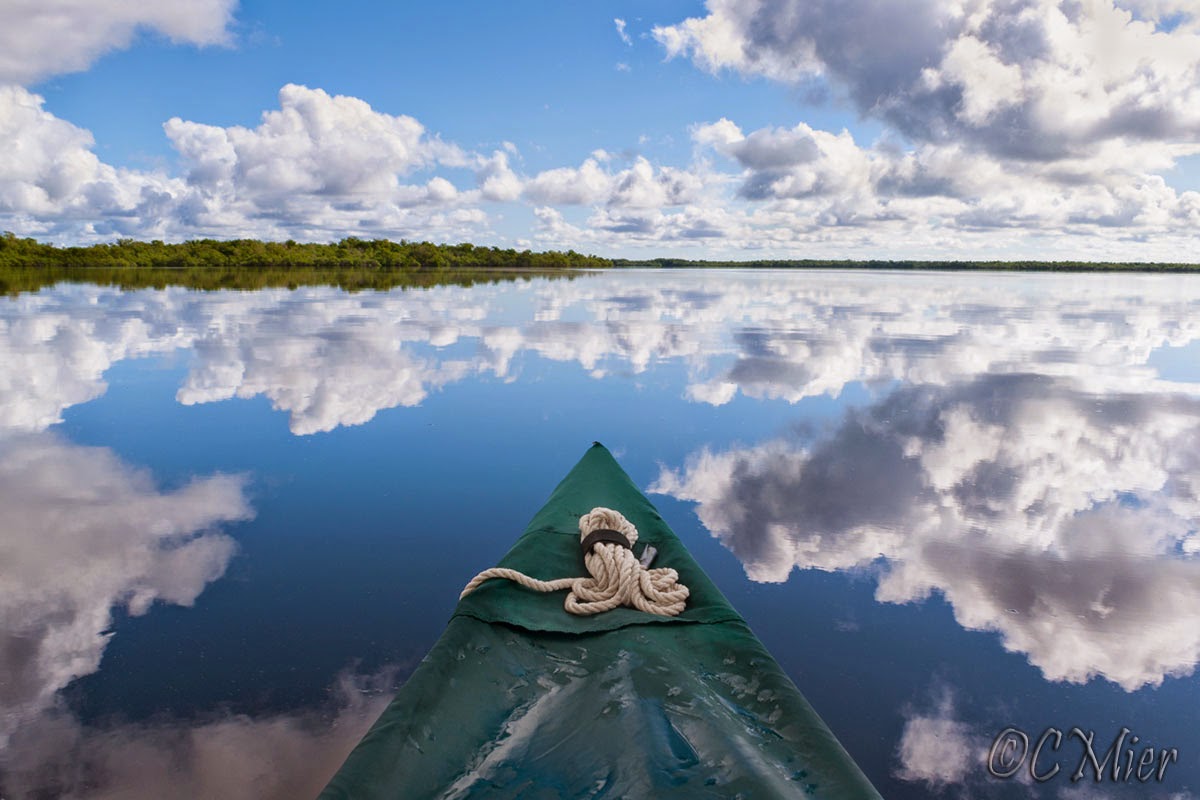
Clouds in my coffee


"Here are no lofty peaks seeking the sky, no mighty glaciers or rushing streams wearing away the uplifted land. Here is land, tranquil in its quiet beauty, serving not as the source of water but as the last receiver of it."  President Harry Truman"s Address on Conservation at the Dedication of Everglades National Park, December 6, 1947.

I was thinking about clouds this morning. If you pay any attention to landscape photography, you might notice that certain elements make a strong image. Color and lighting of course, water reflections, strong foregrounds,  mountains, and clouds to name some. I did a quick experiment, I went into 500px website and brought up the Editor's Choice for Landscapes. If you scan through the first 40 images, you'll find clouds to be a significant and many times the primary element of the image in 20 of those images.

Here in south Florida, the land is flat, there are no mountains or valleys. But it has clouds and wow, does it ever. Now, google search "Landscape photography Everglades". The two artists that will likely appear are Clyde Butcher and Paul Marcellini. Check out there images and you will find lots of clouds.

I've always liked to see clouds in my images taken while on the water or on a beach. But lately, I've been more critical of my images and have become more choosy when looking for images to take, all in the context of clouds. There are several ways clouds can improve an image. One obvious way is that they add texture and shapes to the sky. Here's one from Biscayne Bay as an example.


I often use clouds when photographing at the bird rookery where the sky forms the background. Darkish clouds on the western horizon that are lit up by the rising sun in the east really gives an interesting background to the white birds as seen here.


Clouds can add balance to a composition. You may have a strong foreground, maybe a tree in the middle and behind it the sky. Clouds can complement each of the strong elements in the image by filling a void.  Here are a couple examples.


During sunrise or sunset, clouds add color. So for those beach scenes that may or may not have strong foregrounds in them, I pray to the cloud gods. Here are a couple views at sunrise on Biscayne Bay and another at sunset in the Ten Thousand Islands. When I am in the Ten Thousand Islands, it is to camp, which means I am out there only during winter months. Winter skies in the Everglades can often be cloudless, so I pray a lot.


Maybe the most pleasing way of using clouds in an image is with water. Here in south Florida, you can capitalize on that. Wide open waterscapes prevail and the reflections are endless. Here are two examples.


Of course, storm clouds are a bonus and can make the entire scene. Dramatic clouds are almost always something to be thankful for when photographing. While I do not like paddling my canoe with an approaching storm, sometimes, they get close enough to capture. Here are a couple examples, the top from Biscayne Bay and the other from the Everglades.


I once heard a talk given by Clyde Butcher. He said in order to get a shot, he would often wait hours for the clouds. You may not want to do that, but always look to the sky and pay attention to weather forecasts. Once you focus more on clouds, the possibilities will open wide.


Monday, March 2, 2015

Two Nights in the Everglades: Tiger Key


My first night on Picnic Key began with a brilliant sunset. It had been a day of varying cloud and fog conditions that ended brightly before night set in. After a restful sleep, I woke to hear the low rumble of the crab boats heading out the channels, indicating the pre-dawn hours had begun. It was almost like music to my ear as I lie awake in my cozy tent. I began to gather up my gear and eat breakfast as sunrise approached. This was a lazy morning as I did not need to be on the water at any particular time having only a mile or two to paddle to Tiger Key. I would take my time and paddle around the large Picnic Key, attempt to set up camp early on Tiger and then spend the remainder of the day scoping the beach for dusk photography.

As the sun rose behind the beach, a haze of clouds formed on the western horizon. With the calm incoming tide, it looked mesmerizing to me, so I captured a few images, such as this one.


I walked the beach a couple times, looking at animal tracks. A couple of them seemed odd and I finally concluded that they were dog tracks, unwelcome animals in the park. But, people bring them anyway. By 9 am, I had dismantled the tent amidst the no-see-ums, packed the boat and headed out slowly around Picnic Key. By that time, the sky was mostly cloudless. I followed a couple dolphin for the longest time and while they are frequent companions out here in the gulf, I rarely get a shot of them, or at least one that I care to brag about. They were mostly in good light and after awhile, I caught on to their routine. This allowed me to get rather close to them as they worked the shoreline. At one point, I was close enough to catch the violent wake from their feeding freezy. Here are a couple images, best I could do that day.


I headed over to the western shoreline of Tiger. No one was on the island. I set up camp, and around noon, I sat under the shade of my tarp eating lunch and enjoying the view. Two kayakers had left Camp Lulu Key and were paddling toward the southwestern tip of Tiger. Soon they were out of sight. A nice southwesterly breeze was coming up on shore, which is exactly what I wanted.


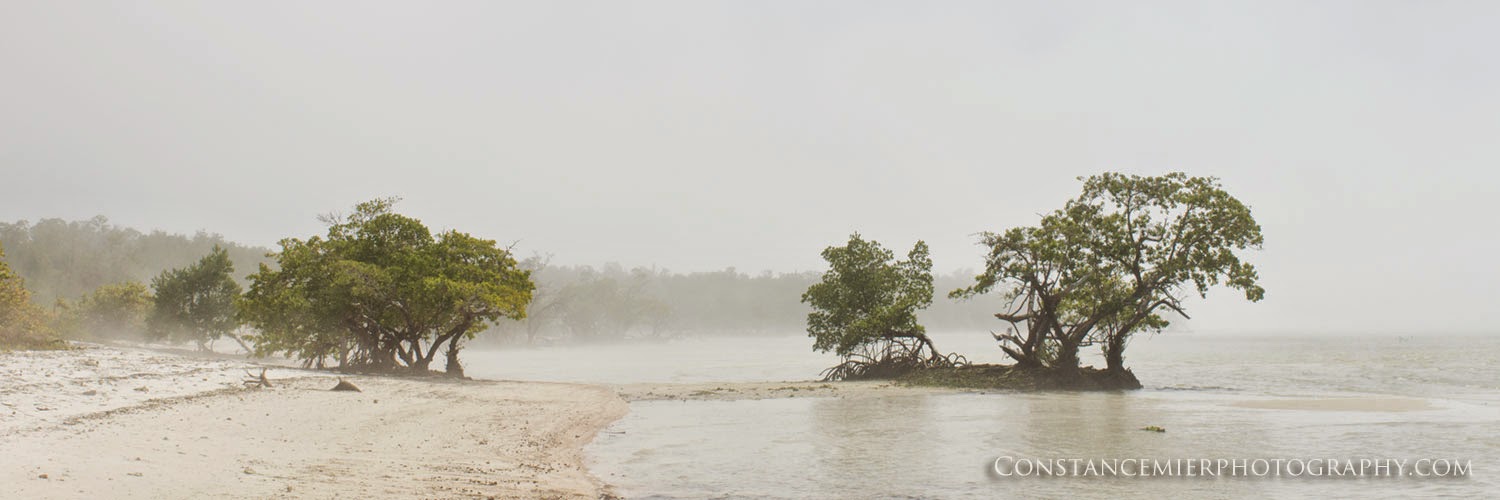
But then, something strange began to happen. A band of dark fog formed along the length of the southwestern horizon while a veil of clouds began to appear to the northeast. The winds increased and the sky became misty. A red kayak came out of the south end of the island and passed by as the fog gradually thickened. The wind came directly at the shoreline and brought with it a wall of mist. If I had not been on a subtropical island, the appearance of that mist would have sent shivers up my spine. It looked cold! I grabbed the camera and began to photograph the beach. Here are a couple images taken around 1-1:30 pm.


From Tiger Key's beach, one can easily see Camp Lulu. But within 15 minutes, it was completely gone, as was the kayaker that was paddling in the fog towards it. For the next couple hours, I walked up and down the beach and photographed. The scene was eerie and my visibility was not much longer than arm's length. Alone on the island, I felt a bit uneasy, but quite happy to be there. Everything looked dark and some things appeared black and white to me. Here is an image that I visualized in black and white.


As the air thickened with fog, the temperature dropped and the winds increased. If it were only fog, I would not have felt the slightest uneasiness. But the winds hitting the beach directly with an incoming tide caused a violent surf. It was not only the sight of the crashing waves, but the sound that continued into the night that made me nervous. These are not the type of waves I wanted to launch my canoe into. The sun, which was directly in front of the beach was not in sight for the remainder of the day. The day turned into night without a blink.


That evening, I sat in my tent listening to the forecast. Heavy fog was expected until about 9 am, but thankfully, it would be relatively calm with winds shifting to the south. If I waited until after 9 to get on the water, I would have to fight the outgoing tide through the channel leading back to Everglades City. If I left at 7 am as planned, I may be paddling through large waters in zero visibility, not exactly a comfortable situation. I prepared to paddle in the fog. I had my GPS with spare batteries in my pelican case. I had a headlamp, flashlight and a solar light. I had a map and compass if it came to that. And I would attach my VHF and waterproof-cased cell phone to my PFD.

I awoke before daylight and started packing and eating breakfast. By 6:30, the visibility appeared high enough that I could distinguish the sky from the water. Soon, I could see Camp Lulu, 1/2 mile away. All was well as I got onto the calm waters and began my paddle back to Everglades City. After 30 minutes of paddling, another dose of fog began to form over the eastern sky. I was in the middle of Gaskin Bay, paddling quickly to get into the creek before losing visibility.


But, the fog was gentle and passed by without a bother. Soon, I was heading across Chokoloskee Bay under clear skies and a gentle slack tide. And yet another memorable trip into the glades, and far from being the last.


Friday, February 27, 2015

Two Nights in the Everglades: Picnic Key


A few months ago, I wrote an article titled"Where the Canoe Takes Me" in the photography magazine Extraordinary Vision. The gist of the story was that I spend much time and energy exploring the Everglades with the intention of photographing in areas that are not easy to get to and return to the same locations with varying conditions. The reason being is that one specific place can appear so different from year to year, day to day, and hour to hour. Tides, water, storms, time, all of these cause things to change out there. And one specific location where I have been able to witness this consistently is the beach of Picnic Key.

Recently, I took advantage of the low wind forecast and decided to head out to Picnic Key. Picnic was the first island I camped on in the Everglades over 11 years ago. Since then, I have spent 14 nights in total on that island. It is also one of the most popular campsites and day-visit sites in the park. Why do I keep going back to it? Mostly, to photograph it. Each time I come to the island, it is new to me. My photography has evolved over the years and each time I go to Picnic Key, I come with new skills and knowledge, sometimes new equipment, and a fresh view of things. That, coupled with the fact that Picnic Key has also changed makes each visit a first.

To illustrate how quickly things change in the islands, I show here some images taken on the day I paddled to Picnic Key, from 8 am to 6:30 pm. To begin the eight mile journey to Picnic, I launched from Eveglades City and was greeted with this scene at about 8 am.


The haze was coming from the prescribed burn in the nearby Big Cypress preserve. At the same time, fog began to form out of the southeast. It did not take long before the entire sky was filled with smoke and fog. As the fog formed, I paddled across Indian Key pass and this interesting rainbow-shaped display of light appeared. It was 8:30.


By the time I reached the bird rookery islands, the fog lay heavily in the sky and visibility dropped to less than 1/4 mile. And it was dead calm. I stayed in the general area of the tiny islands in the bay and attempted to photograph the surreal scene, such as this one taken at about 8:45.


Within an hour, the fog began to lift and this scene greeted me at 9:15.


At last, I was heading to Picnic, riding the remaining tide out to the gulf. I paddled through a small creek that leads into one of the large bays. As I rounded a sharp corner, I looked up to the sky that had some remaining smoke clouds and was amazed at a very large flock of white pelicans soaring on the thermals. By then, it was 10:30. I got out the camera and captured as many images as possible. I positioned the camera vertically to try to capture the extent of their soaring height. An amazing bird with a wing span over nine feet, the white pelican is a favorite winter bird in the Everglades. They are now preparing to make their migration journey north in the next month. I can tell as many of them are already touting the large bump on the beak that is a sign that mating season will begin soon.


By the time I reached Picnic Key, the skies were mostly clear, as shown here. This was taken at about 12:00 pm. Notice the low tide conditions.


After a couple hours of resting in the shade, I observed a strange display of clouds beginning to form and spread out over the sky. The sun was now covered in a veil of clouds. Here is one view of this, at about 1:30. Also notice the incoming tide.


The sun remained covered for a few hours. With the reduced light, I decided to get out the filters and attempt some slow shutter speed images. Here is one that was taken at about 2:00.


Picnic Key beach contains leftover driftwood from various storms, particularly hurricane Wilma that caused extensive damage to the mangrove shoreline. Consequently, the rugged beach can be an interesting scene at sunset, but is also quite challenging with tidal effects. I have been attempting to photograph this beach for years and have yet to capture "the right moment". On this day, as dusk approached, the skies cleared. This was disappointing as I was counting on the clouds to offer some interesting light. Here is how the day ended on Picnic Key, images taken between 5:30-6:30 pm.


Happy with how the day rolled out, I spent a peaceful night camping under clear skies, listening to the breaking waves as another high tide would greet me in the early morning. The next day, I would take my time getting off Picnic and then paddle a very short distance to nearby Tiger Key where I had a mission to fulfill. And on that day, things changed even more dramatically. Part 2 of "Two Nights in the Everglades" coming soon.

Tuesday, February 17, 2015

A Bird Photographer in Downtown Miami


If there is one thing that I have learned about improving one's photography it is that getting out of the comfort zone is essential. Take bird photography for instance. As with any learning process, you go through a period when you climb the steep learning curve and see dramatic improvements in your bird images. Maybe there are one or two specific locations where you spend most of your time, allowing you to perfect your technical skills without having to learn a new location and where you get to know intimately certain birds species.

But what happens when you reach a plateau? How much more can you improve by simply doing the same thing over and over again? Of course, there is always room for improvement under any circumstance, but the learning curve is more horizontal than vertical. You can spend many hours reading about bird photography, studying other bird photographer's images, watching YouTube videos on how to photograph birds and so on. These are all useful tasks. My suggestion is to step out of your photography comfort zone and try something completely different. Think of this as playtime and nothing more; no pressure.

Recently, I decided to step out of my comfort zone and attempt to photograph the buildings of downtown Miami. Keep in mind that I spend most of my leisure time in remote wilderness areas like the Everglades. To me, downtown Miami is much scarier and intimidating.  I had certain doubts as to my ability to walk around taking images without drawing attention.


It wasn't only the discomfort of being in a vibrant urban setting, but it was not knowing anything about architecture photography that blew me away. I could have read up on architecture photography techniques and studied images from those that have mastered it before I ventured out. Instead, I wanted to go into this little experiment as unbiased as possible. I highly recommend this approach when you attempt something new; a different lens, a new location, artificial lighting, macro photography, etc.


So what did I learn from my few hours spent walking around Miami? It really became clear that before taking the shot, visualizing a scene and paying close attention to how the frame interacts with the objects are necessities to good architecture photography. There are so many possibilities in compositions with repeating patterns, strong lines and distorted shapes in the reflections. Upon examining the images closer on the computer monitor, the direction of the lines became more noticeable and it was a task to determine how they should be positioned relative to the frame. Here are a couple images to illustrate my naive attempt. these were cropped to come up with what I thought were the best compositions.


The color blue dominated as the mostly clear sky reflected on the windows. One thing I attempted to do in some of the images was demonstrate a juxtaposition between the unnatural and the natural, commonplace in Miami. Here are a couple images to illustrate this attempt.


One other thing came out of this exercise and that is architecture photography seems to work best in the extreme ends of focal lengths. Here are a couple images where a telephoto lens might come in handy in order to emphasize detail or fill the frame with repeating patterns.


The lens I used is a 16-50mm; however, it is attached to a 1.4X cropped sensor camera. Therefore, my longest focal length appears like 70mm. But, even at 70mm, I still had to crop some of the images to fill the frame, such as this one below.


On the other end, a wider angled lens would be perfect to capture an entire building or dramatize the height of the building. Here's an example where I think a wider angle would have worked better.


Although the color blue dominated, I looked for contrasting colors. The red construction cranes worked nicely for that, as seen above. Here's another image where green and blue complement each other.

I said that visualizing the scene first is essential to architecture photography. But of course, it is essential to all good photography. I just think that architecture has some unique challenges that force you to look at how the frame interacts with objects that are within the frame. Getting use to doing this will only improve your bird photography or whatever the photography subject may be. I doubt very much that I will dedicate myself to architecture photography, but after going into this experience cold, I will spend some time studying it, go back and try it again with an educated eye (or vision) and maybe a different lens. And what I learn will go with me when I photograph birds from my canoe.