Tuesday, May 15, 2012

Egret and Pelican Rookery: Learning to fly

Mercury poisoning from agriculture has been a scourge in the Everglades for decades. Fish eat the mercury, birds eat the fish. The more favorable the hydrology is for concentrated prey, the greater the mercury exposure to the birds. I ran across a study that measured mercury levels in nesting great egrets and white ibises in 2006 (excellent breeding conditions) and 2007 (below average breeding conditions). I was expecting to get very depressed while reading the report. Given that great egrets are "upper level trophic piscivores" (not only that, they are fish eating animals high on the food chain), their exposure to mercury during excellent breeding conditions would naturally be high.


The report found high mercury levels in these birds, especially during excellent breeding season. The great egret experiences the brunt of it, while the "lower trophic level generalist" white ibis does not consume much mercury. However, in the great egret chick, most of the mercury gets routed into the growing wings. This might be because feathers represent the majority of growth in the nestling. Once fully grown, feathers lose their blood vessels and so whatever mercury is in the feathers will stay in the feathers. Because of this, the chicks are buffered from the poison. In fact, bird feathers are used as indicators of heavy metal pollution. So the good news from the report is that the mercury does not have a negative impact on these birds, at least in the short term.


At the rookery this past weekend, I watched several great egret and brown pelican chicks exercise their not-yet-fully-grown wings. Upon examining the photos, you can surmise that stages of growth that occurs. The feathers, which are nothing more than extensions of the skin are comprised of remiges and coverts. Remiges are the large flight feathers that we love to photograph so much. These are often referred to as primaries (the outer wings) and secondaries (inner wings). The coverts are smaller, closer to the bird's torso and form an outer layer of insulation. When you look at the nestlings wings, you can see that the coverts are not formed yet, leaving the remiges exposed. The underside of the great egret wings look more like skin than feather.

The first two photos below are egret nestlings. The first was shot this past weekend and clearly shows the lack of covert feathers on the bird. The second photo was shot approximately 1 year ago. You can see that this bird's feathers are more developed and appear more adult-like. The third photo shows an adult.


Not to forget the brown pelican, the nestlings are also working hard to spread their wings. The first photo shows a juvenile that is close to fledging. The second photo includes two juveniles at different stages; one not yet able to leave the nest and the about-to-fledge juvenile. Notice the adult hunkered in its nest. The third photo again demonstrates a young nestling exercising its small wings. Compared to the first photo, this baby has a ways to go!


Monday, May 7, 2012

Bird photography challenges

Finally got out on Biscayne Bay on a beautiful, calm and mostly cloudless morning. Barely a hint of wind, it never felt too hot, although it did reach 86 degrees. Given the incoming tide all morning, it was a good time to head over to the rookery as no wading birds would be wading with the rising water levels (perigee moon effect making it stronger than usual).

This particular rookery is by far the most challenging of all the bird areas I photograph from the canoe. There are several of them (some unique to the canoe) but the greatest is the shyness of the birds. In short, they hide from me and their flight patterns are affected by my presence. Consequently I have to demonstrate extreme patience in hopes that if I sit still long enough they will forget me and come back into sight. Or I can face away from the tree island rookery and settle for only flight shots as the birds fly in and out. Even that is difficult as the birds' flight patterns are often affected by my presence.

At any rate, I try my hardest to capture the cattle egrets (mostly) in good poses and I am going for that particular shot where all the elements come together. Consider that these birds are mostly in the mangroves (unless it is a flight shot), so the elements I am looking for include the following: good lighting, frontal view of landing or take off, no mangrove leaves covering the bird in any way, sharpness, head turned enough toward camera, and enough sky background to see the bird well. With all these criteria, I rarely get "that shot".
Nevertheless, I keep trying and in the meantime, here are a few different poses of the nesting cattle egret, including one juvenile. None of these is "that shot" but they at least illustrate the busy life of a nesting cattle egret.


Tuesday, April 17, 2012

A weekend in the Everglades

The last possible weekend to camp and the winds once again foiled our plans to get out to the gulf. With expected 25+ knot winds clocking from the NE to the SE during the Easter holiday weekend, we decided to head down to Flamingo and car camp. Not our first choice by any means, but it did provide us the opportunity to explore various locations, including land sites where I might photograph birds with my feet on ground.

The 3-day excursion began early Friday morning at the Coot Bay Pond launch site. From there, we headed across Coot Bay into the Mud and Bear Lakes. Three years ago, I went into Mud lake to photograph a flock of flamingos in the dead of summer, see photo above. This time, there were no flamingos and the wading birds and lone white pelican would not allow me within a couple hundred feet. There were several flocks of American Coots but they also are very shy around boats; here's one photo of a raft of coots.

As I leisurely paddled around, Vivian fished and while I rarely capture fishermen and their catch, this time she was catching snook continuously that it became inevitable that I get a photograph.

The next day would be totally different. The winds calmed down enough to give us reason to head out to Florida Bay. With the outgoing tide, the mud flats grew in size and that meant the shore and wading birds would have lots of space. It's a bit tricky photographing on the bay with the outgoing tide. Florida Bay mud is like quicksand and you don't want to spend your entire day waiting for the tide to reverse so you can set yourself loose (getting out of the boat is not an option). I have learned to focus attention on a bird, but to stay attentive to the water levels. In most other places, like Biscayne Bay, I need not worry much about that and can lose myself in the birds while the water under my boat disappears. But here on Florida Bay, that's a recipe for disaster. Not only that,the winds became more intense out of the east and after a few hours, would force me out of the water. In the meantime, a few photos were captured. Here's a high key shot of a cormorant, would much preferred an open wing pose. The next two are common shorebirds on the flats; a curlew sandpiper and a willet.


Later that day as the winds continued blowing, I walked to Eco Pond. It was late afternoon and the lighting was beautiful except for frequent cloud cover. There were several black necked stilts and some greater yellowlegs in the pond. The stilts did not come close, but the reflections on the pond were irresistible. Here's a couple shots.


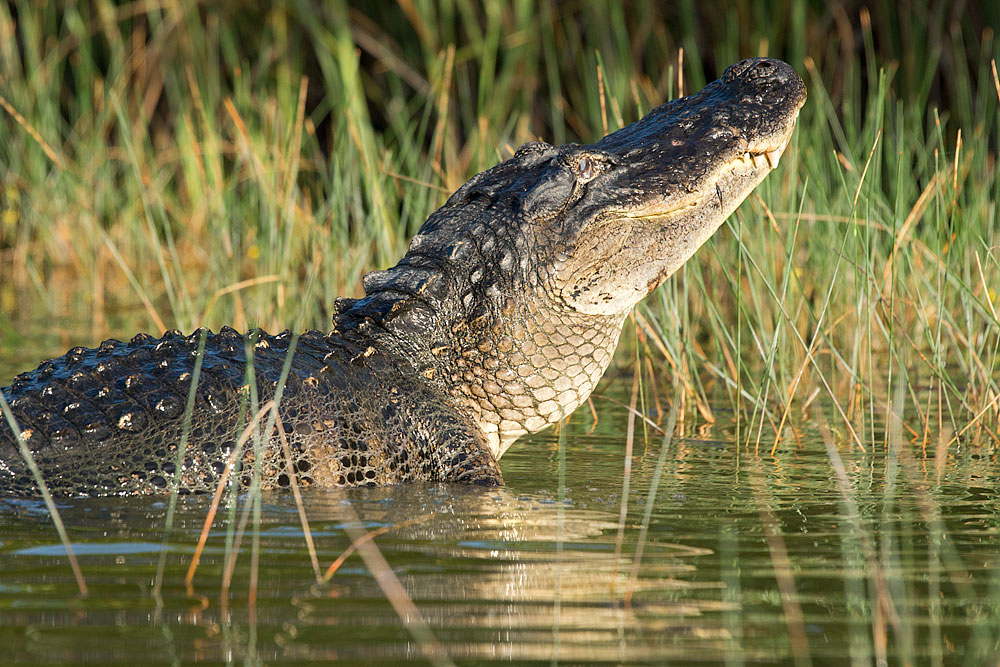
Early Sunday morning we broke camp and drove to 9-mile pond. The black vultures were there in great number to greet us. We launched in a beautiful morning light. Soon, it became evident that the territorial male gators were working their territories. Vivian hooked a spotted gar only to have 2 gators come after her catch. Safely away from that encounter, another gator spooked under her boat causing a scary wake. In the meantime, I was following a couple large lizards that were heading towards a well lit grassy bank. It was a beautiful set up for photographing and I waited for one to get into a good light. But then, one ran out of the water onto the bank as the larger gator chased it. Shortly after, the classic territorial gator bellows began. Here's a shot of one big guy as it bellowed, arching its back and head out of the water. Sitting in the middle of the lake, it was a surround sound of gator bellows, enough to cause me to put the camera away and clear the area.

In the meantime, the lovely vultures were pecking away at the rubber lining along the bottom of my car doors. They are notorious for this, but luckily, we stopped them before they did damage. If they weren't so dang cute...

Another great weekend in the Everglades.

Saturday, March 17, 2012

Summer already?


The temperatures have been unseasonably high this winter. What is generally a winter season speckled with cold fronts, has turned into a very mild, very breezy (typical) year. And now with daylight savings, it is beginning to feel a lot like summer around here.

And in summers, I spend much time on Biscayne Bay. That is what I did on this mid-March Saturday morning. Normally, this would be a camping weekend, but it just seemed nice to stay home for a change. And Saturday morning appeared to be a good time to get out on the bay. Recently, the park opened a canoe launch site on a canal that runs out to the bay near Deering. About 1/4 mile away is the entrance to the hidden lake on the north side of the canal. On the south side is a clearing where you can portage across the dirt road into a creek that leads into the bay in a southerly direction. That route cuts off about 1 mile to the sponge farm sticks and the rookeries, where I wanted to be this morning. Wearing my mosquito headnet, I got my boat into the creek and was on the bay early enough to see this scene.


I figured the clouds would eventually burn off, so I headed south toward the rookery, about 2 miles from the launch site. This was going to be a fact-finding trip more than anything, or so I thought. This is not the time of year I find myself on Biscayne Bay. I wasn't sure what to expect, but I figured if the great white egret and brown pelican were already nesting in the Everglades, the cormorant and cattle egret must be nesting here on the bay. In May, I begin my summer visits to the rookery and at that time, I don't see very many babies in the nest. I figured in March, the adults might be busy building the nest and setting up for a long summer of raising young birds.

I had a high tide this morning, with an outgoing the remainder the morning. No wading birds to photograph, I headed over to the sponge farm sticks where some terns and gulls were roosting. A few years ago, I started photographing birds here and had a great time with the laughing gulls. Their territorial antics are awesome to photograph in the right conditions. On a calm day, I can stake out the canoe close to the birds (gulls are so much friendlier than other birds) and take my pick at what to shoot. Typically, I do not see the birds in number until August or September. And always, they are in their winter attire. Here is one shot from a few years ago.


Today, there were a few royal terns and one laughing gull. This time, the gull was already in its summer plumage. I staked out about 40 ft from the birds, but the winds were a little challenging as my boat sat broadside to the winds. I somehow managed to turn it so that the bow was facing away from the wind, which decreased the rocking considerably. I set the camera to continuous shooting on Hi (8 fps) and started rifling off some shots. A friend in a kayak came up, and while I stopped to visit with him, a mild rain started. After putting away the camera, the rain came down harder, but only lasted about 10 minutes or so. It was beautiful on the bay. The rain drops on the water were illuminated as the sun was uncovered. A rainbow appeared on the south shoreline. This is when I wished I had a canopy or umbrella set up on the boat. I could have continued shooting with the beautiful rain all around. After the rain stopped, I pulled out the camera again to capture what was left of the rainbow.


Here are a few more photos of the laughing gull in its summer plumage. I was able to capture the bird in the warm morning light.


After spending time at the rookery (photos for another blog), I headed back to the launch site, taking my time. The tide had rolled out nicely and the wading birds were back in great number. I stopped to photograph some of them, despite the noonday harsh light. Before entering the creek to get back to the launch, I passed this scene. The bay at low tide is no place for a large boat like this. Someone is going to have a very long day ahead of them on the bay. I wonder what happened?

Sunday, March 4, 2012

The graceful white egret


"Hope" is the thing with feathers—
That perches in the soul—
And sings the tune without the words—
And never stops—at all—
Emily Dickinson

A beautiful morning with the great white egret in its rookery. Mating and nesting, the parent birds will soon have young ones to feed. Lots of work to do before all that happens, nests to build and maintain, in between the continuous sex to keep the lineage going. So much work for these birds that live strong, survivors of cruel human fashion trends and greed for space. For some reason, brown pelicans and great white egrets share their nesting space, quite respectfully I might add. Very rarely do I see a confrontation between the two distinct species. This is the time of year that these birds concentrate on passing along their genes, survivors of the fittest. For this blog, I will concentrate on the great white egret.


I sat in my canoe several dozens of feet away from the mangrove edge where the birds have built their nests. I arrived early enough to work with that perfect morning light. Clouds were many, but the sun remained clear most of the time. The darkest and most abundant cloud formations were in the western sky, so while the morning sun lit up the white birds warmly, the background was a beautiful combination of white, blue and dark gray, brilliantly contrasting the white feathers of the birds. And to top it off, the brisk winds was coming out of the east, somewhat southerly, which forced the birds to take off and land toward me.


I intended to spend most of the morning here and hoped to spend a second morning in the same place since I was staying the night at Chokoloskee Island. But, as almost always the case, the weather controls our plans out here. Saturday began easy as I paddled in a northwest direction to the rookery. The south winds were barely 5-10 knots. By 9 am, they had picked up considerably as I sat in the somewhat protected area of the rookery. While staked out, my boat would often be moved forward with the gusty winds that continually increased in strength as the morning drew on. It required patience to do any photography. By 10 am, the winds were sustained over 20 knots. I anticipated this and knew that my 1.5 mile paddle back to the launch site would be difficult and slow.

But before the time I had to leave, I sat in my canoe and enjoyed the birds. I watched many couples, but concentrated on one of the small mangrove islands where a few couples were in the best light. I was happy to have the Sony a77, 24 mp sensor that would allow some room for cropping. This means that I can capture the birds from a greater distance and still maintain high resolution with cropping. I attempted many flight shots as the sky lent a beautiful background to highlight the birds graceful form.

By 10 am, the lighting became harsh and the clouds more frequent. I decided to make the trek back to the launch site, knowing that I would not be back on Sunday. The forecast called for 30+ knot winds. I enjoyed the few hours I had with the birds and felt content as I paddled through 2-3 ft waves rushing toward my boat on the ride back. My pelican case that houses my cameras and lenses sat in front of me as the waves occasionally broke over the bow. The newly gained photos would make it back home safe as the pelican case was tightly sealed, waterproof and floatable if necessary. It has never come to that, and with confidence, I can take my canoe to glorious places to photograph. It's for the birds.


Sunday, February 26, 2012

A window of opportunity

It certainly has been a windy winter season, so what else is new in south Florida. With that, along with other distractions, I have made it to Biscayne Bay only twice this year. Finally, yesterday was the one day of opportunity and with good fortune, it provided calm winds and sunny skies. By afternoon, the winds were greater than 20 knots and continued that way for the remainder of the weekend. Perfect. Photos shot on Saturday, photos edited indoors on Sunday.

We launched from Chapman Fields, which begins in a canal that empties into the hidden lake. On the north side of the lake is a beautiful creek that leads out to the bay. On the water by 7 am or so, we came into the lake with the morning sun barely over the mangrove canopy. I headed into the creek and thought about coming in here on an overcast day with a tripod so that I could stand on ground and photograph the scene. The mangrove islets intermingled with oyster bars scatter throughout, make the path of the creek less obvious. As a result, it gives one a panoramic view of mangroves and water, rather than a narrow, mangrove lined creek. As these thoughts continued, I watched several birds feeding on oyster beds, hiding among the mangrove roots or flying above. I watched two woodstorks swirling overhead, a site I rarely see on Biscayne Bay. Ibis, little blue heron, tricolor heron, great blue; they were all in the creek.

The water was a bit slack as low tide was about 7:30 am; soon it would reverse. Just before getting out into the open bay, something large in the water near my boat spooked and made a big wake. It was likely the resident manatee, only a baby a couple years ago when we first spotted it in the creek. On the other hand, it could have been a large tarpon. Whatever it was, I was glad it was not directly under my boat as it made a rough wake.

Leaving the creek, I entered the bright, flat calm bay. The low tide was evident as several egrets and ibises were wading. Once the bay was in full view, I spotted a concentrated area of cormorants and laughing gulls. There must have been over a hundred gulls sharing a small area with about 50 cormorants. I stayed with them for awhile, attempting some high key shots of the cormorants.
I turned toward the mangrove shoreline that was glowing with the morning sun. As always, their reflections cast over the water giving it an impressionist feeling. The calm water provided perfect conditions to attempt some shots of the wading birds. I focused on a couple juvenile little blue herons. I thought they were juvy snowys, but I was fooled. Difficult to distinguish, the juvy little blue heron has a duller beak, grayish around the eyes, while the brighter snowy has a yellowish base at the beak. Nevertheless, they cooperated with me well enough that I stayed with them for a long time.
I had no reason to go anywhere else today, the tide was already rolling in. The wading birds were decreasing in number and with the rising waters, the two little blue herons flew closer to the mangroves, continuing to provide me good photo opportunities. With such conditions, I have two choices; at the low tide the birds are far enough from the shoreline that I can photograph them with only the surrounding water reflecting the shoreline. The other choice is to photograph the birds closer to the mangroves as the tide moves in, which provides some interesting textures, as seen in the two photos below and the first photo above. It becomes tricky as some of the background can look quite messy. Not a problem today. My goal is to frame the bird with the mangrove leaves and roots above or behind and their reflections surrounding the bird. The juvy little blue heron provides a nice contrast white to all of that.

Enjoy these photos from a beautiful morning on Biscayne Bay.