Tuesday, August 2, 2011

Birds on the oyster flats


This is a continuation of the previous blog, from my weekend in Chokoloskee Bay. I love paddling this area of the Everglades but it is an extraordinarily frustrating place to attempt to photograph birds, not to mention LEARN how to photograph birds from a boat. I basically began my photography from a canoe on Chokoloskee Bay. I didn't realize just how challenging this place could be until I started photographing wading birds on the easier-going Biscayne Bay location.

Here are a few more photos of a few bird species, other than the usual white ibis. The roseates are always seen here in the summer and almost always within a small range of the bay. Unless they are in the mangrove tree canopies, I most often see them resting on an exposed oyster flat. As this was a low tide morning, I knew they would be there, in the usual spot. The problem is, they tend to not do much and most of the time have their heads tucked under the feathers. Within a group, there is typically one or two that appears to stand guard watching the intruder while the others rest. Capturing them like this is a bit, dare I say, boring. They do let me get rather close though. Today, I inched myself closer (with one foot out of the boat) and got within 50 feet of the group. After a while, a loud powerboat came by (the birds are located relatively close to a channel), and was loud enough to bother the birds so that they flew away, leaving me behind.


I paddled to another flat where a juvenile yellowcrown nightheron was busy capturing tiny crabs. This bird had no problems with me being close and after several minutes with it, it came to within 10 feet of my boat. This was a challenging bird to capture as its feathers blended too well with the oysters. As it approached closer, I went in for the close ups, shifting between vertical and horizontal positions. I wasn't all together happy with the end results, but there were a few images that you can see the tiny crab in the bird's beak.


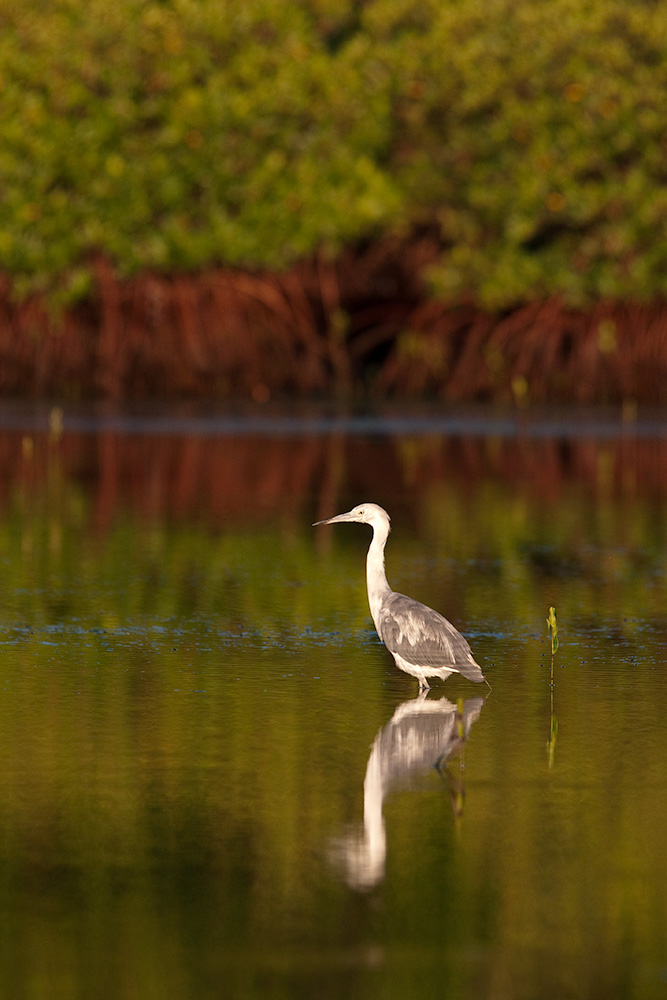
One last bird caught my attention, a juvenile little blue heron that I spotted feeding along the muddy edges of the mangroves. I let the current drift my boat slowly toward it, as it was in very nice morning light. The grayish blue and white body was tiny among the mangrove roots, but it contrasted enough to be seen well. I thought I would take my time drifting toward it and at one point, grabbed the paddle to maneuver the boat. Just at that moment, another juvy came flying our of nowhere towards the feeding bird and within a few seconds, both were flying off to another distant place. How irritating! Now, I have seen this before with pairs of tricolor herons. Just like this, I spot one bird and get rather close to it, then another comes along, scuffles with the first one for a few seconds, and then they fly off together far away. Why must they do that?

After spending time with the wading birds on the oyster flats, opportunities were declining so I headed toward the marina where many pelicans and terns rest on the pilings. More on that later.

Sunday, July 31, 2011

Mangroves, oysters and tidal currents

I spent an entire weekend on Chokoloskee Island (where I dream to retire one day). Mangroves and oyster go together well in this area of the Everglades known as the Ten Thousand Islands. The Ten Thousand Islands is a maze of mangrove islands and oyster flats that riddle the shallow bays, most especially prominent at low tides. While the bay can be a navigational nightmare for powerboats, it is loads of fun for fishermen in small paddle boats. Large fish stage themselves at the edge of the oyster flats, waiting for bait fish to run past on a tidal current or when the bait fish are trapped against a wall of oysters that halts the tidal current like a zealous traffic cop. Bait fish try to hide in the prop roots of the mangroves, and it becomes a common site to watch dolphin torpedo along the mangroves seeking them out. Shark are numerous, large black tips almost the length of my boat stalk fish in the shallow waters. That's under the surface of the water. Above the surface are the exposed oysters as the water levels decrease on an outgoing. What was once living underwater becomes exposed. Small creatures, like crabs the size of a newborn baby's thumbnail try to hide among the narly sharp oyster shells. And this is when the birds come out to feast on the oyster flat creatures. This is the time to be on Chokoloskee Bay.


The Ten Thousand Islands were born from the combination of minerals from the gulf stream and freshwater outflows from the Everglades, conditions that are perfect for oyster larvae. Oysters grow by attaching to the surface and do not move once attached. This is why they rely heavily on tidal flows to receive their nutrients. Food is brought in and waste is taken out. New larvae do best by attaching to an existing oyster shell that is firmly anchored. With that, oysters grow in number forming large colonies in shallow, tidal areas, such as Chokoloskee Bay, or mouths of creeks and rivers. With strong tidal currents, oyster flats become elongated and can make it difficult for a boat to pass through a narrow opening, especially at low tide.


From oyster flats come mangroves, primarily red mangroves. Mangrove seedlings do very well in oyster beds and can eventually take them over, as evident from the thousands of mangrove islands in the gulf. And if you can find logic in the confusing maze of islands in this area, it is that these islands are formed entirely on the whim of tidal currents and storm surges. It is within these islands that I learned how to photograph from my canoe.


The challenges are many. I do much of my photography from the canoe in two areas, Chokoloskee Bay and Biscayne Bay. While Biscayne Bay is soft and forgiving, Chokoloskee Bay is scratchy and irritating; my canoe has the ten thousand scratches to prove it. There is nothing more annoying than to hear the sound of a kevlar boat running across the sharp oyster shells. Like fingers across a chalkboard, only ten times worse. Unlike Biscayne Bay where I can lose attention to my surroundings and totally focus on a bird subject without caring for the well being of my boat, I must keep a keen eye on the waters of Chokoloskee Bay at all times. And with that, birds are often not as approachable as you would think. Hidden oyster beds serve as barriers as you attempt to float toward the birds that are feeding on an exposed bed. With the hard oyster shells all around, staking out is also very challenging and I often resort to sticking one foot out of the boat and into the shallow waters. But, it can be rewarding as birds take advantage of the exposed oyster beds that basically become a buffet table of marine edibles.


The oyster flats of the bay are not attractive and look like out of control mud. But there is something beautiful about all of it, especially with the prop roots of the mangroves and the reflections of the green leaves. A white bird (ibises are common here) contrasts against the dark muddy appearance of its surroundings. Surroundings are half the photo. The challenge to me is to create an image that has bird appeal; outstretched wings, interactions between birds, capturing and eating prey, etc. But, because I am enamored with the bird's surroundings, I also attempt to frame the birds so that the oysters are appealing as well. Not everyone can be as enamored with the oyster flats of Chokoloskee Bay as I am, but enjoy them as scenes from the Everglades you don't often see.


Friday, July 22, 2011

Great day on the bay part 2: variety of waders

I focused attention on the juvenile tricolored heron in my last blog, today I turn to the variety of other waders that were present on the bay two mornings ago. As soon as the sun was cleared of the clouds, the shoreline became illuminated from its rays. That's when I look for those photo opportunities of birds foraging in the shallow waters reflecting the mangroves. Today was ideal with calm waters. There were a couple of things I attempted today. First, I wanted to maintain as low an ISO as possible to minimize noise. I typically do not go above 800 and prefer to not use 640 or higher. But early mornings in a boat make that difficult without using a less than optimal shutter speed. The glow of the sun allowed me to begin shooting semi-white birds (tricolor heron, juvenile little blue heron) at an ISO of 640 and a shutter speed of 400. Not bad for when the bird is not moving much but as soon as it strikes the water, 1/400 will result in blurriness. I had started with a juvenile little blue heron and over a course of about 20 minutes, I was down a full stop using an ISO of 320. It shifted the histogram to the left, but I was happy with the results regardless. I was content with the shutter speed for this bird that never seemed to find a fish to strike. Here are a couple images with the classic mangrove reflections complimenting the bright bird.


The other thing that I attempted was to compose a shot of a bird with mangrove roots in the upper portion of the frame believing that this would add some depth and balance to the photo. Even more to the point, I love the look of the mangrove roots and their reflections in the water. I also like to capture a bird (preferably a white one) close to the roots so that they fill the frame. Whenever I look at such a photo, the roots always appear so much larger. Today, I had lots of options with many birds foraging in and around the smallish mangrove trees that form a barrier between the ocean and the shoreline. Here are a few shots that include the mangrove roots.


I spent the first couple hours following the tricolor herons, a green heron, some white ibises and little blue herons. The sun was high in the sky and the tide was rolling in. I expected to put the camera away and paddle back to the launch site. On my way, I noticed a great white egret looking for food. While the smaller waders pretty much disappear into the trees as the water levels rise, the larger egrets are frequently still out there searching. I paddled closer and figured if it lets me hang out close enough, maybe I'd attempt to capture some images. Sure enough, this bird was too intent on feeding that it barely paid attention to me. So I hung out with the lone white bird. Here are a few results of that encounter. The challenge was to stay between the bird and the sun and it was heading in a direction that made it more difficult to capture it with a good head angle toward the camera. The other challenge is that the sun and shoreline are not perpendicular to each other, so consequently I almost always have to do some kind of rotation to the image in post processing. When the shoreline is in the frame, it often is not running parallel to the ripples in the water created by the bird. But, that's a relatively minor issue when it is all said and done.


It was such a productive day that I barely noticed the intense heat during the 4 hours I was on the water. The great white egret was a perfect ending to it all. Almost always alone in its pursuits, here is another image of this glorious bird.

Thursday, July 21, 2011

Great day on the bay part 1: a tribute to the tricolor heron

Here's a quote I ran across: "Knowing trees, I understand the meaning of patience. Knowing grass, I can appreciate persistence." I'm inclined to change that to "Knowing nature, I understand the meaning of patience. Knowing birds, I can appreciate persistence." I think most bird photographers have two qualities in common with their subjects; patience and persistence. A bird requires them for survival, a bird photographer requires them for successful capture of a bird.

Without getting too contemplative, I simply want to convey what a fantastic day it was on the water. I arrived at the bay at 6 am, before sunrise. The water was dead calm and the eastern sky was congested with cumulus clouds (they are actually called cumulus congestus), as is the case every summer morning here in south Florida. During the initial minutes of sunrise, the sun is covered by these clouds but eventually they burn off with increasing temperatures. Here is how the day started:


The clouds burned off quickly and soon I was shooting with clear skies. Low tide was scheduled at 8:40 am, perfect for wading bird photography here on Biscayne Bay. I never know what I will find out here, but the bay never disappoints. Today was a bonanza of bird photo opportunities. It wasn't easy, I can't simply anchor my boat and stay in one spot. Rather, I have to follow the birds, sometimes hundreds of feet away. And at low tide, that often means pushing my boat with some effort through very shallow waters. The grasses provide an easier surface to glide across, but it is not easy. The worse part is when I get into a good position with birds, they move and then I am stuck having to push myself out of the spot and work my way back into another one.

But all that effort pays off eventually and today, it paid off big. Let's see, I captured a few ibises, a green heron, a juvenile little blue heron, a great white egret and a juvenile tricolor heron; over the course of about 4 hours. Each of these birds were a hit, but the star of the day was the tricolor heron.

For this blog, I pay tribute to this patient and persistent bird as it allowed me to get very close to it while it pursued its prey. I love photographing this bird because it offers so many styles of foraging behavior. It's quite dynamic and is almost always moving. Enjoy these photos of the young tricolor heron.


Sunday, July 17, 2011

Calm, clouds and heat


The combination of the three makes Biscayne Bay an awesome place. I love summers in Miami, only because it is when I spend most of my time on Biscayne Bay. A precious jewel to our city, few know that it exists beyond the few beaches that people frequent.


Today, like yesterday, heated up quickly and the breeze was absent all morning. The water was glazed with sunlight but the clouds and the reflections were dynamic. Using the polarizer filter on the 18-70mm lens, I played with the side light. Today, there would be no photographs of birds (a few spiders, but no birds), and I simply paddled around and photographed the clouds. Having a boat in the waterscape composition adds depth, at least you can appreciate the vastness of the bay. So I took advantage of having Vivian near by as she fished and captured her beautiful Hemlock canoe in the water.

I can be a little more care free taking these photos. I let the sun and its intense light do what it does best and that is to offer severe contrast to the clouds and water reflections. With that I shoot in just about any direction where the sun is at my side or in front of me at an angle. Enjoy these dreamy photos of Biscayne and imagine feeling the sun and the heat.


Friday, July 15, 2011

High key on the water


Dang it was hot this morning. With no breeze to speak of, it felt like being in a sauna. But the magic of the bay called and I had an opportunity to get out there on a weekday. On the water by 7 am, distant clouds seemed to be dropping water but these never appeared threatening. Rather, the thin veil of clouds the covered the majority of the sky burned away and soon, the sky was clear with only the distant cumulus clouds laying over the horizon. The water was like glass and Chicken Key and the distant city scape of Miami looked gray against the whiteness of the sky and water. This would be a good day to visit the sponge farms for high key, backlit shots.


Cormorants live in great number near the sponge farms and consequently spend time resting on the various sticks in the water. I love the scene and have been attempting to capture it with various bird poses and interactions. It is about a 2-mile paddle to get there, so I enjoyed the time it took to get there. Lots of baby sharks were swimming in the water and at one point a couple of them swam under the boat in a curious kind of way. I thought maybe the boat provided shade that allowed them to see their prey. Cormorants were flying around, some were in the water. The peace was breathtaking, no other boats, no planes making noise; all this allowed me to ignore the heat.

I arrived at the sponge farm sticks to find several cormorants hanging out. I wanted to see what I could capture there and also try for some flight shots. The combination of sticks and uncooperative bird poses made it somewhat difficult today. But I stayed long enough to capture a few good shots. As I've always said, these are pretty much what comes out of the camera. I set the exposure at + 1 2/3 and increased the ISO so I could keep a relatively high shutter speed for flying birds. For the most part, the sun was off-centered to the left about 25 degrees as I pointed the camera toward the birds. You can judge from the reflections in the water that the sun was not overhead, but low enough to provide some long reflections.

Sitting in a boat on the water while facing toward the sun as the temperature approached 90 degrees and without the benefit of a breeze gets to you after awhile. I had to leave and face the other direction. I decided to head into the creek to hang with the spiders. Those photos will come later. For now, enjoy these high key silhouettes of the cormorant. Here are a couple more with a little post processing. I added a low density yellow filter to the first one and the next two photos are in grayscale.