Sunday, August 23, 2009

Biscayne Bay: Storms and skimmers


What a weekend! Yesterday on Chokokoskee Bay offered some surprises and today, Biscayne Bay did not disappoint. Seems that this year has been more interesting than usual on the bay. I've spotted three birds that I have never seen here before; woodstork, black neck stilt, and today, black skimmer. To top it off, the summer storms have been fantastic to photograph from the water.

It was a perfect tide, low at 7 am as we got on the water at Matheson. There were very large clouds covering the eastern sky and through much of the morning, the clouds would prevail allowing the sun out only on occasion. I noticed several birds to the north near the channel, so I headed in that direction, opposite of my usual route. Little blue herons were out, they tend to feed farther out in the water and are easy to photograph with the morning frontlight casting over the water. Dozens of laughing gulls were in the shallows near the grasses. Amongst them were a few egrets and nightcrowns. I attached the external flash and attempted some flight shots with several gulls and some ibises. And then I saw it, the skimmer, skimming along as a silhouette against the morning sun light. I captured a few shots, watched it come back and circle around near the shoreline. Soon, it flew off, never to be seen again. Surprisingly, there were no others that I could see. The only time I've seen these birds on the water was in Florida Bay off of Flamingo where a large flock hang out in the winter and spring months. Once again, Biscayne Bay surprises me.

I stayed on with some ibises feeding among the mangroves while I kept the flash on. I captured a nightcrown and a tricolor heron as it spread it wings over the water. After a couple hours, the sky started to look black as large storm clouds covered the Miami skyline and were soon on top of me. I quickly put away the equipment as it begain to sprinkle, but not before capturing the storm clouds looming over the bay. I wished I had my wide angle lens today, but did the best I could at 70mm.


It started raining hard as I paddled back to the launch site. The equipment got a bit of rain so I got back to the car to dry everything off. By then, it had stopped raining and the sun was out again. I dried off the equipment, and headed back out on the water. I paddled around the creek area and used the macro lens for some photos of mangroves


There was an enormous storm cooking up out on the bay and mushroomed upward into the sky, splaying out to the north and south. Soon, thunder could be heard and then the lightning could be seen. The storm appeared to be moving more north than west, so I wasn't to concerned. I was only a few minutes away from the car, so I captured several photos of boats passing under the stormy sky. One kayaker had just gotten on the water and was heading south as I photographed him and his lime green boat, contrasted against the black sky. He changed his mind and started heading back north and soon after, decided to go south as planned. While doing this, I continued photographing him and a sailboat that was further out on the bay, much closer to the storm.

We were back in the car by 11 am, in time for the rain to come back. My days on Biscayne Bay will become fewer for the next several months as I begin a new semester tomorrow. I hope to get back to the rookery, maybe next weekend.

Chokoloskee : manatees, sharks and pelicans

Sometimes we get lucky and so far this hurricane season, we've been very lucky. As hurricane Bill headed north, far away from our shoreline, we looked at this weekend (my last before the semester begins) for opportunities to be on the water. I hadn't been for a few weeks and this was looking to be one of those class act weekends in the canoe. We decided to head to Chokoloskee Bay on Saturday, Biscayne Bay on Sunday. Mornings would be perfect, but various storms were crossing the state of Florida with the high pressure trough that also managed to push the hurricane away from us.

We had an outgoing tide all morning, high being around 4:30 am. On the water by 7 am, the sky was clear and it was going to heat up quickly, reaching low 90s before 11 am. I stayed close to the marina for awhile, defogging the lens and watching the eastern sky turn brilliant orange over the tall palm trees that speckle the island. Gulls and brown pelicans were flying about but not much else going on. I headed west toward the long chain of oyster beds that line the bay hoping that the outgoing would reveal them enough for the birds to take advantage of the oyster feeding grounds. It was a new moon, so it would not take long for the water levels to decline.

The area I spent the morning is challenging with the endless oyster bars. If you get on to a good photo opportunity, it's easy to not pay attention to the water below as it becomes shallower with the outgoing tide. A sharp oyster shell cutting into the gel coat of a Kevlar hull is more irritating than fingernails across the chalkboard. I cringed a few times today as I took a few too many chances with the shallow water in attempts to get to better lighting or close up. Nevertheless, hanging out in this area all morning was a blast.


The water was boiling with life. Mullet and smaller bait fish were jumping everywhere as they were being chased by larger fish lsuch as shark and tarpon. I caught a glimpse of a large snout sticking out of the water and for a long time, I chased a manatee that was working the oyster beds. It cooperated, so much so that at one point, I backed off as the animal seemed to pay more attention to me than to its fishing. I've said it before, my biggest fear on the water is getting capsized by one of these behemoths.

Despite the out going tide, there were no wading birds except for one immature blue heron and one great white egret. A few ibises were in the mangroves earlier in the morning, but then went into hiding. I couldn't figure out why no birds. I would at least expect to see the ibises and usually a yellowcrown nightheron or two. On the other hand, the brown pelicans were busily diving and flying overhead.

As the morning wore on, I headed back to the marina where by now, several brown pelicans, mostly immatures, were hanging out in the water and on the numerous pilings. A couple of herring gulls were rushing about, skimming the water for bait fish. As I sat near the pilings for an hour or so, I watched several flocks of brown pelicans fly overhead. Those that hung out on the pilings offered some fun poses and I was able to capture a few of them. By now, the sun was blazing and the lighting was harsh.

The roseates have left the bay, but soon the royal and sandwich terns will be in large numbers. Although nothing more spectacular than a common gull, the terns are always fun to photograph as they fight for space on the dock pilings. Before the camping season begins, I'll be back to Chokoloskee a couple more times.

Sunday, August 2, 2009

Return to the Biscayne rookery

What started out to be a very dark morning with large clouds looming overhead as they headed toward the west, progressed into a great day on the water. For the most part, the clouds cleared. Those that stuck around moved west as I sat facing the rookery island with the sun behind me. The young fledglings were showing off their wings, fluttering mostly in the mangrove canopy and occasionally flying overhead circling crazily as they learn to fly. Through part of the morning, the dark clouds in the west provided a brilliant contrast to the birds and mangrove leaves.

I tried something different to get to the rookery earlier than usual. We launched from the canal that runs under 152nd St just before the gated entrance. We unloaded the boats and all the gear next to the unlocked fence. The entrance to the water is about a 70 foot walk through some trampled weeds. I then drove the car to the closest point along the road where parking is not banned, about .3-.4 miles away. Vivian got all the gear down to the water and when I got back, we carried each boat to the edge, loaded up and paddled out. Fortunately, there was enough wind to slow the mosquitoes down. All told, it really didn't take much longer to launch here than the usual Deering Estate site. I might not be inclined to do it alone; if I did, I'd be carrying my 15-20 lb pelican case full of camera and gear from the car.

The winds were gusting by now to 15 knots straight out of the east and the wave action was evident in the open bay at the end of the protected canal. I didn't care because from this point, I was only a half mile away from the rookery. So I arrived earlier than usual as the large thick dark clouds continued to pass over. The bird activity seemed lively this morning as I watched hundreds of ibises fly over head. I see them flying overhead every morning that we've launched from Deering. Today, I was on the water paddling and could see them coming from a distant point past the bird rookery. Lots of cormorants and egrets were flying near the rookery as usual. The wind appeared to die down a bit and as the clouds dissipated, it was warming up to be a great day.

I anchored and staked out near the rookery and pretty much stayed in one spot the entire morning. Today I would need both anchor and stake out pole to stabilize the boat in the winds that seemed to increase again as the morning wore on. This made photography a bit tricky but not impossible. There was lots of activity as the young birds appeared more adult-like. The cattle egret and cormorant adults were still coming in continuously to feed the various nest groups. I saw no cattle egret in flight with nest material but did see some cormorants with branches. I noted more anhinga activity as well, particularly in flight. They seem to like to nest very high in the canopy, at the highest points actually. And within the trees, I could only see their long necks and faces sticking out as they watched their surroundings.

I noticed several black crows in the trees as well and I am not sure if they are nesting or simply harassing the other birds. I watched them on occasion hover over the canopy, like an osprey or kingfisher. They made interesting silhouettes as they fanned out their wings. Maybe these were young birds that recently fledged; I do not know and probably never will.


As for shooting, I never used the flash today and only had to wait on a few occasions for a cloud cover to pass by. Once, it began to sprinkle enough for me to put the camera away, but just as soon as I did, it stopped. About that time, the birds started acting nervous, lots of flapping and flying around. That's also when I ran out of memory and battery power. As I fumbled to change both while protecting my gear from the sprinkles, it all stopped. Up until recently, I had only used as high as 4G with the memory card. For uncompressed RAW files, that yields a little more than 200 images. Now I use 8G but will not increase above that. This is because I am paranoid of losing all my files. 8G gives me over 400 images and that can last me most mornings on the water.

Today, I played around with higher ISO settings so I could get a higher shutter speed. I set the aperture at 5.6 and never changed it. Early in the morning I went as high as ISO1600 on some cormorant shots. They seemed relatively OK in terms of noise but I didn't like the side lighting so didn't keep them. I tried some shots at ISO640 and continued the remainder of the day as they sun rose higher with ISO400. Very pleased with the little noise results! I exposed for the cattle egrets and pretty much ignored the cormorants with just a few exceptions. My shutter speeds ranged from 1/2000 to 1/3200. Today was a treat with the easterly winds as the birds always land and take off into the wind, perfect for trying to photograph them head on. Lots of opportunities for those shots but as the sun rose high, the shadows became more prominent. I practiced shooting only when the bird was banking or offering a full wing spread toward the light.

So it seems the rookery has been successful yet another year. My third year here, and it seems these birds still have a good thing going. I hope to get back again before the summer is over one last time or two. By then, the fledglings should all be flying about and more cormorants should be seen in the water. I love Biscayne Bay.

Tuesday, July 28, 2009

Summer Storms in Chokoloskee


I understand how Clyde Butcher capitalized on the Everglades skies with his camera. Especially with the summer storms, the cloud formations are monumental and breathtaking. When you are paddling on the waters, they can become overpowering. And they are unpredictable. Nevertheless, the fascination with them is that the clouds appear alive, and take on all kinds of dimensions and splay out in various directions with varying intensities that if you turn away for 10 seconds and look back again, you will see a very different image.

This past weekend was a Chokoloskee Bay weekend. High tide was about 7:30 am on Saturday, an hour later on Sunday. Certainly not ideal for wading bird photos but I thought I could find the roseate spoonbills somewhere in the mangrove shorelines or various islands near Chokoloskee Pass. The humidity didn't seem so bad in the early morning and even better, the bugs were not out enough to be thought of. This weekend, we would stay over one night capturing another morning on the bay. We were on the water before 7 am both days and at that time, the sky was nearly clear of clouds. Within an hour, thunder could be heard rumbling in the west on both days. From my location, I could not see the western horizon that was hidden by the high mangrove canopy, but the sky above gradually became darker and busier with cumulus clouds. Behind me was the morning sun without cloud cover.

I found the roseates as usual, and stayed with a batch of them for some time. The background sky against their powerful pink feathers was quite pleasing and I had the sun directly behind me for most of the birds. Unfortunately, they were not doing much of anything, and mostly had their spoonbills tucked away. Every once in awhile, one would become more alert and do some stretches or yawns, providing some interesting pose. As the western storm approached, the birds became more nervous. Soon, several of them would do a head stretch, straight up, like a bugle blower. Sounds were made, squacks that appeared to be some kind of warning perhaps. After a time of that, one by one they flew over me toward a distance mangrove shelter where they would hide the remainder of the day as the southwesterly storm blew through. There was some opportunity here to get some flight shots, head on with a beautiful background. But, still getting use to the zoom lens, I struggled to capture them well enough as they flew overhead quickly.


After the birds all disappeared, I put away the telephoto lens and got out the wide angle. A rainbow appeared on the edge of the storm that seemed to be moving northward but never directly on top of us. By now the outgoing tide was relatively strong in Chokoloskee Pass as the thunder became louder. I had yet to see any lightning so I wasn't too worried. I decided to capture several cloud photos as the tide moved me out. The clouds began to loom over me and appeared to be coming in darker and more boisterous. The lighting was marvelous with the sun still uncovered and brightening up the mangroves that were surrounded by dark clouds with magical formations. The winds were still relatively calm, so I was able to take several images with little problem. Lining up the shot can be challenging when mangrove shorelines are not perfectly perpendicular to the camera's lens. I will always take several shots from the approximate same angle with the hope that one will come out fine. Usually, a little straightening is all that is needed. Some shots are taken with the boat in the foreground, but IMO, it's very difficult to get the fullness of the sky AND the boat in the same photo. Plus, the boat often appears angled and doesn't blend well with the straight horizon.


Despite the heavy clouds and darkness, it never rained on Chokoloskee Island that day until about 7 pm. At that time, the edge of the storm passed over the island with a strong northly wind and torrential downpours. Within minutes, the winds clocked around until they were blowing from the south . We sat on the patio overlooking the bay and enjoyed the cooler temperatures. It rained the remainder of the night but we were awakened to yet another clear morning on the water.

A near perfect weekend in Chokoloskee Bay. I find that July and August are relatively interesting for photographing birds here, especially with the roseates. But the best time to come is on a low tide, this weekend was not that. Come September and October, the terns return in force and I have fun with them near the marina where they roost with the brown pelicans on the numerous pilings sticking out of the water. I anchor and sit with dozens of birds surrounding me. I can usually capture some other birds at low tide, ibises are common, there are yellowcrown nightherons and oystercatchers as well. We'll see what the next visit will bring, but there is always something to be photographed here. My paradise.


Sunday, July 19, 2009

The sun blazed over Florida Bay


Decided to head down to Flamingo yesterday to catch the early morning low tide and take advantage of the relatively "dry" conditions we've had lately. The difference is most noticeable on the car at 4:30 am when normally, moisture covers it like a blanket. Not this morning, it was as dry as can be in south Florida. This would be a hot day without the early storm clouds to scare us off the water.

We arrived at the marina at 6:45am, exactly at low tide. With mosquito jackets on, we loaded the boats and headed out. The bugs were not too bad, there was a slight wind to keep them at bay somewhat (about 10mph). I headed toward the mud flat that is southeast of the channel and directly west of the small island that sits about 500 ft from the marina entrance. The sun was already well above the mangrove canopy, but the sky was white with haze. It remained that way all morning with a few small clouds here and there. It was as if the sky was covered in parafilm, barely noticing any blues today. I later learned the haze was the result of the African dust; imagine that.

I approached the flat and pulled out my retractable paddle that I use to push through the mud in about 1 in of water. A lone white ibis and reddish egret were present. The egret was on the other side of the flat, well away from me. The ibis was closer so I lined up to get some shots of it. In the meantime, several plovers (or sandpipers) and a few dowitchers were foraging about. I noticed the dowitchers digging up some marine edibles. I wasn't sure what they were catching until I looked at the photos on the computer. They were tiny horseshoe crabs. Horseshoe crabs spawn on mudflats at high tide during spring and summer months. This is where females deposit the eggs. So these little crabs that the birds are catching must be the recent results of this.

The white ibis didn't take long to fly away to the mangrove island behind me. I decided to try to get closer to the reddish egret that was frequently demonstrating its dancing moves. It jumps crazily with outspread wings and will do this for a few seconds. In between that display it will concentrate on the water with beak pointing vertically toward it and then spread its wings with the hovering pattern it is notoriously well known for. I wanted to get as close to this as possible. It would be very difficult with the low water levels, but by now, the tide was incoming and it seemed to be doing so very quickly. It became easier and easier as the morning wore on to paddle around the area.

I spent the next hour chasing the dang egret around. With patience I would sit in one spot and it seemed to get use to me and would start to come closer. But every time it did that, it would head toward the sun and I would lose my lighting. The background is tricky as well with frequent power boats motoring through the channel, and the park buildings lining the shoreline. I managed to get some shots of its flamboyant fishing talents with a clean background but still a couple hundred feet away from me. Finally, it walked past me toward the sun within 50 feet of me and stood as a silhouette for some time. I thought I could capture its silhouette while it displayed its wing spread but it never produced. Instead, it decided the tide was too high and flew off to the mangrove island where it would hide during the remainder of the day until the next low tide offering.

I paddled around the island and started noticing several young osprey flying about. This place is crazy with osprey. Within this area of the park, I've counted 6 nests and those are the most noticeable. Two of these are located on manmade structures and clearly seen by all visitors. Now, this years crop of fledglings look almost like adults as they soar and dive. I watched them practice their diving maneuvers and its clear that the learning curve for these birds is very steep.


More than I've ever seen before, there were several manatee showing their snouts around the bay. I noticed some shark fins also. The waters were alive with life, but my paddling partner would not catch any redfish today. The sun was blazing and it was hot. A slight breeze kept it comfortable but the sun exposure was intense, despite the haze. I paddled to Snake Bight and turned around at the point and headed back to the marina. Heading back, something very large was seen in the water about 60 feet in front of me. I figured it was a manatee and veered to the left of it, trying to give it some fin room. All of a sudden, something very large spooked about 5 feet from my boat leaving a very large wake path moving away from me. Whatever the animal was, it stirred up the mud fiercely and left my boat rocking. I didn't see a manatee head and thought maybe it was a crocodile.

Off the water by 11:30, I had spent the past 4 1/2 on the water unsheltered. Despite the little opportunity for photographing, it was the only place I wanted to be. Despite the economy, the Everglades exists and I'm lucky to have access to it.

Sunday, July 12, 2009

A rare siting on Biscayne Bay


Two years ago on Chokoloskee Bay, I found a lone white pelican resting on the roseate spoonbill's oyster bar. It was July. White pelicans migrate from the north to south Florida in October. It's an incredible site to see huge flocks crossing the sky above as they come in for the winter season. Then in late March, they begin flying back north for nesting. Two years ago, the pelican I saw on Chokoloskee Bay was left behind for some reason. I photographed this large white bird, surrounded by the smaller and active roseates. The pelican seemed like it had seen better days. On one wing, a large patch of skin was exposed and its overall appearance was evidence of old age. Clearly, birds do get old and/or sick. In this bird's case, it would spend its final days alone. Above is a photo of the bird.

Fast forward to yesterday, July 11, 2009. I was paddling on Biscayne Bay toward the bird rookery. It was before 7 am but the sun was high in the sky, yet covered in a thin veil of clouds. About 500 feet or so away from the channel, I could see the bird rookery island and the shallow waters that surround it. There was a large figure in the water not far from the island. It was not a brown pelican, it was too light feathered. The sun was backlighting the figure so it was not clear. But I recognized the distinct size of a pelican and because it was not dark, I could only conclude it was a white pelican. Same situation as two years ago, a lone bird in the middle of summer in south Florida.

I paddled around the bird, keeping my distance as I headed toward better lighting. Eventually I came up about 150 feet from the bird and staked out. It became alert to my presence. I did not move closer and took some shots hoping to get enough detail to take a closer look at this bird on the computer. Within a few minutes it flew off to the other side of the channel. It was in the dLinkeep channel water and soon, a powerboat with loud occupants came through. The bird flew off and I never saw it again. In winter, I rarely see white pelicans on Biscayne Bay and the two times that I have seen them, they were small flocks flying overhead. So this was a rare siting, indeed.


By now, the outgoing tide had slacked and soon, several great white egrets were wading in the shallows near the boat channel. I attempted to get close to them, but wow, they were extremely shy. No closer than 500 feet and one by one, about 7 GWEs flew another 500 feet away. I tried it again but once I saw one fly off, I decided to leave them be. In this same area, I have come very close to GWEs. In fact once, a bird kept walked toward my boat with interest and was only a few feet away. With a 420mm prime lens, it was too close for my taste! But today, these birds were too wary and would not have it. So I moved on to the rookery island.

Cormorants were numerous along the boat channel and were flying to and fro. Despite the opportunities for high key shots (facing the direction of the sun), I decided to head to the island. Small sharks (1-3 ft in length) were feeding everywhere, their dorsal fins rippling the water. One got spooked by my boat about 10 feet away, got confused and shot toward the boat bumping it hard before heading in the opposite direction. It was low tide and there was a feeding frenzy going on under the surface of the water.

The bird island was alive as usual and seemed particularly loud today. I hung out for awhile before paddling over to some creeks about 1/4 mile north of the island. After some exploring, I headed back to the boat channel and stayed for 30 minutes or so. I was sitting in the deep waters watching for incoming cormorants when I heard a snorting sound to my right. I looked over to see a extremely large mammal (that would be a manatee) sticking its large snout out of the water about 5 feet from my boat. Curious to my presence, it began moving toward me as I started to focus the lens on it. As soon as it moved in my direction, I realized that I needed to make it stop right away. If there is one thing I am genuinely afraid of in these waters it is having a manatee the size of a hummer come up under my boat. Yes, I know of paddlers who have been flipped by these evil, oops, I mean gentle giants. I put the camera down and placed my paddle in the water. That was enough to divert the animal before it got under my boat. It dove deep leaving its back fin to flip just off my stern but not enough to make a splash. I saw it again as it headed out with the tide toward the busier section of the boat channel. A large powerboat was heading toward it. The manatee was quite obvious making waves and raising its nose out of the water, or so I thought. The boat proceeded toward it. Then it was on top of the manatee! I hear that manatees are fast and it is quite likely that it got cleared of the boat in plenty of time. But sometimes, they don't make it.


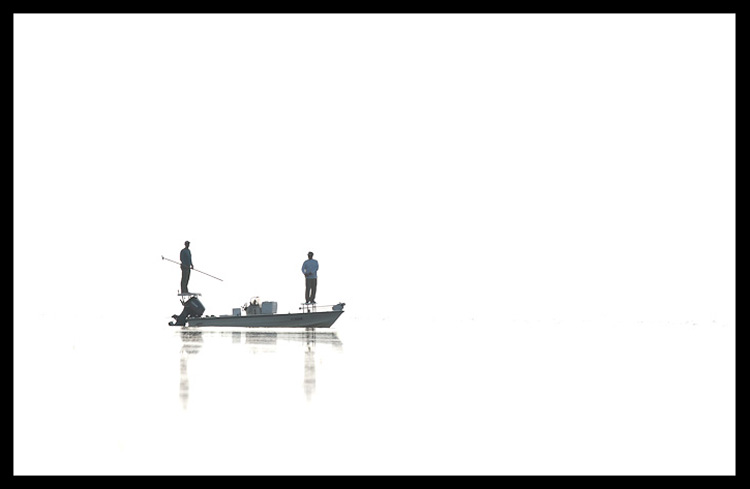
I was off the water by 11:30 am. After five hours on the water, I was hot and had enough sun to last me awhile. Summers on the bay, got to love it. No matter how often I come here, there is always something to bring back home with me. Here's a high key shot of a fisherman and his guide.

Thursday, July 9, 2009

In coming tide at Matheson Hammock

With the moon at 97% and low tide at 6:12 am, the incoming tide came in like a river flow all morning. I was on the water just before sunrise and anchored near the mouth of the creek and watched for any type of bird activity in the direction of the horizon. I brought both the a100 and a700 cameras; the 70-400mm on the a100 and the 180mm macro on the a700. I started the day with the telephoto lens with the intention of spending time with the wading birds. Later, I would pull out the macro lens and head into the creek.

The bay was like glass with no wind to speak of. It was already 80 degrees upon arrival and would reach 90 degrees before 10 am. I was alone on the bay and paddled gentled in the shallow grassy waters. I heard the loud squacks from a couple tricolor herons flying among the mangroves and took that as a sign that the birds would soon be feeding in this area. Sure enough, shortly after sunrise the birds came in to the shallows. The usual players were there; yellowcrown nightheron, little blue heron, ibis and tricolor heron. I spotted the black necked stilt pair that I had seen on other days this year. Unlike some of the herons and egrets, these two are extremely skittish and will freeze if there is any indication of a predator nearby. They quickly lose their patience and will move further on, making it difficult to capture these little guys.
In the meantime, I honed in on some ibises, typically less fearful of my presence. A little blue heron was farther out that I could come toward him with the sun in the background. This was a very nice photo set up as the water was calm and smooth. I captured some silhouettes of the bird while it busily caught and ate the water worms that live in the mud.


After awhile I stayed with some ibises; but the tide was rising so quickly that the birds really didn't have much feeding time. One by one, they flew to a farther point. I decided to paddle around the mangroves and see what I could find with the macro lens. I focused on some mangroves that stood alone in the water with the sun to my left. I set the aperture at f16 and bumped up the ISO to 400. I liked what I saw through the viewfinder. The high key look really distinguishes the mangroves and with the smooth water, it was surreal. I played around with these shots for awhile. I paddled on to smaller mangroves that I could isolate. I purposely put ripples in the water that headed toward the tree. The reflection would be broken up by the movement which made an interesting look.

Eventually, I headed into the creek and after paddling 10 minutes or so, the mosquitoes were in high gear and out for blood. I really wanted to use the macro and was hoping to find a female golden silk spider above. They generally weave a hardy web above the creek, well above eye level. This is good because you can find them easily if you look up. My guess is that from toe to toe length-wise, the spider is a good 4 inches long. Quite beautiful too. Today, I paddled in and did not see one with the sun behind me. But as I paddled out with a barrage of mosquitoes following, I finally found one. The spider was facing the sun and the best lighting was on her underside. This could be interesting. I didn't plan to stay long with the bugs so I rifled off a couple shots and left it at that. While shooting, it occurred to me that a really interesting shot would be to get underneath the spider and shoot straight up. Today, I could barely get into a good position, the sun and bugs were not cooperating.

I left the creek and headed back to launch with the sun blazing and a slight wind. I was off the water before 10 am.

Notes on the new lens: love them. the Sigma 180mm macro lens is a joy to shoot with. And the Sony 70-400mm is tack sharp, even with the a100. Two perfect lenses for the bay.